
This piece by Dr Luke Kelly, Lecturer in Humanitarian Studies at HCRI, was originally published in K4DD.
Humanitarianism is a broad field that has developed considerably since the 1990s. Accompanying this growth has been a proliferation of researchers seeking to understand and improve humanitarian practices.
The K4DD Humanitarian Evidence and Discourse Summary is a monthly evidence digest sharing the latest humanitarian outputs. They’ve been running since 2020 and feature emerging research and opinion as it is published. They are designed to bring the latest resources directly to humanitarian workers, particularly in these turbulent times. Here’s why evidence summaries like these are needed.
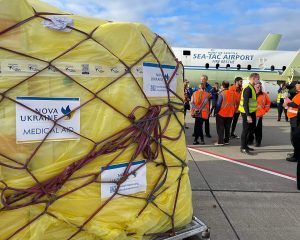
Credit: Medical Aid before being loaded onto a plane chartered by Nova Ukraine from Seattle to Lublin, Poland – March 29, 2022 by Igor Markov. CC BY-SA 4.0. https://tinyurl.com/jjcsdf3s
Why is humanitarian evidence needed more than ever?
Even before the recent cuts in government aid, humanitarian actors confronted immense problems. Protracted crises, violent armed actors operating with impunity, a growing number of natural disasters stemming from climate change, violence against refugees and the development of new weapons, are some of the challenges facing the humanitarian sector and beyond.
For several decades, the humanitarian sector has sought to ‘professionalise’ itself. The creation of standards, platforms for sharing best practice, coordination mechanisms, and a culture of research and evidence use, have all contributed to this effort. The sector has also expanded to include new topics and domains of action.
Humanitarian thinking is thriving in many forms. Universities (including the Humanitarian and Conflict Response Institute at the University of Manchester), humanitarian think tanks and organisations, as well as the United Nations (UN), produce regular evidence and discussion. The outputs are rich and varied, covering a range of intersecting and pressing topics which include health, shelter and water, humanitarian diplomacy, civilian protection, anticipatory action, systemic reform and new ways of working.
Seeking to help improve a sector that works in complex, dangerous and uncertain situations, this evidence has contributed to the analysis and improvement of numerous activities, the discovery of new problems, and different ways of thinking about aid.
Keeping up with evidence
The expansion of evidence is certainly a good thing, but the sheer volume of new blogs, papers, databases and more can be hard to keep up with! Especially in such turbulent times.
K4DD’s Humanitarian Evidence and Discourse Summaries are not a review of the evidence on a particular problem, as with K4DD’s Rapid Evidence Reviews that focus on answering a specific thematic question. Instead, the Summaries collate the recent evidence on humanitarianism more broadly, using FCDO’s themes of ‘protect, prioritise and prevent’. Each month, we search for newly published evidence that fits into these broad categories. We then ask a guest editor, either a humanitarian practitioner or researcher, to choose five ‘top reads’ from the list, to highlight evidence they find particularly interesting, or draw out emerging topics and themes in the discourse.
Although we split the publications into evidence, discourse and guidelines, there is no simple way to divide the publications we spotlight, as they are varied in topic and methodology. Publications that are more systematic and based on empirical studies tend to be categorised as evidence. Resources that provide commentary or insights on humanitarian problems are designated as discourse. And publications that disseminate best practices for a particular sub-field of humanitarianism tend to be classified as guidelines.
We hope that people working in the humanitarian sector find the Humanitarian Evidence and Discourse Summaries useful, to:
- bring together a large body of publications in place for easy finding
- assist with the cross-fertilisation of ideas and approaches across ‘siloes’
- introduce readers to a range of topics, disciplines and perspectives
- prompt readers to take a broader view and engage with critical perspectives that they might not otherwise have come across.
It is important to integrate longer and more tailored forms of learning. To this end, K4DD also published a humanitarian resource guide and resource packsignposting a number of online courses and resources for humanitarian practitioners.
Humanitarian aid seeks to address difficult, intractable problems, without straightforward solutions. Nevertheless, the sector has seen progress in understanding on many fronts: from refining famine early warning, to growing evidence on the effectiveness and effects of cash aid, to the importance of intersectional analysis of needs and vulnerability to crisis, the sector has learnt. It is therefore hugely important to be able to collate and disseminate this information. In turbulent times it is more important than ever that actions are supported by considered, evidence-based thinking.
You can find the latest edition of our Humanitarian Evidence and Discourse Summary here.