
About
Welcome to the Faculty of Biology, Medicine and Health’s (FBMH) Social Responsibility (SR) blogsite. This site aims to update staff, students, and members of the public about the wealth of SR activities taking place within the Faculty. If you would like to submit a blog for this site, please email srbmh@manchester.ac.uk.
Find out more about SR on the Faculty website: Social responsibility in FBMH.
What is social responsibility (SR)?
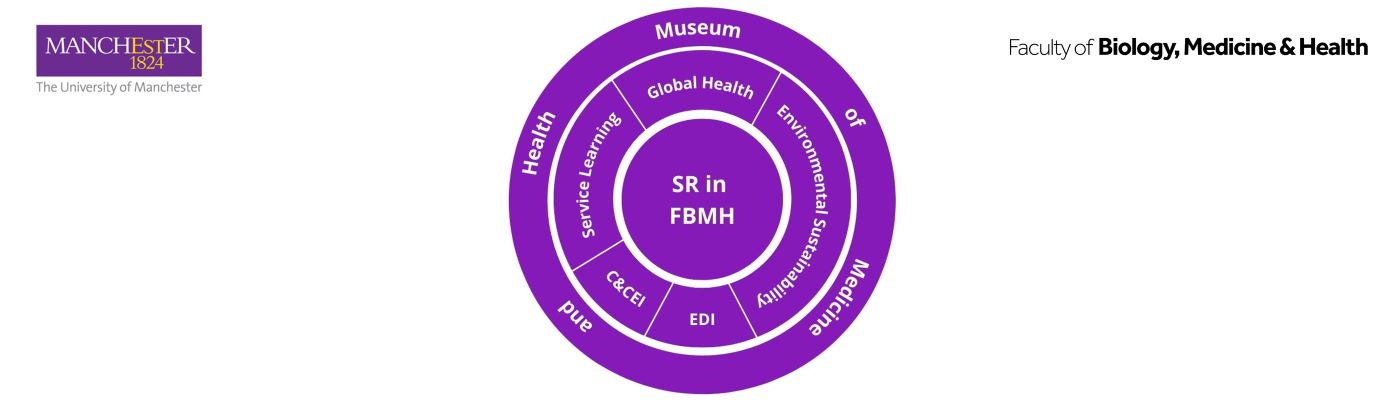
Social Responsibility in the Faculty of Biology, Medicine and Health (FBMH) is our commitment to advancing the theme of ‘Better Health’ locally, nationally and globally. Aligned with the University’s Manchester 2035 vision, itSR is embedded across our teaching, research, engagement and operations to ensure our work delivers meaningful, measurable impact for society.
What does this mean within FBMH?
- Impactful research: Addressing local and global urgent health challenges such as inequality, public health, sustainability, and access to care.
- Inclusive education & partnerships: Supporting diverse learners and collaborate with patients, communities, the NHS, policymakers, and global partners to co-create solutions.
- Open & responsible practice: Sharing knowledge publicly and operate in ways that promote social, environmental and long-term sustainability.
Our SR areas include:
- Civic and Community Engagement and involvement (C&CEI)
- Environmental Sustainability (ES)
- Equality, Diversity and Inclusion (EDI)
- Partner Enabled Learning (PEL)
Additionally, the Museum of Medicine and Health (MMH) supports all of our SR activities by placing science in a social and historical context.
Civic and Community Engagement and involvement (CCEI)
 CCEI or Patient and Public Involvement and Engagement (PPIE) describes the different ways in which members of the public can be involved or engaged in research and teaching.
Public engagement describes the ways in which the activities and benefits of higher education and research are shared with the public, whereas involvement is an active partnership between research or teaching staff with patients or members of the public.
Find out more about CCEI in our Faculty:
- Working Together: Patients, staff and the public website
- PPIE toolkit: features resources, information and templates.
- Watch a short film on PPIE in our Faculty (YouTube)
Environmental Sustainability
 As a Faculty focused on the biological, medical and health sciences, we understand how important the environment is to the wellbeing of the planet, people and all living things.
Through our research, teaching, operations, engagement and people, the University is helping to lead the way to a more sustainable world.
We also support students and staff to get involved in a number of Faculty and University-wide sustainability initiatives.
Find out more about ES within our Faculty:
Equality, Diversity and Inclusion (EDI)
 EDI is fundamental to the success of the University and is at the heart of all our activities.
We know that diversity strengthens our research community, leading to enhanced research creativity, productivity and quality, and societal and economic impact.
The Faculty is committed to promoting EDI in all its activities and aims to provide a work, learning, research and teaching environment free from discrimination and unfair treatment for both its staff and students.
Find out more about EDI in our Faculty:
- Equality, Diversity and Inclusion in FBMH website
- Equality and diversity initiatives in FBMH and University-wide website
Partner Enabled Learning (PEL)
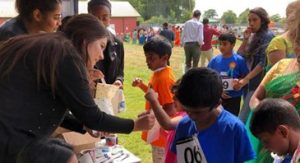 Partner Enabled Learning (PEL) is a teaching and learning approach that combines academic study with community service.
Within the Faculty, PELL allows students to engage with, educate and deliver essential healthcare to communities – strengthening the University and community partnerships, whilst enhancing the student’s own employability and development.
Find out more about PEL within our Faculty:
Museum of Medicine and Health
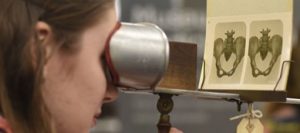 The Museum of Medicine and Health (MMH) is one of the most extensive collections of medical artefacts in England.
Spanning more than 300 years, the collection is a significant educational and cultural asset. MMH contributes to exhibitions, research projects and runs events to support outstanding learning and student experience and public engagement with the collection.
Find out more about the Museum of Medicine and Health on our website
Get in touch
Contact us by:
- email at srbmh@manchester.ac.uk,
- Instagram at @bmhsocialresponsibility, and
- BlueSky at @srbmh.bsky.social