
Nigeria in the Antimicrobial Eras Stakeholders Workshop

Nigeria in the Antimicrobial Eras Project
First Stakeholder Workshop
24 March 2026, 13:00-17:00 UTC
CHSTM Seminar Room, Simon Buiding, Room 2.57
Please see the University’s maps and travel page for directions.
We are pleased to announce our first stakeholder workshop for the Wellcome Trust funded project Nigeria in the Antimicrobial Eras. This hybrid event will take place online and in person in Simon Building Room 2.57 on Tuesday 24 March 2026 between 13.00 and 17.00 UTC.
Attendance is free. If you’re in Manchester, please just come along. If you want to attend online, please register here.
Antimicrobials have been with us in Africa since they were discovered. Prior to the discovery of the first natural antibiotic, penicillin, in 1928 by Alexander Fleming, patients and health institutions in Nigeria were exposed to synthetic chemotherapeutic agents like Salvarsan. These medicines were accessed either through regular doctor prescription in hospitals, or through missionary doctors and nurses working in hinterland communities attending to the disadvantaged patients. Over time, these medicines have evolved to become part and parcel of our communities, saving lives and improving living conditions. But their use has also been threatened with the increase of resistance cases, resulting in severe health repercussions on patients. Most African societies have experienced the various episodes in antimicrobials chequered histories, either as recipients of the medicines or as participants in research (specifically in antibiotics resistance surveillance).
The Nigeria in the Antimicrobial Eras project documents the history of antimicrobial use, stewardship and resistance surveillance. Our aim is to understand how institutions and stakeholders in the global majority have approached the important topics of antimicrobial (antibiotics) use, stewardship, and resistance over time. A reading of the existing history has shown a significant gap concerning developments outside of Europe and the United States, areas that have received quite a significant amount of attention from historians of medicine and science. Based on this, one would think that these conversations do not exist in the African context. However, preliminary reading of colonial medical archives and some post-independence sources has revealed that some of the issues that are currently experienced by stakeholders are not new. Over a period of one year, we have engaged with a broad category of participants to explore some of these topics and their contributions broadly corroborate the findings that emanate from the archive.
Our aim in the workshop is to have a shared space between history/anthropology and medicine, specifically to get colleagues across disciplinary divides to talk to one another about antimicrobials and antimicrobial resistance (AMR). We plan to organise the workshop in a colloquium format, where participants can respond to topics on a high table and provide social and historical contexts. The event is scheduled for Tuesday 24th March 2026 between 13.00 and 17.00 UTC.
Please contact Dr Adedamola Adetiba if you have any questions: adedamola.adetiba@manchester.ac.uk
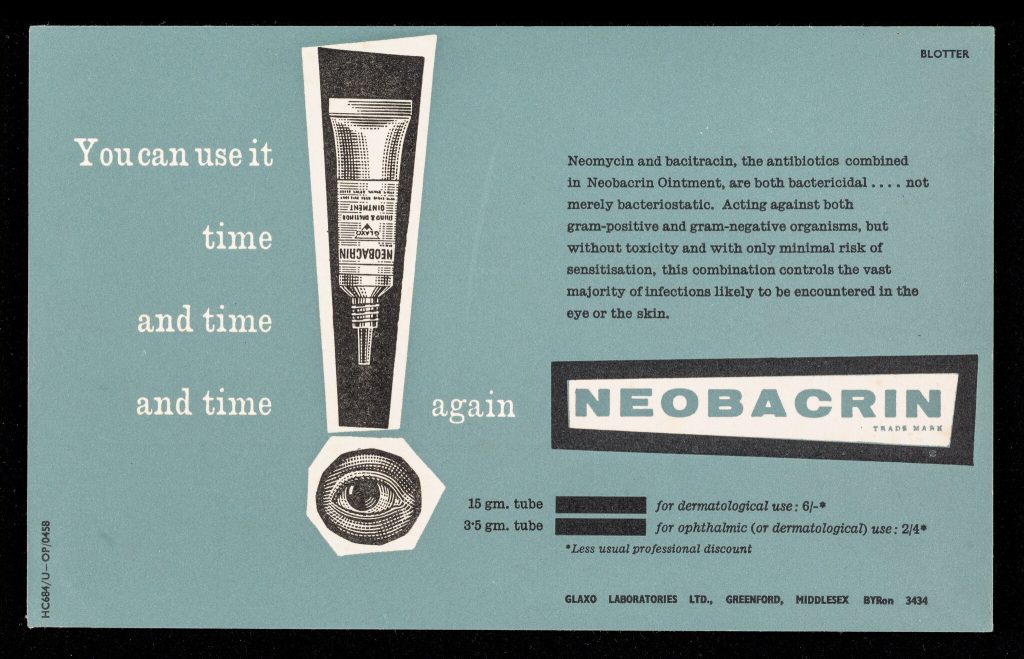
Featured image: Blotter issued by Glaxo Laboratories advertising the antibiotic ointment Neobacrin, containing neomycin and bacitracin. Circa 1958. Source: Wellcome Collection.


Contact Us
+44 (0) 161 306 6000


0 Comments