
This piece was written by Dr Alice Robinson, a Postdoctoral Research Associate on HCRI’s Developing Humanitarian Medicine (DHM) project. It was originally published on the DHM blogsite.
“Blood has the potential to carry multiple historicities, and to dissolve the distinctions between past, present, and future” (Carsten, 2013: S18).
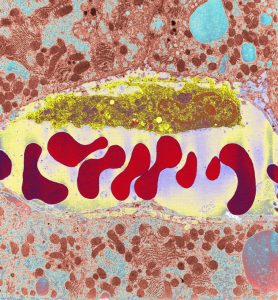
Blood vessel with red and white blood cells. University of Edinburgh. Source: Wellcome Collection
On 20 May, the DHM team joined scholars working on blood flows from different disciplinary perspectives for a one-day workshop, funded by the Centre for Interdisciplinary Research in Arts and Languages (CIDRAL) under this year’s theme of ‘bodies’. The event sought to historicise blood journeys and foster exchanges between historians, anthropologists, humanitarian studies scholars and others. It was co-organised by Laure Humbert (History Department) and Alice Robinson (Humanitarian and Conflict Response Institute).
Blood is a subject that has long fascinated researchers across disciplines. As one of the participants has written, blood is at once malleable and immutable, “easily separated from the body, transformed into various forms, transported to distant places and bodies” (Kim, 2018: 297). Anthropologists have explored blood as a complex, multivalent and ambiguous substance with an “unusual capacity for accruing layers of symbolic resonance” (Carsten, 2013: S2). Humanitarian studies scholars have considered the safety and availability blood supply and transfusion during humanitarian crises, pandemics and conflicts (Van Denakker et al., 2023; Abdella et al., 2018), in contexts in which blood products are scarce and health systems may be damaged or destroyed (Johansson and von Schreeb, 2025). They have shown that blood moves and flows: within and between bodies (Sodero and Rackham, 2020), across material, symbolic, social and medical domains, and across disciplines. Our aim was to collectively explore how these blood histories might inform blood futures.
The first session involved the presentation of works in progress, exploring new approaches to the history of blood transfusion, donation, and blood-transmitted diseases. Together, the presentations examined blood governance, markets, and the structural and iatrogenic (i.e. harm caused by medical treatment) consequences of humanitarian and medical interventions.
First, Dr Janelle Winters (University of Manchester) examined the challenges of developing paediatric drug formulations for malaria, a blood-transmitted disease. She highlighted the ethical and practical difficulties of clinical trials, including blood testing, in children, and the position of paediatrics as a “canary in the coalmine” when thinking about failures in drug markets. Next, Faith Cheonga (University of Manchester) showed how donor funding for HIV in the early 2000s reshaped the healthcare system in Malawi, with far-reaching and long-lasting implications for accountability, power and health governance. Finally, Professor Bertrand Taithe (University of Manchester) raised the “iatrogenic ghost in the machine”, exploring the contamination of blood by humanitarian actors in refugee camps in Cambodia, and the noticeable absences of blood in literature on the history of humanitarian aid. Acting as discussant, Dr Benoît Pouget (Science Po Aix) highlighted the diversity of actors involved in blood governance, with states, NGOs, medics, researchers, militaries, humanitarian organisations, pharmaceutical companies and others producing and participating in complex blood ecosystems.
The second session centred on the work of Dr Benoît Pouget. Focusing on the French Armed Forces, Dr Pouget argued that a ‘transfusional turn’ took place in the two decades following World War II, with advances in blood transfusions (including through research, innovation and standardisation) driving transformations in battlefield medicine, in the medicalisation of the army, and in the relationship between military institutions, soldiers and society. Dr Laure Humbert (University of Manchester) and Dr Siobhan Hearne (University of Manchester) shared comments on the presentation, considering the space for analysis of failure, resistance and disruption within the concept of a transfusional turn, and the implications of the military transfusional turn for civilian systems.
The closing session took the form of a roundtable discussion, chaired by Dr Stephanie Sodero (University of Manchester) and featuring Dr Jieun Kim (University of Leeds) and Dr Meng Zhang (University of Manchester). This rich discussion examined how blood histories across different contexts can inform blood futures. Dr Zhang, a Wellcome Trust Research Fellow at the Centre for the History of Science, Technology and Medicine, discussed the history of blood in China, including the use of blood tests as a tool of imperial control, justifying Japanese colonial occupations. He made a case for examining blood from different angles (government, social, surgical). Dr Kim, Principal Investigator of the Hematopolitics project, argued that blood is at the “frontier of how medicine intervenes in our body”, and how our health is governed. She reflected that blood acts as a “transtemporal hinge” (Copeman and Banerjee, 2019: 4), containing baggage of the past.
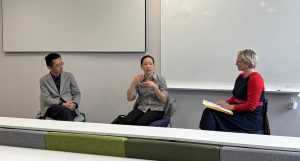
Dr Meng Zhang, Dr Jieun Kim and Dr Stephanie Sodero
Dr Stephanie Sodero closed the event by raising four important questions, which participants discussed:
- Do developments in manufactured blood, such as efforts to grow red blood cells or to convert other blood types to the universal “O” type, represent the next ‘transfusional turn’, and what are the implications for blood donation and commodification?
- How are new technologies, including drones and artificial intelligence, transforming blood landscapes?
- How is climate change (re)shaping blood futures, from an expansion of blood-transmitted diseases carried by mosquitoes to climate-related disruptions to supply chains?
- What is the future of blood in humanitarian settings, considering changes in regulation, market logics, disease landscapes and iatrogenic contamination?
We thank all the participants for their contributions, and look forward to continuing the conversation.
END