
Brandy Schillace Visit
Visiting Scholar: Brandy Schillace, 11–24 May
Brandy Schillace is a writer, historian, and social justice advocate working across medical humanities, creative writing, disability, neurodivergence, and representation. An award-winning novelist and former academic, Brandy writes for public audiences and speaks internationally on disability, visibility, and inclusion.
Brandy will be visiting the Centre for the History of Science, Technology and Medicine for two weeks, from 11–24 May. During her visit, she will meet with staff and students, run a creative writing workshop with undergraduates, and contribute to CHSTM’s research culture through a range of conversations and events. She will also give two talks on Monday 18 May.
Coming Out as Disabled: the fraught politics of disclosure and the fight against discrimination
Monday 18 May, 13:00–14:00 BST
Online
Join author, historian, and social justice advocate Brandy Schillace, PhD, for a talk and open discussion about the complicated nature of disability disclosure.
Not all disabilities are immediately apparent, and choosing whether or not to share is far from straightforward. Sometimes called “hidden” or “invisible” disabilities, this includes everything from autism to dyslexia to dissociative disorders, each with its own stigma.
The burden of proof and of educating the public almost always falls upon disabled people, who find themselves caught between twin pressures: to “pass” to avoid stigma, or to “come out” to receive accommodation.
Brandy speaks to this divide, offering lessons from LGBTQ discourse: the solution is not enforcing disclosure but creating sustained equity and accessibility for everyone.
Attendance free – all welcome.
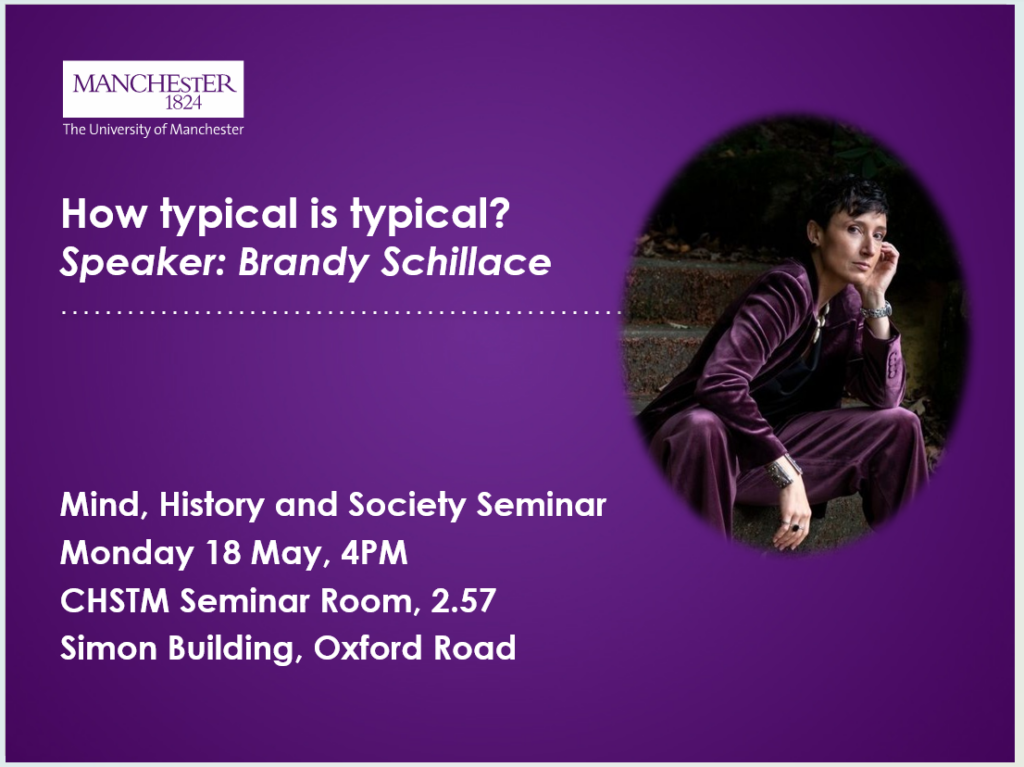
How typical is typical? Mind, History and Society Seminar
Monday 18 May, 16:00-17:30 BST
CHSTM Seminar Room, 2.57 Simon Building
Join us for our next Mind, History and Society seminar, presented by writer, historian and advocate Brandy Schillace. The seminar will take place in the CHSTM Seminar Room, 2.57 Simon Building.
How typical is typical? We talk about the autism spectrum, but “neurotypical” is often treated as though it exists outside, such that we still end up with binary thinking: ND vs NT. My current research asks what do we mean by “neurotypical”? Is this a social term about conforming to standards? Is it a scientific term about the way brains work? Where are the “edges” of “typical”? As we watch a new panic unfolding in the USA around autism, a resurgence of “cure” narratives, and attacks on disabled autonomy, it is more important than ever to see there is more that unites us than divides us, a blurring of the line between divergent and typical, without erasing diagnostic difference or support through accessibility, for the flourishing of every kind of mind.
Attendance free – all welcome.
Brandy is keen to hear from those of you who attended either (or both) of these events: brandy@bschillace.com


Contact Us
+44 (0) 161 306 6000


0 Comments