
Knowing and doing otherwise: Interdisciplinary encounters at the 2025 ISA forum of Sociology | Daniela Cocco Beltrame
When Daniela Cocco Beltrame travelled to Rabat for the 2025 International Sociological Association Forum, she encountered an academic gathering that offered far more than formal sessions: moments of surprise, creative expression, and critical exchange revealed the ways scholars and practitioners are considering questions of justice in a time of environmental and social uncertainty. Daniela reflects on her own contributions to the event and on conversations that reshaped how participants thought, listened, and learned alongside one another.
As part of MUI’s commitment to supporting early stage researchers, several travel grants were awarded to enable them to present their work at global events. Daniela’s blog is the second in a new series featuring insights, learning and reflections from the recipients of this funding.
 Even though I am no stranger to methodologies and formats that depart from hegemonic ways of knowing and doing, I’ll admit I was surprised when one of my roundtable mates at the 2025 International Sociological Association (ISA) Forum of Sociology pulled out a guitar for his presentation. The feeling was far from mine alone. The packed room looked at him with a mixture of perplexity and anticipation, a slight discomfort perhaps. After a presentation that combined song, verse and spoken word, any discomfort was long forgotten, and we were all singing along to some of the last century’s catchiest protest tunes. Cut to sitting under a tree with an economist colleague sharing her experience in a heavily structured panel made entirely of quant-loving development economists. That’s the beauty of this kind of forums, I thought to myself, the sheer diversity of disciplines, epistemologies, and praxis.
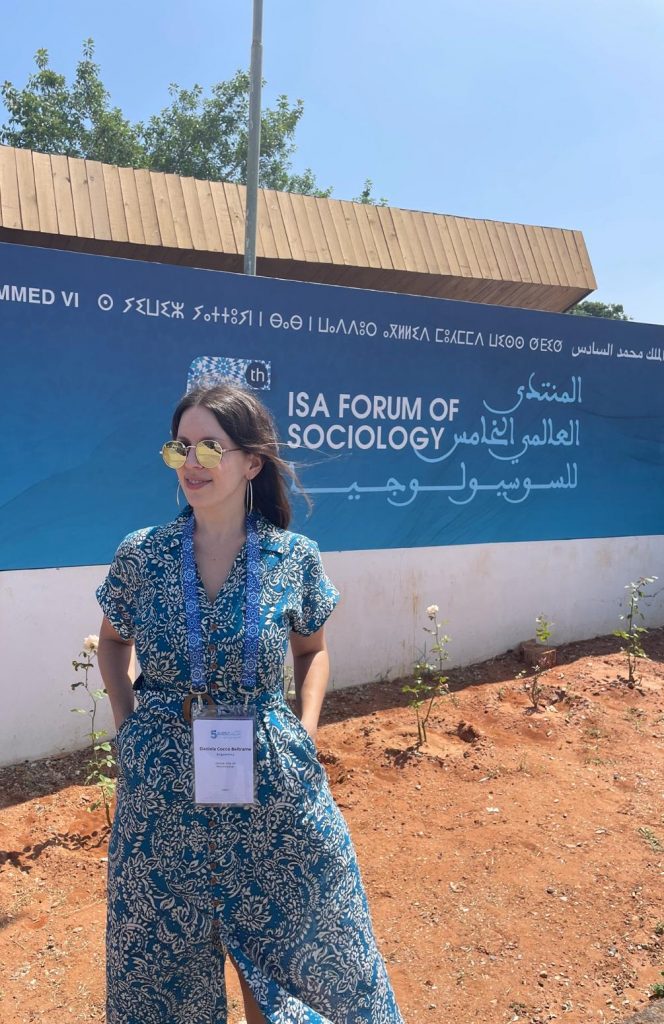
The 5th International Sociological Association (ISA) Forum of Sociology took place in Rabat, Morocco on July 6-11, 2025, and I was fortunate to participate with support from the Manchester Urban Institute (MUI). Hosted at the campus of Mohammed V University, the Forum was a great setting for discussion and reflection around the theme “Knowing Justice in the Anthropocene”. The intense intellectual debate was complemented by a sociological film festival open to the public.
Point of departure
The Conference’s point of departure included “the recognition of the Anthropocene and the environmental concerns that accompany it.”. The organisers acknowledged that the term “Anthropocene” emerged around 25 years ago when geologists began recognizing what they saw as permanent human imprints on Earth’s geological record. However, in March 2024, these same scientists reversed course, concluding that we haven’t actually entered a distinct geological era. Despite this scientific rejection, it was observed that the concept had already become so influential in fields like anthropology and history that it would likely remain culturally significant. This clash between different forms of knowledge—scientific, cultural, and beyond—represents exactly the kind of intellectual debate that was explored in Rabat.
My participation entailed presenting the co-produced findings from the participatory action-research project I conducted in Nairobi, Kenya from February to July 2025 alongside a cohort of 13 co-researchers (part of my PhD fieldwork). My roundtable, on Activism, Strategies and Collective Action, was chaired by RC48 vice-president. I was fortunate to share the space with insightful presentations on social movements, solidarity and activism from Greece, Spain, and the United States of America.
More than sociology: Urban and Social Movements footprint at ISA 2025
Even though it was labelled a Sociological Forum, ISA 2025 brought together a wide range of disciplines from around the world to unpack its complex theme. I encountered educators, economists, engineers, biologists, sociologists, political scientists, and architects, and that is just the panels in which I participated. With 67 Research Committees (RCs), as well as Working Groups (WGs), and Thematic Groups (TGs), ISA Forum 2025 is likely the largest space of its kind I have attended.
I participated in as many of the multitude of panels as I could, and met a few of its 4,842 participants, who are doing groundbreaking work across topics such as youth political participation, governing urban community spaces, and social movements as producers of knowledge. I was particularly drawn to spaces that addressed urban issues and social movements, which would often mean attending spaces organised by RC21 and RC48, and encountering pretty much the same crowd each time. This was helpful in order to develop or deepen connections and share thoughts and experiences around city-making and movement-building with colleagues old and new.
Knowing justice
The appeal of the Conference, for me, was in its prompting questions. I lingered on meditations on whose knowledge counts and how we know what is fair and just. Through thought-provoking sessions, we were invited to complex reflections around issues of ontological, epistemic, and methodological justice, as well as environmental justice, gender justice, and racial justice, to name a few avenues.
This resonated deeply with the ethos and practice of my own work.
At the time of the Forum, I was fresh out of my first fieldwork leg in Nairobi, Kenya. The question of alternative ways of knowing and doing featured heavily all along the five-month participatory action-research project I conducted there. Questions around the coloniality of knowledge (Mignolo, 2002) contributed to explain how and why the potential behind alternative and diverse forms of knowing and doing never escapes from powerful social structuring related to knowledge hierarchies.
Indeed, hegemonic structures and hierarchies equate academic knowledge to rigour, authority and legitimacy, with alternative knowledge production frequently dismissed as anecdotal or subjective. But, as Bell Hooks (1994) wrote in Teaching to Transgress, education is the practice of freedom – and, during the forum, we practiced freedom indeed.
At ISA 2025 we came together to continue the centuries-old tradition of sowing the seeds of autonomous thought and agency. Particularly during the sessions of RC48, through an ethos of intellectual humility, we moved beyond academic ontologies and epistemologies and held space for those who create knowledge from the marginalised frontlines, those who organise and mobilise to claim rights and hold elites to account – just like my guitar-holding colleague who invited a room packed with academics to burst into song and solidarity.
Perhaps, by overcoming any initial perplexity, we can continue learning the value of knowing and doing otherwise.
Contact us
+44 (0) 161 306 6000


0 Comments