
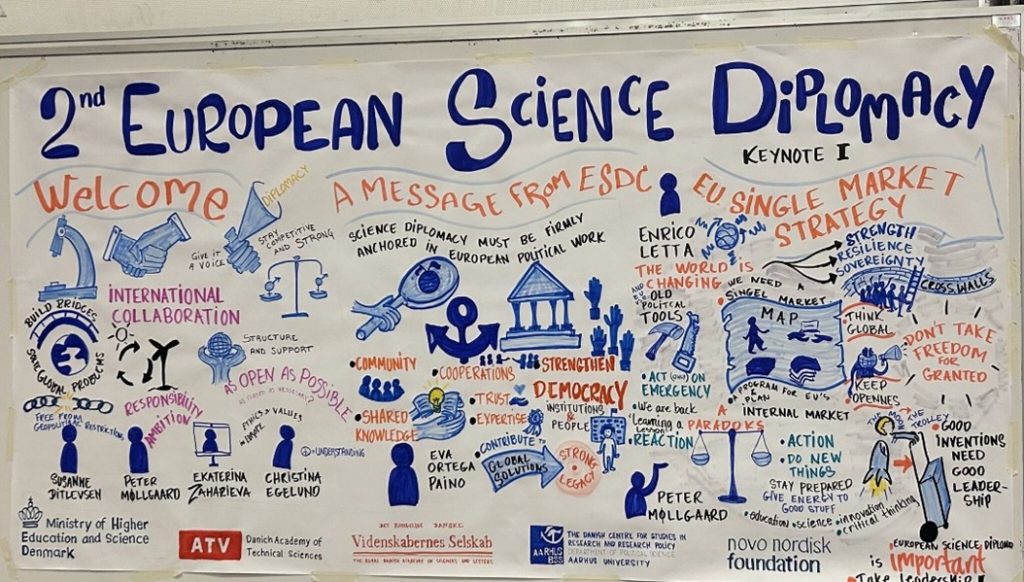
Insights from the European Science Diplomacy Alliance Conference (2025)
On 17 and 18 December 2025, Adam McCarthy and Alice Naisbitt represented the Transatlantic Partnership project at the 2nd Conference of the EU Science Diplomacy Alliance, held at Copenhagen Business School. The conference, titled Bridging Divides in a Fragmented World, built on discussions prompted by the European Framework for Science Diplomacy, published in February 2025.
The Framework was published alongside another influential paper by the Royal Society and the American Association for the Advancement of Science (AAAS), which revisits their 2010 tripartite definition of science diplomacy. Taken together, these interventions point to a wider shift: the idea of science diplomacy as a straightforward tool for bridge-building and solving global challenges is increasingly hard to sustain. Instead, science diplomacy needs to be understood in a more fragmented geopolitical context, where collaboration is shaped by strategic competition, technological sovereignty, global asymmetries, and research security.
This shift in framing was evident throughout the Copenhagen conference, where science diplomacy appeared to be gaining political traction as a tool the EU can deploy more strategically, particularly amid intensifying US–China competition. Yet many discussions returned to a persistent tension: science diplomacy is still framed as a hopeful, bridge-building practice even as it operates within increasingly hard-edged geopolitical realities. Optimistic accounts, such as scientific cooperation on volcanic monitoring in North Korea, were repeatedly cited as evidence that collaboration can endure in sensitive contexts. By contrast, discussions of Ukraine highlighted the limits of this narrative, focusing on scientific displacement, wartime collaboration, and the deliberate severing of ties with Russian institutions, serve as clear reminders that political conditions both enable and constrain scientific exchange. Underpinning these examples is a deeper conceptual tension that deserves greater attention in policy debates. Science diplomacy often rests on claims of scientific neutrality and universality, while diplomacy is explicitly concerned with power and interests. Treating science as inherently apolitical risks obscuring how research agendas, institutions, funding, mobility, and partnerships are shaped by political choices, rather than standing apart from them.
These abstract tensions were especially concrete in discussions around research security. Research security (or knowledge security) emerged as a recurring theme throughout the conference. Many discussions referenced the guiding principle of being ‘as open as possible, as closed as necessary,’ which has increasingly supplanted the ideal of fully open science. Yet this phrase is not without controversy; as several participants noted that determining what is ‘necessary’ is inherently value laden. Views on the relationship between research security and science diplomacy diverged. Some saw research security as undermining the ideals of science diplomacy, while others argued that it has – rightly or wrongly – become an integral counterpart, with the two representing different sides of the same coin. Participants noted that concerns over intellectual property theft, malign interference, and dual-use technologies are not new, neither are policies that have historically constrained collaboration between certain countries. What has changed is the geopolitical context in which these risks are now managed.
In his keynote address, Enrico Letta raised a central challenge for Europe: how to avoid strategic naivety in international scientific collaboration while preserving openness in research, calling in this context for a “Fifth Freedom” based on the free circulation of knowledge, research, innovation, education, and science. This call for openness, however, was complemented by a powerful reminder from Macharia Kamau, Kenya’s UN Representative, that openness must be matched by equity. Drawing on lessons from the Covid-19 pandemic, Kamau argued that unequal partnerships create global vulnerabilities and urged Europe to move beyond an aid-based mindset, reframing Europe–Africa cooperation as a strategic necessity central to both continents’ economic and technological competitiveness.
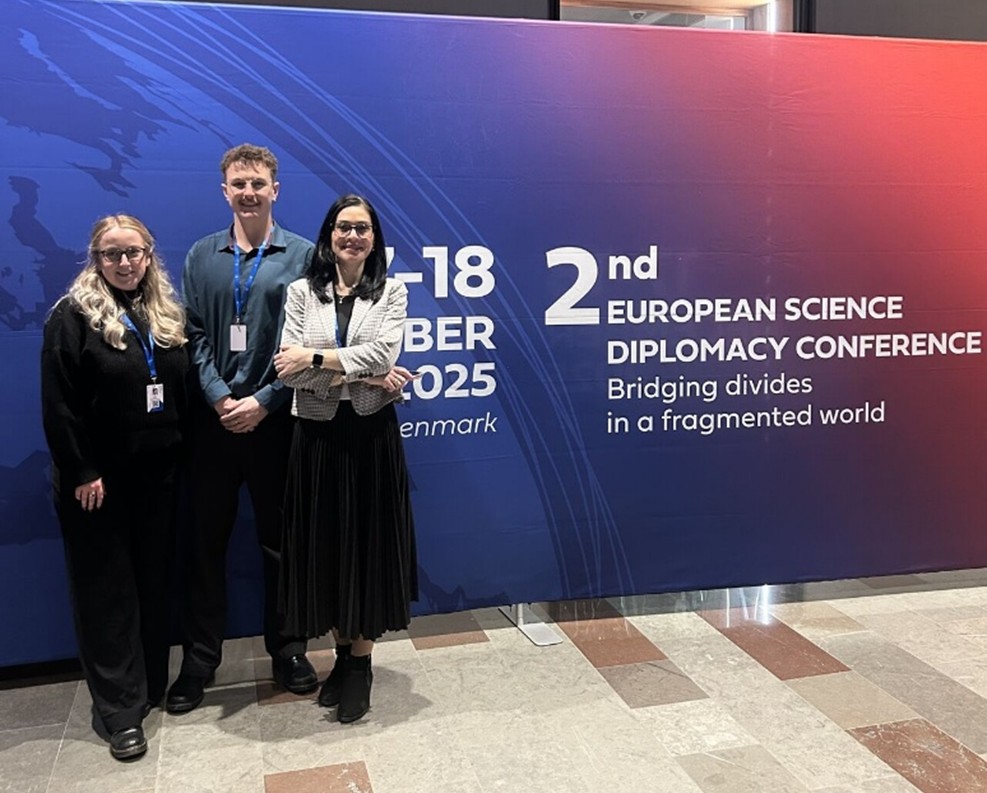
Photo © Adam McCarthy
We attended the conference as part of our Trans-Atlantic Partnership (TAP) Project: Investigating the Relationship between Science Diplomacy and Global Democracy, Governance and Trust (DGT): The Role of Inclusive Metascience Observatories. Many of the themes explored during the event were directly relevant to our research.
For example, trust was widely presented as a practical precondition for effective science diplomacy, particularly at the level of bottom-up networks and long-term relationships. Several interventions emphasised the importance of equitable partnerships and the risk that agenda-setting remains dominated by the EU and the broader Global North, with mobility barriers and systemic constraints shaping who can participate.
Artificial intelligence was also raised as a rapidly evolving challenge for the science diplomacy agenda. Our TAP project examines the UNESCO Recommendation on the Ethics of AI (2021) as a case study of international AI governance, and conversations around expertise and authority building during the conference hold relevance for our study. Significantly, this debate on AI underscored a broader concern: Europe must move beyond reactive approaches to science diplomacy and begin anticipating emerging challenges. In his closing keynote, Jeremy Farrar, Chief Scientist at the WHO, warned that we are in danger of responding to change rather than anticipating it, and urged the development of ethical, cultural, and regulatory frameworks ahead of time.
One of the most useful ways the conference avoided slipping into simple, celebratory narratives was through the presence of a more explicitly critical voice. These interventions were often left unanswered clarifying how much analytical and practical work remains, and they signalled a clear opportunity for further research and contribution in this area.
Contact Us
+44 (0) 161 275 0924


0 Comments