
Urban Frontlines: Second Cold War Cities | Seth Schindler
As geopolitical tensions intensify, cities are increasingly emerging as key arenas where global rivalries are both shaped and contested. In this context, Seth Schindler reports on the conference Second Cold War Cities: Geopolitics and Urbanization in the 21st Century, co-hosted by the Manchester Urban Institute. The conference brought together leading scholars to examine how intensifying competition, particularly between the United States and China, is reshaping urbanization processes, infrastructures, and governance systems worldwide.
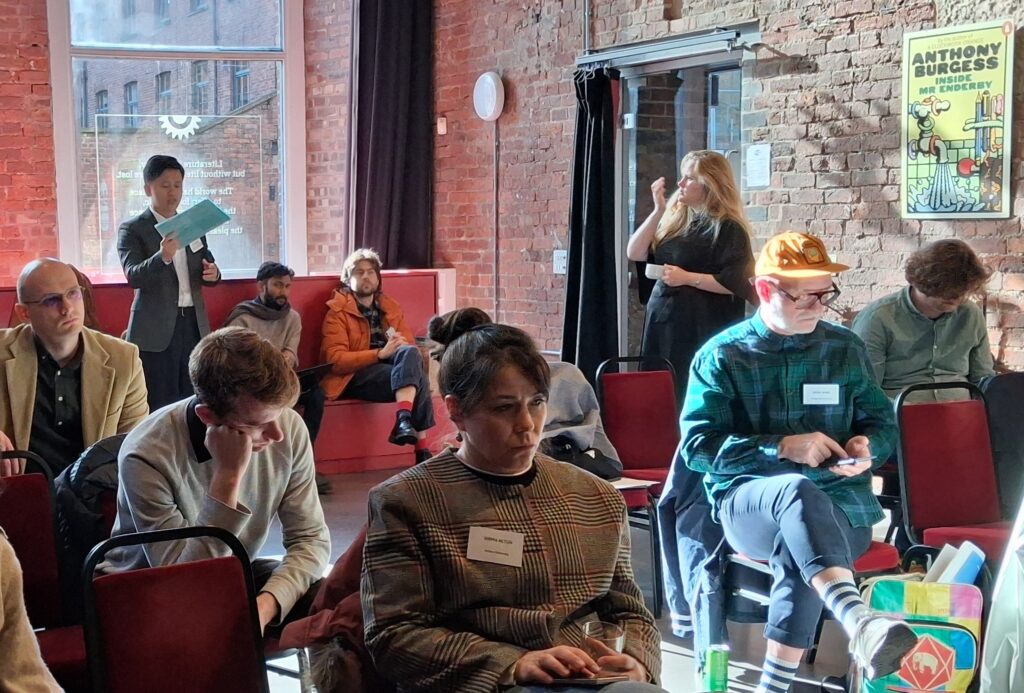
In March 2026, Manchester Urban Institute co-hosted the international conference Second Cold War Cities: Geopolitics and Urbanization in the 21st Century, bringing together a diverse group of leading scholars to examine how intensifying geopolitical rivalries are reshaping urbanization processes worldwide. Held at the International Anthony Burgess Foundation and supported by the University of Manchester’s Hallsworth Fund, the conference was organized by Seth Schindler (University of Manchester) and Kevin Ward (Georgia State University) in collaboration with the Global Development Institute and the Second Cold War Observatory.
The conference addressed a central question of contemporary urban studies: how does the “Second Cold War” — characterized by intensifying competition between the United States and China to control transnational networks that underpin globalization — impact cities and urbanization?

Across two days of panels, presentations, and discussions, participants explored how geopolitical competition is increasingly mediated through infrastructure, production networks, financial systems, and technological development, with cities acting as critical nodes in these contested networks. The event highlighted the growing importance of understanding urbanization not only as a local or national phenomenon, but as a deeply contested geopolitical process.
The programme was organized into a series of thematic sessions that examined these dynamics from multiple perspectives. The opening session focused on topics such as semiconductor production in the United States, the emergence of neurotechnology as a dual-use urban infrastructure, and the enduring imprint of military logics on cities such as Sevastopol. These papers demonstrated how technological systems, defence strategies, and industrial policy are increasingly intertwined in shaping urban development.
Subsequent sessions examined how global rivalries manifest in subnational contexts, including the role of “illiberal gateway cities” in Hungary, the geopolitics of infrastructure corridors in southern Europe, and the evolving urban political economies of resource-rich countries such as Angola. Other contributions focused on how cities in China, particularly Shenzhen and Hong Kong, are pioneering diplomatic and industrial statecraft. Together, these papers underscored the importance of multi-scalar analysis in understanding how global power struggles are mediated through urban and regional spaces.
A further set of sessions examined infrastructure-led urbanization and its uneven impacts across different contexts. Contributions addressed topics including electric vehicle production in Turkiye, the financialization of urban transport systems, and energy transitions in the European periphery. Empirical case studies from Moldova, Hungary, the US, Greece, and elsewhere illustrated how infrastructure investments are reshaping urban futures while simultaneously generating new forms of dependency, contestation, and inequality. These discussions reinforced the need to analyse infrastructure not only as a technical system, but as a central instrument of geopolitical strategy.
The second day of the conference focused on economic development, logistics, and subnational political dynamics. Papers examined the role of port cities such as Mombasa and Colombo in global supply chains, highlighting how competing geopolitical actors shape investment, governance, and local development trajectories. Other contributions analysed “gateway” regions at the margins of Europe, as well as city-regions in Southeast Asia, demonstrating how local actors navigate and mediate competing global alignments through strategies of polyalignment. These sessions highlighted the agency of cities and regions in responding to geopolitical pressures, rather than treating them as passive sites of external influence.
The final sessions turned to questions of the built environment, symbolic power, and urban transformation. Papers explored how financial centres such as Luxembourg function as contact points in global rivalries, how large-scale redevelopment projects in cities like Delhi are embedded in shifting geopolitical imaginaries, and how neighbourhood-level transformations in Havana reflect broader global processes. Across these diverse cases, contributors emphasized the importance of connecting macro-level geopolitical shifts with everyday urban experiences and socio-spatial change.
In addition to the academic programme, the conference included a well-attended public evening event, which extended these debates beyond academia.
Overall, Second Cold War Cities demonstrated the value of interdisciplinary and globally grounded approaches to understanding contemporary urbanization. By bringing together research spanning multiple regions, scales, and methodological approaches, the conference advanced debate on how cities both shape and are shaped by geopolitical rivalry.
Seth Schindler is the Deputy Director of Manchester Urban Institute and leads our Polycrisis cross-cutting theme. He is Professor of Urban Politics and Development. We acknowledge the support of the Hallsworth Conference Fund.
1 Comment
Submit a Comment
Contact us
+44 (0) 161 306 6000


Excellent insights into infrastructure-led urbanization. The link between geopolitical strategy and local inequality is a critical area for urban planners today. Thank you for this multi-scalar perspective!