
From Urban Silos to ‘Joined Up City’: Where next for urban governance and knowledge co-production? | Joe Ravetz
Cities are increasingly shaped by complex political, social and economic tensions that challenge traditional ideas of who governs and whose knowledge counts. Using a recent Greater Manchester by-election as a starting point, Joe Ravetz explores the changing landscape of urban politics and the growing importance of knowledge co-production in understanding and shaping our cities. Joe asks a simple but fundamental question: in today’s fragmented urban systems, who really runs this place?
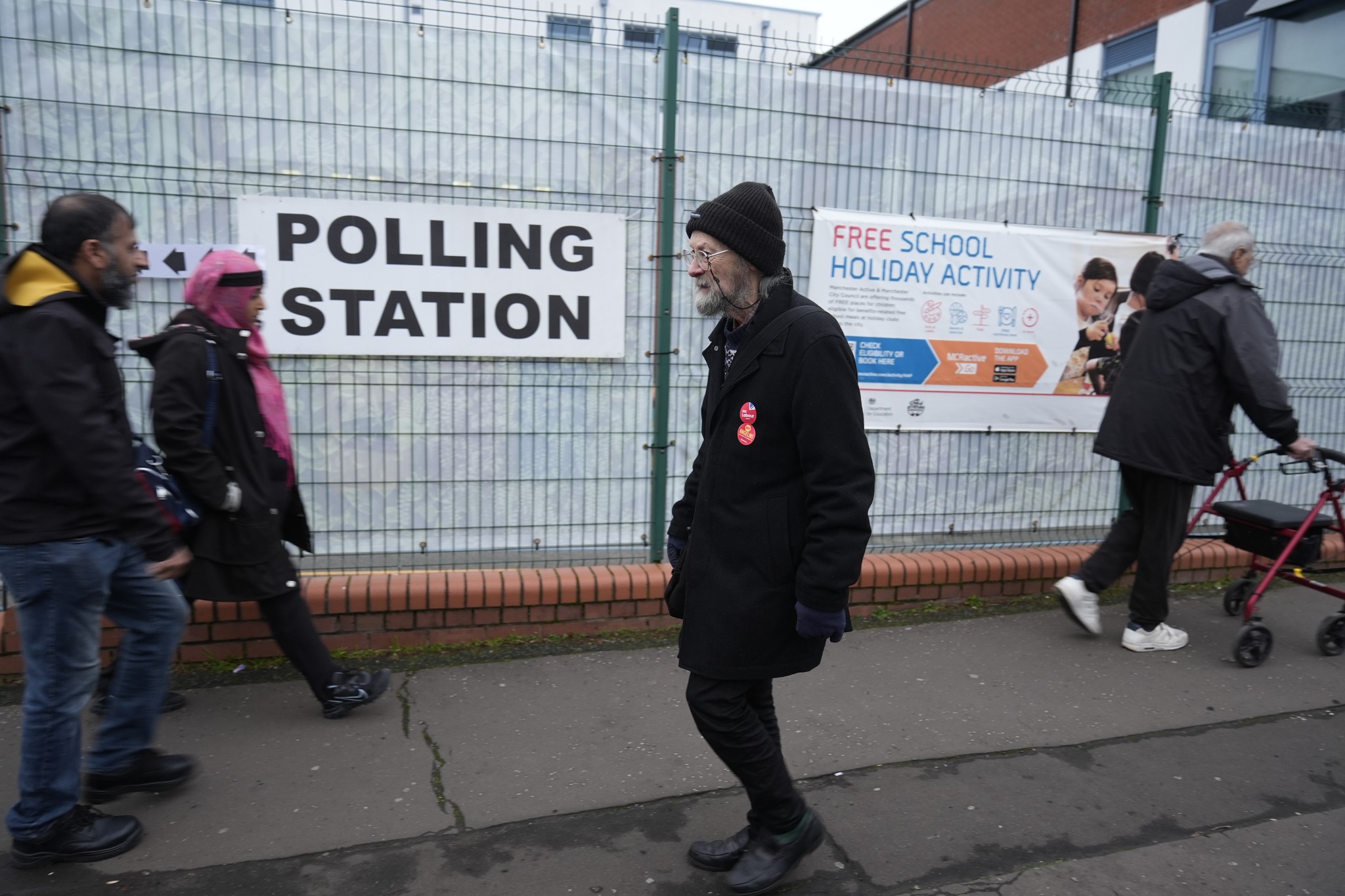
The Greater Manchester byelection in Gorton & Denton (26 February 2026), covered some of the most deprived wards in the city, and the winning candidate is a plumber by trade. So why was she standing for the Green party, not Labour, the historic party of the workers and under-privileged? And what does this say about the changing landscape of cities, how they are run, and how to understand it?
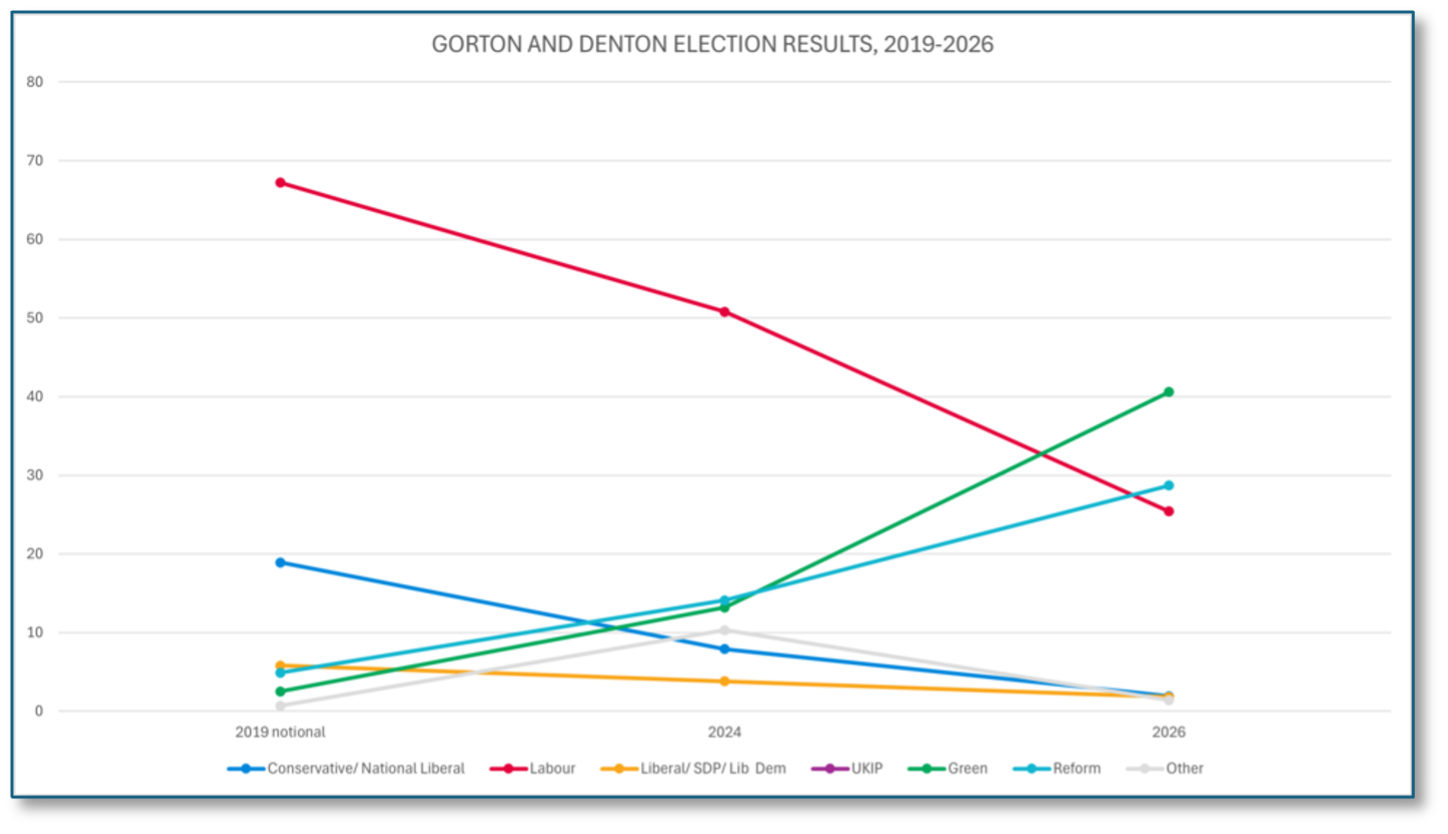
Image © Cal3000000 (Creative Commons: CC BY-SA 4.0)
This highlights some conundrums for cities and governance – and then, some topical ways forward for urban research and knowledge co-production.
There’s a conundrum of ‘multi-level governance’, where cities and city-regions are all tangled up with national politics. In this case, Labour’s fall seemed a direct result of the National Executive Committee’s blocking of Andy Burnham, the current mayor of Greater Manchester, to stand as the obvious challenger for national leadership.
It’s also a conundrum of the ‘politics of grievance’ – two of the three main contenders, Reform and Green, were riding the waves of distrust of establishment ‘politicians’ and their managerial compromises. Each points in opposite directions, so highlighting the schisms in the ‘body politic’… (and in British surrealist style, the sixth placed candidate, after the Conservatives, was Sir Oink-a-Lot of The Official Monster Raving Looney Party).
There are conundrums in the national story of progress, as the cost of living rises, jobs look more insecure and mental distress spreads. Rarely has an upcoming generation been so technologically affluent but so pessimistic, as in “The old world is dying, and the new world struggles to be born: now is the time of monsters.” (Gramsci 1971).
Cities are then the site of everyday conundrums. Even while GM is seen as the most successful ‘Devo’ metropolitan anywhere in the UK, there is a common narrative that distant forces are playing games. The city centre is now overlooked by gleaming high-rises for overseas investors, while the local homeless sleep on the pavements beneath. While many people here ‘Love MCR’, for others it’s a global crossroads with little connection to its local governments, still based on a 19th century model of democratic representation.
So what could or should MUI do in response, on this vital theme of urban governance – or in plain language – ‘who runs this place’? Here are four directions of travel, drawing from a decade of experience with the LUCI (Laboratory of Urban Collective Intelligence).
Multi-level governance
Each decade sees yet another change in urban, rural, county, city-region or regional systems of administration, which then translate into hard choices, in planning, infrastructure, health, education or housing. Meanwhile real-world economic and social geography extends far beyond the ‘grey areas on the map’, cutting across administrative boundaries, with the forces of peri-urban sprawl, post-industrial shakeout, commuter-sheds or watersheds. Urban / regional research is beginning to catch up with such complex VUCA (‘volatile, uncertain, complex / controversial, ambiguous’) realities – and the new styles of governance also emerging. Adaptive, collaborative, participatory, deliberative, ‘urban reform coalitions’ – each model also suggests new ways of doing research.
Systems thinking in governance and ‘collective urban intelligence’
It’s also self-evident that cities have many layers – social, technology, economic, environmental, political, or cultural – with many kinds of synergy and inter-connection between them, positive and negative, stable or volatile. The systems approach to urban governance highlights the quality of emergence, where the whole is greater than the parts, with transformation of the nature of the system itself. Here in the LUCI we extend systems thinking to the ‘metro-mindscape’ or ‘collective urban intelligence’ – the capacity for learning, co-creation and collaboration, with a wider community of stakeholders, and deeper layers of value. This is explored in projects such as the ‘risk and resilience’ in Melbourne, smart cities of India, shack-dwellers in Mexico, the global peri-urban, and the Manchester Local-wise as in the graphic. Each of these shows a similar pathway, from the gaps and disconnections of the ‘silo-city’, to the synergies of the ‘joined-up city’, and the enablers of ‘knowledge co-production’ in different parts of the system.
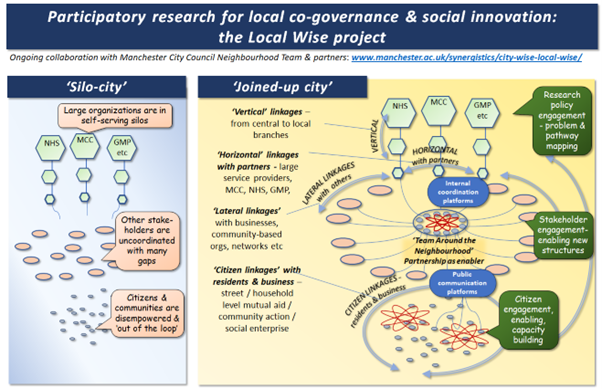
Graphic from the ‘Local-wise’ program, in partnership with Manchester City Council (sponsor: UoM Humanities Strategic Investment Fund) © JRA
Urban futures & governance in transformation
Urban governance around the world sees rapid transition, with cities now pictured as centres of progressive policies, often in contrast to national authoritarian governments.
Some current trends can be projected, such as ‘urban globalization’, as seen with the 143 languages spoken in Manchester. Demographic / economic change then shows a new ‘localization’, with semi-retirement, working from home, and multi-generation households. Peri-urbanization also brings hybrid polycentric landscapes such as ‘auto-carceral cities’ and ‘eco-gentrification’ (Ravetz & Sahana 2025). All these raise challenges for government systems so far based on clear urban or rural units: they point towards new forms of multi-level, multi-sectoral partnership ‘adaptive governance’. Many variations on adaptive / deliberative / participative democracy are now in testing, from citizen’s assemblies to participatory budgeting, community asset management, and public service co-production (Cottam 2028).
Digital systems can now take such prototypes to the next level, with for instance, crowd-sourcing, sentiment analysis, AI-enabled decision support or public engagement platforms, as tested by Plurality or the NESTA Centre for Collective Intelligence Design. However, general levels of trust in democratic government continue to fall, pointing in the direction of extremism, post-truth and authoritarian leadership. The last futures / foresight project in Greater Manchester highlighted the challenges for democratic government, just before the 2016 Brexit vote and a new wave of distrust, as in the graphic here (Ravetz & Miles 2016). A proposed update – “GM2050” – would start with the scenario of a radical change of government and work back from there.
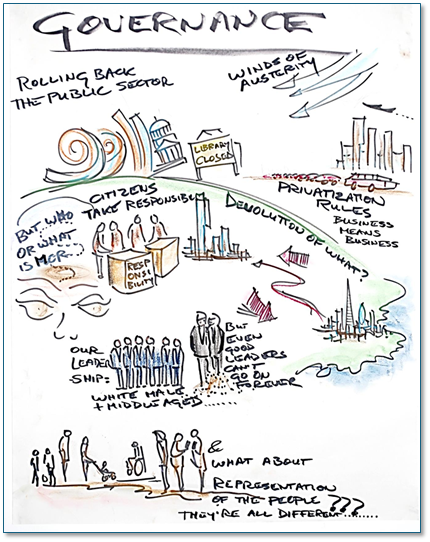
Graphic from the ‘GM2040’ workshop of the UK Foresight on Future of Cities (Ravetz & Miles 2016) © JRA
Manchester may be a digital leader (home to the world’s first computer etc), but up to now it works largely as a ‘silo city’, even while the aspiration grows for ‘joined-up’. While the digital frontiers of ‘smart governance’ move rapidly, the challenge of a ‘wiser society’, with methods and tools just emerging, is running to catch up.
Knowledge co-production and the ‘collective human-artificial intelligence’
All this points to a changing picture on what is useful knowledge, who can produce it, how and where? Here MUI aims to lead the way with methods, tools and demonstrations, in the context of ‘Manchester 2035’ as a leading civic university. Following the logic of collective urban intelligence, such wider and deeper inter-connections are clearly beyond any one sector, department or field of knowledge. This points to a bigger picture for participatory research and knowledge co-production – not only as community or stakeholder input to academic research, but where stakeholders and researchers work together as equals. Current directions include:
- Participatory research which is led or carried out by citizens / communities / stakeholders, e.g. citizen science, participatory mapping;
- Participatory research which is directly engaged with activism for social innovation and progressive politics;
- Knowledge co-production where analytic research works in parallel with other creative media – narratives, video, performance, community action etc;
- Knowledge co-production as a wider and deeper multi-helix ‘multiversity’, based on systematic co-learning between policy, business, civil society, academics, communities and citizens.
Practical prototypes for each of these and more are in development and demonstration, in MUI and elsewhere. Some are looking at new methods and tools for citizen empowerment and decolonization: others at AI and the digital potential. Here at the LUCI we are running prototypes on ‘Foresight-CHAI’ (‘collective human-artificial intelligence’) in Beijing, Kolkata and Manchester, aiming to harness AI to better enable the CHI (‘collective human intelligence’). Could such a CHAI model be useful in the Local-wise with its more synergistic ground-level social entrepreurial approach? And could it bring about new forms of democracy in east Manchester – maybe more participative, deliberative and knowledge-based – in time for the next election? Interesting prospects lie ahead…
Joe Ravetz leads the Urban Governance cross-cutting theme at Manchester Urban Institute. He also the Director of Mind Lab (Laboratory for Collective Urban Intelligence (LUCI)).
From Urban Silos to ‘Joined Up City’: Where next for urban governance and knowledge co-production? | Joe Ravetz
0 Comments
Submit a Comment
From Urban Silos to ‘Joined Up City’: Where next for urban governance and knowledge co-production? | Joe Ravetz
0 Comments
Submit a Comment
Contact us
+44 (0) 161 306 6000


0 Comments