
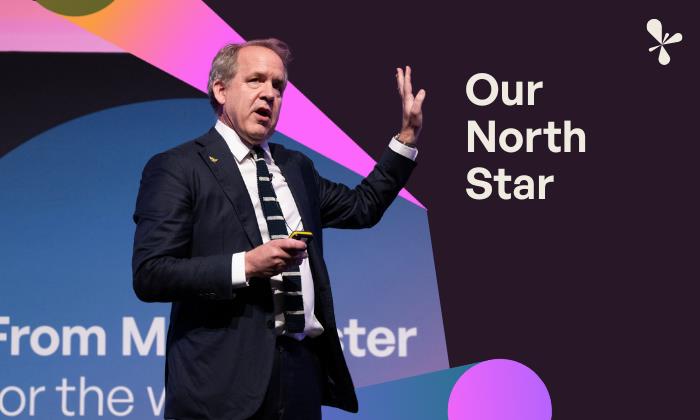
Professor Duncan Ivison: North Star and Foundations
Between October and December, we are running a series of Viewpoint blogs written by our University Executive to give their personal perspectives on our new strategy to 2035, play back what we heard, explain the choices we are making, and set out how we will test, learn and scale to deliver our strategy.
In the first piece, Professor Duncan Ivison, President & Vice-Chancellor, introduces our North Star and the foundations that make it real and enable our leaps.
You can explore the strategy on our webpage, or download the full strategy text.
The world is sending what social scientists and futurists call ‘signals’ – early clues already visible around us that will build over the next decade, even if the route each takes is uncertain. We can see AI moving from a discrete set of tools to permeating much of our shared infrastructure; health and life sciences shifting toward prevention and data-led care; climate adaptation becoming an inescapable need for cities like ours; learning unbundling into flexible routes that integrates with non-linear careers; and new discoveries emerging where disciplines intersect.
Each signal expands the opportunities in front of us – to shape new fields, create solutions and benefit local and global communities. That is why our strategy is a framework for choices, rather than a fixed path – a way to focus where we can make the biggest difference and connect our strengths without knowing all the answers yet.
Our North Star
I liked the idea of calling this part of our strategy our North Star – not ‘our vision’, because a North Star is not a detailed map or a desired future you simply will into being. It is a steady point in the distance to steer by (though I spent 22 years in Australia, where you can’t see it – you follow the Southern Cross!). The lesson holds: choose a star you can see – however distant and seemingly out of reach – and aim for it. For us, From Manchester for the world is that star.
It’s about what we will be known for – setting our course to be a great civic university for the 21st century and creating knowledge for the public good, locally and globally, so we can do more of what matters. We’ll do this with a distinctively Manchester edge – practical, radical, collaborative.
Over the next 12 months, we’ll work hard to demonstrate where we are heading. We have set our ambition, but we need to translate this into practical steps that will help all of us understand what that means in our daily interactions with each other. For some, it might not make much of a difference initially. For others, you’ll have a chance to start working on some of the new initiatives almost immediately. I want to make sure everyone understands, as best they can, what it means for them.
Our foundations – where opportunity starts
In our conversations across the University, colleagues asked us to do three things – fix the basics, be ambitious (and don’t lean so heavily on the past), and be clear about how we deliver. That is why the strategy is built around ‘foundations’ and ‘leaps’, and why a delivery handbook that sets out the ‘how’ of working together to reach our ambition will follow soon.
The foundations are the core commitments we heard you say must be true in any future and define what we need to get right to succeed. The leaps are the bold, strategic choices that will take us further and faster– my University Executive colleagues will share more on each leap in this series.
But getting our foundations right and embedding them across the University can also be game-changing, because they will help create the conditions in which we can respond effectively to both the known and unknown challenges we’ll face in the years ahead.
Our commitment to teaching and research excellence will be felt more in our students’ experience and in the city. They will build portfolios based on real problems and challenges shared by our partners. Researchers will see their ideas put into play sooner. And employers will be able to recruit graduates who can deliver. Being values-led and sharing our knowledge openly with the world keeps us alongside our communities – not apart from them – so we can build the trust that makes tackling difficult projects possible and more impactful.
Framing our ambition as being of Manchester and for the world gives us a proving ground – we can take what we build here to the world, as bring back what we learn from our global partners. And being organised for success means we aren’t stymying new thinking through bureaucracy – we’ll have simpler systems, shared data and cross-functional teams to shorten the distance from idea to impact. I realize we have a long way to go on this front. But we must start working in a more integrated and flexible way if we’re to realize the ambitions we’ve set out across both the foundations and leaps.
Finally, being a place where everyone matters – and feels that they matter – creates a culture where experimentation and innovation become easier, and you feel you can have a go at making things better, wherever you are in the organization. It doesn’t mean we will always agree about everything, but that you have had a genuine opportunity to shape the things that matter to you.
Fixing the basics (we’ve already started)
Throughout the consultations I heard some very direct messages. One that really stuck with me was: “Fix the basics – fewer forms, faster decisions, systems that talk to each other”, but also, that colleagues want to connect with each other across teams and disciplines. When I arrived last July, I half-joked that we should retire a committee a week – and I’ve tried! – so, I hear you on that: simpler governance and quicker, clearer decisions help everyone.
We’re not waiting. We are putting in place some basic improvements now that will enable us to transform our services down the track. Our new finance and HR systems project – ‘Future Foundations’, being led by Carol and Ele- will improve our core People and Finance services. Our current major IT initiative – ‘Evolve’, being led by PJ and his team – is modernising key IT systems for performance, reliability and security. These improvements will free up time, reduce duplication and support the tell-us-once, clear-ownership approach you asked for.
Alongside this, we need to sharpen and modernise our brand identity so that it matches our ambitions, given the hugely competitive environment we now face to recruit students, colleagues, funding and partners. Our current visual identity was built for a world of print and pamphlets, not AI and Chat-GPT. So, we will refresh how we present ourselves visually and tell our story as a university, as well and improve the navigability of our digital platforms. Our new homepage and strategy pages are the first examples of our refreshed approach to our website.
Of course, there is much more to do! But we’re on our way.
How we will deliver
Not everything can happen at once. We will sequence our work carefully, test in the open, learn quickly and scale what works. So, keep telling us what helps and what hinders, and we’ll keep trying new ways of working based on your insight and expertise.
Over the last 14 months, I have seen what many of you already know – Manchester’s energy and ingenuity are extraordinary. If we keep hold of that spirit, we’ll deliver on our strategy.
Thank you for the ideas, the care and the candour you have brought to this process so far. Keep it coming.
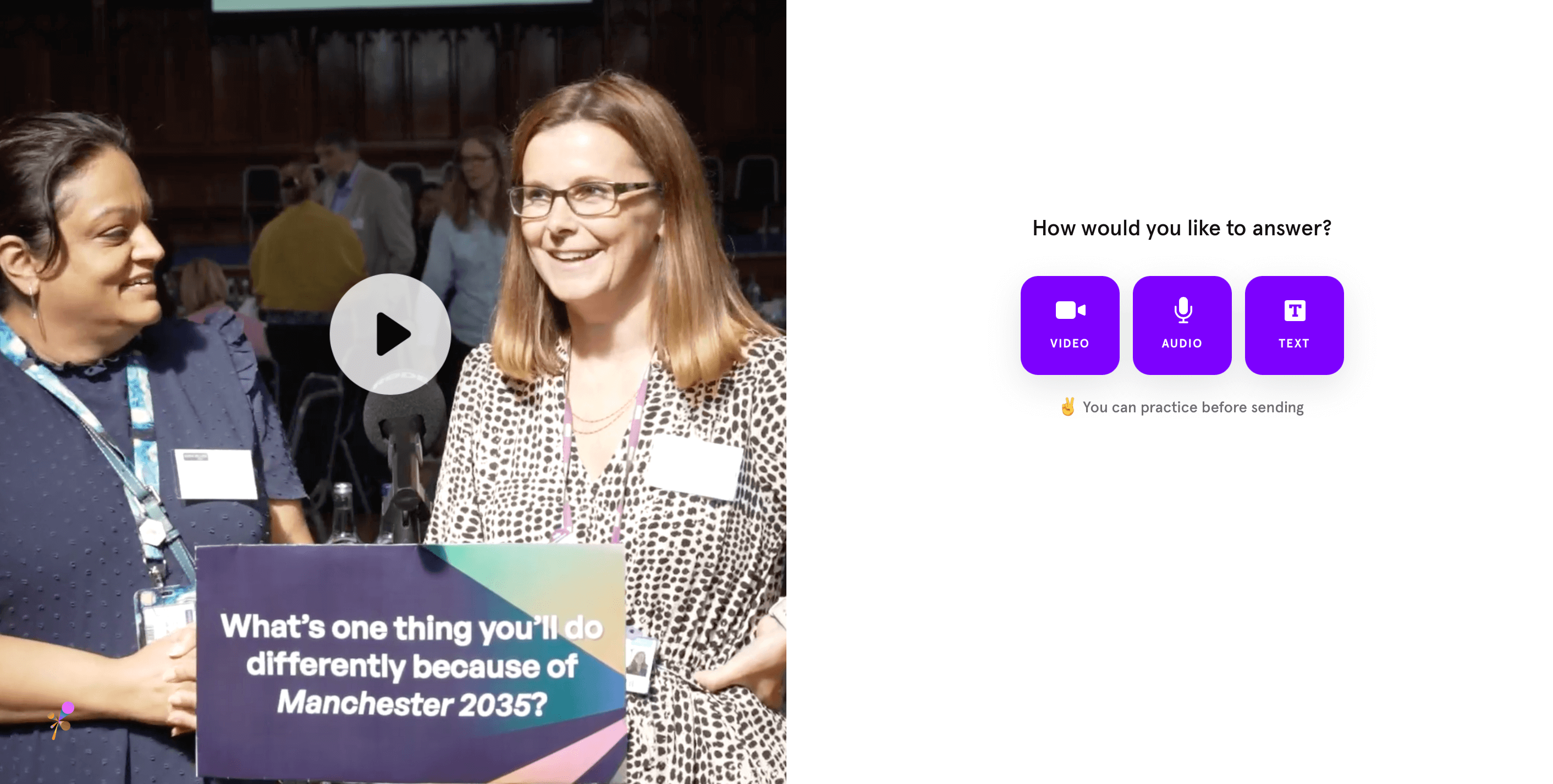
One question to discuss: What is one thing you will do differently because of our strategy to 2035?
- See some of the answers our colleagues gave:


We talk as if the university is a kind of mission-driven conglomerate, strategically steering research toward grand challenges. In reality, a modern research university is a platform — closer to Amazon— that lets academics use its infrastructure, reputation and regulatory status to access other people’s money. And that money is mostly public: taxpayer-funded research councils and medical charities whose donors think they’re paying for breakthroughs, not for universities to build ever larger central bureaucracies.
Yet our strategies are written as if the university itself is the originator, investor, and beneficiary. It isn’t. We are intermediaries. When something actually does look commercially promising, we are very quick to invite in private equity and venture capital, who quite reasonably protect their risk by diluting the university’s stake to a rounding error. The pattern is familiar: the university puts in small, high-risk seed funding (and decades of salary, labs, PhDs — all effectively public subsidy), then business walks away with the real upside. Universities then point to the spinout as “impact,” but economically, it’s marginal for us.
So the corporate fantasy goes like this: “We will be a research-intensive university solving the world’s problems.” The operational reality is: “We will be a platform through which publicly funded academics compete for publicly funded grants, while the serious downstream value creation is captured elsewhere.” Which is why I find the 2035-style visions incomplete. If everyone is chasing the same challenge-led funding, we produce conformity, not originality. And if our actual revenue is teaching plus highly competitive public research money, we should admit that the real, defensible business of a university is still teaching, training, and safeguarding fundamental, even esoteric scholarship whose value can’t yet be narrated for a VC deck. Everything else is fashion.
The strategy makes an attractive assumption that Manchester can keep doing what it’s been doing, only faster, more “joined up”, and at larger scale. But that rests on a growth path that is no longer guaranteed.
Over the next decade we face at least three headwinds the document only half-acknowledges: (1) domestic demand will not rise indefinitely, especially if more young people choose paid work + employer-backed training over three years of HE; (2) international recruitment is now a policy- and geopolitics-sensitive income stream, not a tap we can just turn up; and (3) AI is already eroding some of the graduate-entry labour market that underpins the “Manchester premium”. A university with very large fixed costs, a lot of real estate, and ambitious digital investments can’t assume a permanently rising student base to carry all of that.
There’s also a tension in how we talk about “inclusion”. What we mostly mean is: “people who want to come to university, on our terms.” We do not mean the sizeable group who are sceptical of universities as sites of ideological conformity or threat to free speech, and who are building things — AI is the clearest case — outside HE because they think universities slow them down. Their contributions can be massively value-creating and just as massively destabilising. At the moment, they sit outside the story the strategy is telling.
So the real strategic question isn’t “how do we scale Manchester 2025 → Manchester 2035?” It’s “what if the scale plateaus, or dips — which bits of this strategy survive?” That’s where we need clearer choices: which activities are mission-critical even in a flat or falling income scenario, and which ones only make sense in a high-growth world. Otherwise “From Manchester for the world” risks becoming a narrative about a university model that the world isn’t actually choosing.
Thanks Adam – good challenge. In fact, it doesn’t assume we can keep doing what we’re doing or a ‘high growth’ world, quite the opposite, actually …that’s a fundamental premise of the strategy! Early in the strategy document we outline the risks and challenges we face – including around student recruitment, financial stability and geopoltiics. So it’s all about how we build resilience in light of these challenges and also be clear about our ambitions for the future. The foundations and leaps are meant to help us do that – by clarifying the fundamental things we need to get right in any scenario, and then the transformative things we need to do to succeed in future, but which will require making some choices and priorities. None of what we are proposing presumes us finding a magic money tree…but it does mean focusing on the quality of our student experience, doing excellent and impactful research, but also finding ways to engage with the real economy in new and creative ways, among other things. It certain doesn’t mean just doing what we have been doing and a bit more…there are some clear choices we are making. Finally, as we are explicit about – it’s hard to predict the future, so we need to be ready for the different challenges that will come, including student recruitment and financial challenges.