
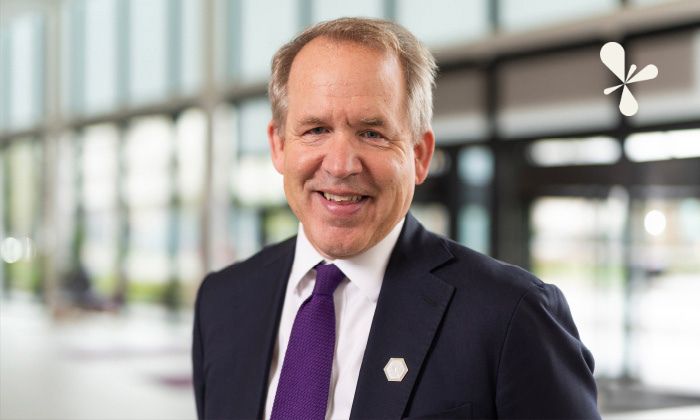
Professor Duncan Ivison: From strategy to delivery
2025 has been quite a year for all of us. Thank you for everything you’ve done to make it a good one.
Alongside all the brilliant things you’ve achieved individually, I hope you feel proud of the way we came together to create our new strategy From Manchester for the world.
When we began that work, we started with a simple question: what kind of university do we need to be in 2035?
From there, we listened. And listened. More than 12,000 of you – colleagues, students, alumni, partners – shared your ideas, stories and ambitions for the future.
The answer we arrived at together – the thing that has become our north star – is that we want to be a great civic university for the 21st century, creating knowledge for the public good, locally and globally.
Getting to this point has been energising – from listening and discussion, to developing the ideas, to finding agreement – with plenty of debate and honest challenge along the way. It was a shared effort from start to finish.
Now comes the exciting part. We get to bring it to life.
Today, we’re sharing two of the things that will help us do that.
First, a three-year work package that sets out what we’ll focus on first. Second, a practical handbook that looks at the how, and gives us a shared way of doing things.
The strategy works because we created it together. It will become a reality because we make it real together.
We won’t get everything right straight away. And we shouldn’t expect to.
We’ll reach the answers together as a community – of colleagues, students, alumni and partners.
- To help you get involved, here is the three-year work package and the handbook.
The three-year work package
We can’t do everything at once, so we’ve set out the things we need to get moving on first. We’ve looked ahead to where we want to be in three years’ time. We’ve set some clear priorities for this year. We’ve agreed simple ways to check whether we’re on the right track.
This work package isn’t fixed. It will shift as we learn and as the world changes around us. It gives us a strong starting point and helps us focus on the things you’ve told us matter: working out what comes first, involving the right people, managing our workload sensibly, and paying attention to the order in which things need to happen. And you’ll see more detail as the different initiatives kick off. Some things we’ve already begun. Others haven’t been started yet.
Next year we’ll share more about the different ways to get involved in making all this happen. Please lean in, speak up and keep driving us forward.
The handbook
The handbook explains how we’ll approach making improvements at Manchester – openly, with shared principles and approaches, involving our whole university community. It’s designed to be a practical and usable guide, with people at the heart of our approach.
Looking ahead
Next year we’ll keep working in the same open, collaborative way. We’ll need your ideas and your voice to help us turn this strategy into reality.
The world around us is changing fast – in our city, our country and far beyond – so we need to be more innovative, more engaged and more committed to excellence than ever before.
Our University is full of talent and energy, and we have the chance to make an even bigger difference. We should feel confident about what comes next.
Let’s keep going. Together.
Best wishes, D
- Join the delivery conversation at our next all colleague Townhall on Tuesday 13 January, 10am – 11am.


Thanks for this, Duncan.
The delivery handbook contains a lot of good stuff. I think it would have been significantly improved by some commentary about the SEP report recommendations and how the guidance in the handbook aligns with it. This is surely the place it should found. Here is what you said:
Since I arrived, I have heard from many of you who found
SEP to be a deeply frustrating and difficult process, and
it’s clear from the report that there are important
lessons to be learned. I also know that many colleagues
worked with care and dedication to deliver SEP. This is
why the evaluation report is so important to me.
I’m especially mindful that, behind every recommendation,
there are genuine experiences and concerns that have
informed them. My aim is to use these insights to make
meaningful, practical improvements to the way we deliver
projects now, and in the future, especially as we develop
our Manchester 2035 strategy, which will guide us over
the next ten years.
Secondly, I would like to understand what are the composition of the crucibles for the decisions on which work packages to pursue. All our exams are mediated through individual excel spreadsheets, for example. It is prehistoric. Why not sort this out?
Thirdly, how does one find out what is meant by the words in the Gantt chart? What does ‘Academic Advising Model’ mean, for example? What was the outcome of the ‘PGT Review’? In the delivery handbook, the very first piece of guidance is ‘Make the goal clear’. The next is ‘Work together on design’. But I am an academic advisor and I have no idea what is going on. This is just one example.
You need a page somewhere that lists all the change projects, how they were commissioned, who is involved, what the plan is, what stage they are at, and how one gets involved if one wishes.