
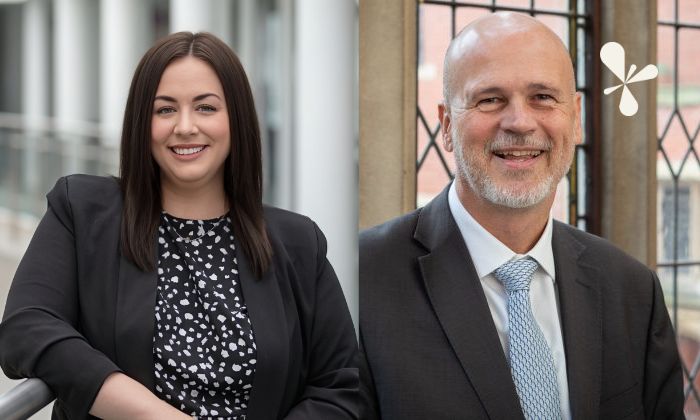
Jenn Hallam and Ashley Blom: Making the Leap: Flexible, Personalised and Digitally Enabled Learning
Between October and December, we are running a series of Viewpoint blogs written by our University Executive to give their personal perspectives on our new strategy to 2035, play back what we heard, explain the choices we are making, and set out how we will test, learn and scale to deliver our strategy. In this piece, Professor Jenn Hallam, Vice-President for Teaching, Learning and Students and Professor Ashley Blom, Dean of the Faculty of Biology, Medicine and Health, give their insight into the flexible, personalised and digitally enabled learning leap. You can explore the strategy on our webpage, or download the full strategy text.
Making the Leap: Flexible, Personalised and Digitally Enabled Learning
When we think about Manchester’s future, one phrase keeps coming to mind: learning without limits. Our 2035 strategy sets out a bold ambition, but at its heart it’s about something very human: making sure every student feels their learning fits them, supports them, and sets them up for success in a fast-changing world. Just as importantly, it’s about ensuring our colleagues feel equipped, trusted and supported to deliver that vision. This leap matters because we both know, from experience, that when learning and teaching work at their best, they change lives. A student who feels connected to their academic adviser, who knows their programme has been designed with rigour and flexibility, is a student who thrives. A colleague who has the training, digital tools and support they need is one who feels energised to innovate and proud of the work they do. The Manchester we are striving for by 2035 is one where both students and colleagues experience learning that is purposeful, personal and transformative.
Watch: From Manchester for the world, our new University strategy to 2035 has five leaps – bold choices where we’ll go further and faster to become the university the future demands. We challenged our students to explain each in just one minute. Can they beat the clock?
Everyday practice, everyday choices
It is tempting to imagine that a leap of this scale will be made only through major systems changes or new technology. But in reality, it will be visible in the everyday, in how we prioritise, plan, and choose where to focus our energy. Making learning flexible, personalised and digitally enabled means being clear about what matters most, and being willing to make choices. That means identifying priorities together and setting out a roadmap for change that colleagues can see and trust. It also means being honest that we cannot do everything. Sometimes the most important decision will be to stop doing things that no longer serve our students or colleagues, so we can concentrate on the activities that really matter. This is as much about wellbeing as it is about strategy. What we heard from you consistently was how important it is to protect colleagues’ time and energy. This requires us to reduce duplication, simplify systems, and focus on the areas with the greatest impact. The strategy asks us all to think about how our daily decisions either reinforce or undermine the kind of Manchester we want to become. Flexible, personalised, digitally enabled learning is not “someone else’s job”, it is about how each of us interprets our role and how we align our work to the vision of learning without limits.
Taking the long view, step by step
A ten-year vision matters, but so does honesty: we will only get there step by step. That is why the work will be delivered in three-year packages, each building on the last. In the first three years, our focus will be on creating the conditions for success. As one colleague put it, “The ‘tell us once’ model – with a reliable single point of truth for student records and outcomes”. This means ensuring that academic advising is recognised and supported as a priority, addressing colleagues’ feedback about workload and system usability, and embedding robust quality assurance and training for teaching and assessment. Without solid foundations, we cannot build lasting change. As we move into the middle years, we will scale up our ambition. This will include expanding and diversifying our postgraduate taught portfolio, ensuring it is distinctive and aligned to emerging fields and professions. It will also mean embedding personalised learning pathways, supported by digital systems that feel seamless and intuitive. Take, for example, the postgraduate taught portfolio. In the future, our programmes will not only showcase disciplinary excellence but also reflect the realities of the job market our graduates are entering. To achieve this, we will need to decide what to refine, what to grow, and, in some cases, what to step back from. These are not easy choices, but they will help Manchester to move forward with clarity and purpose. By the final phase, as we approach 2035, we want to be able to say confidently that Manchester has become a place where learning is flexible by design, where digital tools enable rather than obstruct, and where every student feels known and challenged to achieve their best.
Building on what we already do well
We are not starting from a blank page. Already, we can point to examples that show the leap is possible. Canvas has replaced Blackboard across the University, giving students a more consistent, intuitive experience and colleagues improved tools to create high quality, accessible teaching. We see colleagues experimenting with digital innovations that make teaching more inclusive. We see advisers who go above and beyond to connect with their students. We see assessment practices being rethought to ensure they are fairer, clearer and more developmental. These initiatives, sometimes small and sometimes transformative, give us confidence that we are on the right path. They also remind us that the best ideas often come from the ground up, from colleagues and students working together to test new ways of learning and teaching.
Imagining 2035
So, what does success look like? We imagine a student arriving at Manchester in 2035 who immediately feels their programme has been designed with them in mind. They know who their adviser is, and that this adviser has the time and tools to support them. Their learning is flexible, whether they need to adapt around work, health, or family commitments, or whether they want to accelerate and stretch themselves further. Digital platforms connect their learning journey seamlessly but never replace the human touch. Assessments are challenging but fair, and every step feels purposeful, preparing them for the next stage of their lives. For colleagues, it means clarity and support. Lecturers know that quality assurance processes are robust but not burdensome, and digital systems enable rather than frustrate. Advisers feel valued for the role they play in students’ development. New programmes are easier to design and deliver, freeing energy for creativity and innovation. This vision is not utopian. It is possible, if we take the leap together.
Continuing the conversation
Your feedback will shape the priorities of the first three-year package and beyond. We know many of you are already contributing great ideas and testing new approaches. Please keep sharing them. Together, we can make From Manchester for the world a reality. A University where every student experiences learning without limits, and every colleague feels empowered to make that possible. We want to end with an invitation. The strategy cannot succeed unless it feels real and relevant to you in your work.
We want to hear your views: What’s one thing that would most help you deliver flexible, personalised and digitally enabled learning?


The one thing that would most help me deliver flexible, personalised and digitally enabled learning is to start making a reality of the idea of ‘stackable’ qualifications. This is particularly important for part-time and professional-programme students. There is a push for this from e.g. NHS commissioners and their staff we have as students.
It would allow students to build up credits over a longer period and top-up awards. The current rules on pathway trajectories and time limits and ‘entry’ and ‘exit’ will need thinking about, as will ‘surrendering’ a qualification (e.g. PgCert) for a higher one (sometimes up to a professional doctorate). It will also require acknowledgement of the requirements for academic director and programme/area-specific admin support time!
I am keen to know more about how this vision will impact upon an academic’s day-to-day in terms of contact time with students. I am keen, in particular, to hear more about the difference between the meaning of ‘flexible’ and ‘personalised’, and how they differ from one another in this strategy / what they refer to, in more concrete ways. At present, I can’t grasp it.
Is this a vision of students being able to take whichever combination of modules they wish to across Schools and Faculties? Is it primarily about the ability of students to undertake scheduled lecture content at a time that suits them? Depending on the answers here, there are some big implications potentially for the relationship between staff and students.
Only with a clearer idea about these things would I feel confident about volunteering one thing that would help achieve these goals. As it is, I offer the following, with the proviso that I may be misreading and acknowledging that the vision is yet to be fleshed out.
I am a little nervous that the role of the academic will be focused more on advising and supporting students as they each make their own ways through a raft of quite personalized and different programmes of study. I acknowledge that we need a stronger link with students as advisors, however, though for me this is a case for greater integration with courses units rather than more time spent advising outside of course units.
For example, one thing that would make the connection to advisors stronger is for more group tutorials with advisors in the first year of study. Group tutorials would also reduce the risk of (for example) a poor one-to-one interaction between advisor and advisee being concentrated through increased one-to-one contact, while building the sociality that is central to learning and critical independence. So, perhaps there is something to be considered about how advising is integrated into the deliver of certain key units within each year of study.
More widely, there is something very powerful about the sense of community, critical independence and support that arises from working and learning together on particular projects and course units. This also stems from a department and discipline that forms the foundation of your academic identity (as teacher or student). I would love to see this strengthened further through future developments, rather than being designed out or inadvertently diluted. In particular, I would hate to see ‘limits’ in ‘learning without limits’ as a synonym for disciplinary borders.
It’s great to hear that you understand that flexibility is a two-way street. For teaching staff, it would doubtless be welcome to have greater control over the timetable (e.g., the ability to concentrate and timetable hours at different stages of the semester, or depending on activity), less burdensome and protracted processes for making changes to learning outcomes and assessments, and greater control over the specifics of summative assessment (within broadly agreed standards).
This is going to be a very challenging leap to achieve, as digital inclusivity/accessibility isn’t built into our processes. The Canvas LMS platform is only partially-compliant with Web Content Accessibility Guidelines, additional effort will be needed to provide students with an alternative learning experience or support, for where they experience ability barriers in the system. You can see the Canvas accessibility statement here: https://www.itservices.manchester.ac.uk/uom-accessibility-statements/canvas-learning-management-system/
Since most of this post concerns academic advising rather than teaching per se, I’d like to suggest a way to create stronger cohesion between advisers and advisees, and also among advisees. Why not assign advisers one timetabled hour per semester for each year group (so 3 hours total per semester) run as a core methodology, critical thinking (to pick up on Siobhan’s great comment above) and general information session for their discipline?
This would 1. encourage greater engagement from students, as the session would appear on their timetable; 2. facilitate time management and targeting of advice for colleagues, as advisees would be grouped by year cohort; 3. provide greater transparency in workload terms, as these sessions and associate preparation would be accounted for in the WAM.
It goes without saying that these sessions would be counted over and above existing office hours and advising duties. I’d be interested to know what colleagues think about this.
As for the personalisation of programmes, this seems diametrically opposed to the current “Teaching Sustainability Programme” policy of drastically cutting the number of joint degree combinations made available. I’d therefore be interested to hear more about how the university will cater for students wanting to study, for instance, German and Art History in 2035.
As for Canvas, we’ve only been using it for a month and some aspects of the application (especially the assignment grading system) do not so far appear to be an improvement over Blackboard – quite the opposite, in fact.
It’s great to read the statement that ‘They know who their adviser is, and that this adviser has the time and tools to support them’. Previous waves of digitalisation in relation of teaching have often reduced rather than increased the time academics have available, whilst raising expectations of what academics should deliver. To achieve this laudable goal will require a transformation not so much of digital infrastructure as of an admin/management culture that is incentivised to push as many tasks as possible down on to academics because the cost of doing so is not reflected in the direct KPIs of those doing the pushing down, but rather is hidden by being distributed across all the goals and KPIs of the University. Inefficiencies created in this way don’t penalise the people creating them but massively harm our overall performance and the overall student experience. So building a culture that prevents this from happening will be key!
Thank you for this. It is encouraging and exciting to hear how this vision will play out. The only thing I would like to add, if I may, is to make much more visible throughout all our design and delivery of taught provision, a key aim of higher education namely to help our students become independent critical thinkers. This should be there from the start of year 1 and throughout the student’s learning. It hopefully will avoid the narrowness of thinking which can come from the ‘student as customer’ narrative. Helping students to become critical thinkers will surely help them throughout their lives and hopefully make their experience at Manchester a much more challenging and interesting one. I speak as someone who discovered, as a mature student, how empowering higher education can be, because it both taught and gave me the confidence to be, an independent critical thinker.
It is great to imagine a student arriving in Manchester in 2035 and finding that their programme has been designed to help them achieve their best results.
It is not great imagining a student **not** arriving in Manchester at all in 2035, yet being enrolled in a UoM programme. Assessments could not be challenging nor fair for them! I am glad that this “online only” part is not mentioned here, it is perhaps a sign that we are rethinking it, but it’s still in the strategy…