

The Nutrition Gap: Quantifying the Structural Barrier to a Sustainable Diet in Manchester | Jules Buckland
As inflation rates ease and policymakers declare the end of the cost-of-living crisis, quieter challenges are taking hold in cities like Manchester. For households on local wages, the real issue is not just whether food prices are rising, but which foods are unaffordable. Jules Buckland looks beyond headline inflation to show how the rising cost of basic, nutritious food is becoming a structural barrier to healthy living.
We are frequently told that the economic storm has passed. The headlines reassure us that inflation is falling and supermarket prices are finally stabilizing. But for households in Manchester navigating the city on a median local wage, the receipt at the checkout tells a very different story.
While the aggregate numbers suggest a cooling economy, a deeper look reveals a stark divergence in the cost of living. To understand the real barrier to urban health in our city, we moved beyond the headline rates and built a specific economic model using ONS consumer price micro-data. We analysed pricing data from January 2023 to December 2024, isolating the “budget” tier (the cheapest 50% of items) and evaluating their nutritional quality using the UK Food Standards Agency (FSA) Nutrient Profiling Model.
The results confirm a hypothesis that many in our communities have felt intuitively. The cost of being poor and eating well is rising significantly faster than the cost of being poor and eating unhealthy food.
The Cheapflation Trap
Our analysis reveals that the “cost of living” crisis has evolved into a specific “cost of health” crisis. Starting in mid-2023, the price trajectories of healthy versus unhealthy staples began to decouple.
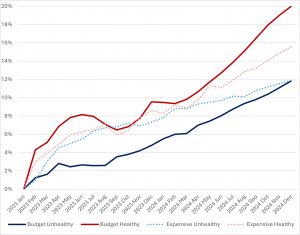
Data Sources: Inflation based on ONS consumer price micro-data. Nutritional quality scored using the UK FSA Nutrient Profiling Model, derived from McCance and Widdowson’s CoFID. Unit weights based on Mistral Associates guides and NHS Eatwell portion sizes.
As the graph illustrates, while the price of nutrient-poor budget staples (such as sugar, white bread, and processed meats) has effectively stabilized—rising 11.81% over the last two years—the price of healthy budget staples (essential fruit, vegetables, and dairy) has continued to accelerate, surging by 19.98%.
Mathematically, this means the inflation rate for a healthy diet is currently 70% higher than for an unhealthy diet. Crucially, this inflation gap does not exist for expensive proteins like salmon or lamb, which have seen relatively lower price increases.
The crisis is not at the luxury end of the market. It is concentrated in the absolute basics—the carrots, onions, and milk that form the foundation of any sustainable diet. For a household on a tight budget, the “healthy choice” isn’t just harder. It is becoming the “luxury choice” at a rate that far outpaces wage growth.
The Manchester Context
This data exposes a specific structural barrier for Manchester. As recent reports highlight, we are a city of economic contrasts. While our city-centre economy thrives, attracting a high-skilled workforce, the median income of Manchester residents trails significantly behind that of the workforce who commute in (an income gap of roughly £4,600 a year).
Our analysis builds on the work of local groups like Sow the City, who have mapped Manchester’s ‘food deserts’ and the struggle to access fresh produce physically. We add the financial reality to this spatial picture. With 40% of children living in poverty, a 20% inflation spike on healthy staples does not just squeeze budgets; it actively locks these families out of a healthy diet, regardless of where they live.
The consequences are already visible in our health statistics. Manchester currently battles some of the toughest health outcomes in the country, with female life expectancy lagging behind the national average (79.2 years) and a staggering 18-year gap in “healthy life expectancy” between our most and least deprived neighbourhoods.
Our data suggests this gap is being reinforced at the supermarket checkout. When the price of fresh ingredients rises nearly twice as fast as the price of processed carbohydrates, “eating well” stops being a matter of education, culture, or willpower. It becomes a matter of solvency.
A Structural Barrier to Urban Health
The prevailing narrative often suggests that families on lower incomes simply need better education on cooking cheap, healthy meals. This perspective ignores the cold economic reality of the last 24 months. The very ingredients required for those meals (the raw components of a sustainable diet) are exactly the products facing the steepest inflation.
If we want to address Manchester’s health inequalities, we must acknowledge that the economic wind is blowing against our poorest residents. The preliminary data suggests that the inflation premium for eating sustainably has detached from the wider economy. The barrier to a sustainable diet isn’t just cultural. It is structural.
Until we address the affordability of the “Budget Healthy” basket, we are asking Manchester’s most vulnerable families to swim against an increasingly expensive tide.
Jules Buckland is a second-year Philosophy, Politics and Economics (PPE) student at the University of Manchester. His research uses economic modelling to explore the intersection of urban inequality, public health, and the cost of living crisis.
1 Comment
Submit a Comment
Contact us
+44 (0) 161 306 6000


This is a valuable perspective for urban health planning. Small policy changes could make a big difference.