
Reflections from the Manchester Urban Film Series | Arielle Lawson, Elllie Barker, Sandhya Sharma, Philippa Winship & Shengjun Zhang
PhD students, Arielle Lawson, Ellie Barker, Sandhya Sharma, Philippa Winship and Shengjun Zhang share their experience collaborating with local community groups to organise a series of film screenings on ‘social justice and the city’ (funded by the Interdisciplinary PGR Research Activities Fund and Manchester Urban Institute).
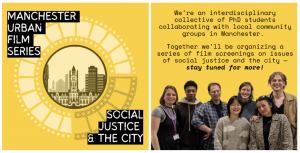 Manchester has a rich, deep, and diverse history of social justice activism that we wanted to explore. While we recognised that some of this history has been documented, our focus was on shining a light on the more hidden and marginalised voices and community organising efforts—particularly the voices of women, racialised minorities, younger generations and working-class communities. These communities have a contested history within the city that continues to shape their lived realities and concerns around equality and justice. Since the 1990s, Manchester has undergone significant regeneration in a shifting global political context. However, marginalised communities and their struggle over rights and resources have not benefited equally from these changes, and structural and material inequalities have been amplified. This tension provided the political starting point and platform for our five events, as we asked the question: ‘what does social justice in Manchester look like?’. With a shared connection to Manchester, whether as researchers, activists or residents, we wanted to create space to respond to this question, reflect on the city’s contested history and contemporary struggles, and give voice to the local communities who experience and resist the brunt of social injustice.
We approached each event as an opportunity to bring people together from within and outside the university, and to encourage collective conversations and engaged dialogue. Starting with topics that resonated personally — often rooted in our own research, activism or community identities — we branched out to specific community groups and university researchers to curate a programme of films and speakers. Interdisciplinarity, collaboration and social relevance formed the fundamental framework of both the process and the outcomes of each event.
Overall, the series successfully brought together PhD students from across departments, highlighting the common ground across our various research interests. It also enabled us to collaborate with a wide range of partners – from local venues to community organisations – and expand our reach, gaining over 250 Instagram followers and securing additional funding. The events were well-attended and sparked engaging conversations, laying the foundations for future collaborations and partnerships.
Below we have a short written and visual recap of the film screenings. While each event in the series was distinct, collectively they explored a range of interconnected social issues. By focusing on community-led resistance and representation, we examined the realities and challenges of activism on the ground. Each event attracted a diverse audience – including past and present, older and younger activists – and many collaborators returned for multiple events in the series. This fostered a cross-movement, intergenerational conversation about how to build continuity and solidarity within the current hostile political climate.
More information and photos of these events is available here.
Social Justice and the City Screening Series 2025
ESEA and South Asian women speak out
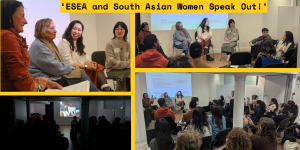 Organised in collaboration with and hosted at esea contemporary, this event showcased two short films addressing feminist and anti-racist activism. It was followed by a discussion featuring two long-standing local women’s rights activists, curated and led by Sandhya Sharma (Sociology) and Shengjun Zhang (Sociology). Drawing connections across generations and marginalised communities in Manchester, the event threaded together the ongoing legacies of racism, colonialism and patriarchy—from South Asian women’s battles against the sexist and racist Home Office immigration rules to the increased racism faced by the East and Southeast Asian (ESEA) community during the pandemic, affecting multiple generations. ESEA and South Asian women’s anti-racist and anti-sexist activism has so often been overlooked; our event centered their voices and aimed to inspire a more unified and solidaric generation of activists in the city. Learn more via Women’s Voices (@womenvoicesmcr) and Besea.n (@besea.n).
Collyhurst Voices: Community perspectives on urban regeneration
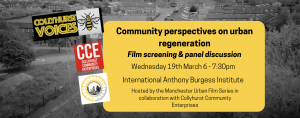 Hosted at the Anthony Burgess Foundation in collaboration with Collyhurst Community Enterprises (with additional support from the Manchester Urban Ageing research group), this event screened the recent documentary Collyhurst Voices, followed by a discussion with three community members chaired by Philippa Winship (Sociology). The event explored the emotional toll of prolonged regeneration uncertainty, the vital role of social infrastructure in sustaining community ties, and the diverse ways people can shape and influence urban planning processes through local campaigning and city-wide alliances.
Reclaiming the City
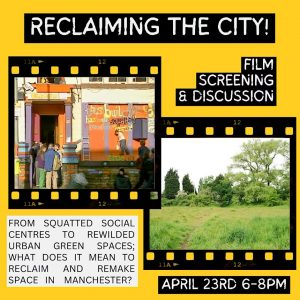 This event was screened at Bridge Five Mill in collaboration with the Save Ryebank Fields Campaign and the Pride Library. We showed two short films: the first about a pop-up squatted social centre from the late 90s, and the second was the premiere of a new film focusing on Rybank Fields — a rewilded green space in Chorlton under threat of development. The screening was followed by a conversation connecting the themes across both films, facilitated by Pete Duberly (Politics). Both directors were in attendance and spoke on the films, along with representatives from the Save Rybank Fields Campaign and the Pride Library.
Feminist Urban Planning
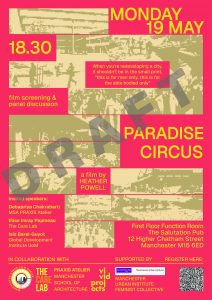 Hosted at the Salutations Pub and organised by Arielle Lawson (Geography) and Mariza Daouti (Architecture), this event aimed to foster a conversation and reflection on what a feminist city or feminist urban planning practice might look like both past and present. We screened Heather Powell’s documentary Paradise Circus about feminist urban planning efforts in Birmingham in the 1980s and brought together three feminist academics and practitioners from the university to reflect on and share about their own feminist spatial practices in Manchester today. Rather than focusing directly on community collaboration, for this event we tried to foster a collective space for feminist urban researchers across both Manchester Metropolitan University and the University of Manchester to come together, think about their engagement with the city and to build community as well. It was organised in collaboration with the MSA PRAXIS Atelier, The Care Lab, Vivid Projects and with additional financial support from the Manchester Urban Institute Feminist Collective.
Undercurrents: A screening of activist videos from the 1990s
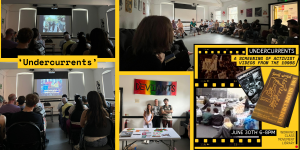 Hosted at the Working Class Movement Library and with the videos drawn from their collection, this event featured a curated series of activist videos from the 1990s, followed by a discussion with current youth activists. Organised in collaboration with Global Justice Now and the University of Manchester’s Climate and Justice Group and facilitated by Ellie Barker (Geography) and postdoctoral researcher Reka Polonyi (Drama), its aim was to focus on legacies of direct action, youth activism and media-making across generations. We showed a collection of 8 short videos, including protest music from the indigenous people of Brazil, women’s empowerment through direct action, and a Yorkshire mining community’s fight for jobs and the environment. We then had an insightful discussion with attendees and current youth activists, making use of a circle seating arrangement to allow us to easily collaborate and exchange opinions and insights.
Next steps
We’re planning on organizing an event at the University this Autumn to share in-person reflections and provide more information to other university members who would like to get involved with organizing more screenings this semester, so stay tuned or get in touch if you’re interested in learning more! You can reach us on Instagram @MCRUrbanFilm or email Arielle at arielle.lawson@manchester.ac.uk.
1 Comment
Submit a Comment
Contact us
+44 (0) 161 306 6000


Great initiative! Love how it brings research and community voices together through film.