
Heart Health History – The Museum of Medicine and Health at British Science Week
Blog by Cara Kilpatrick, CHSTM Master’s student
What do glass lantern slides, wooden stethoscopes and letter tiles have in common? They were all elements of the Museum of Medicine and Health’s British Science Week stall: Heart Health History. British Science Week is an annual celebration of science, technology and engineering with a range of events held across the country. In Manchester, the Biodiscovery Science Fair was held on the 9th and 10th of March in the galleries of Manchester Museum and was attended by over 1000 school pupils from the local area.
I was lucky enough to take part in the event for my master’s course placement in the Centre for the History of Science, Technology and Medicine (CHSTM). Working with the Museum of Medicine and Health’s Heritage Officer Stephanie Seville, I was tasked with helping to plan and run a stall at the fair. We worked in collaboration with the Division of Cardiovascular Sciences to share objects and stories of medical education and heart health from Manchester’s past.
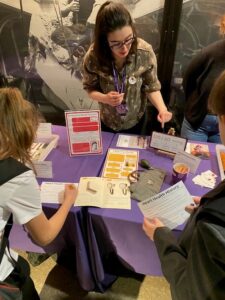
Cara, explaining instruments to local school pupils in Key Stage 3 and 4, who attended the event across two days.
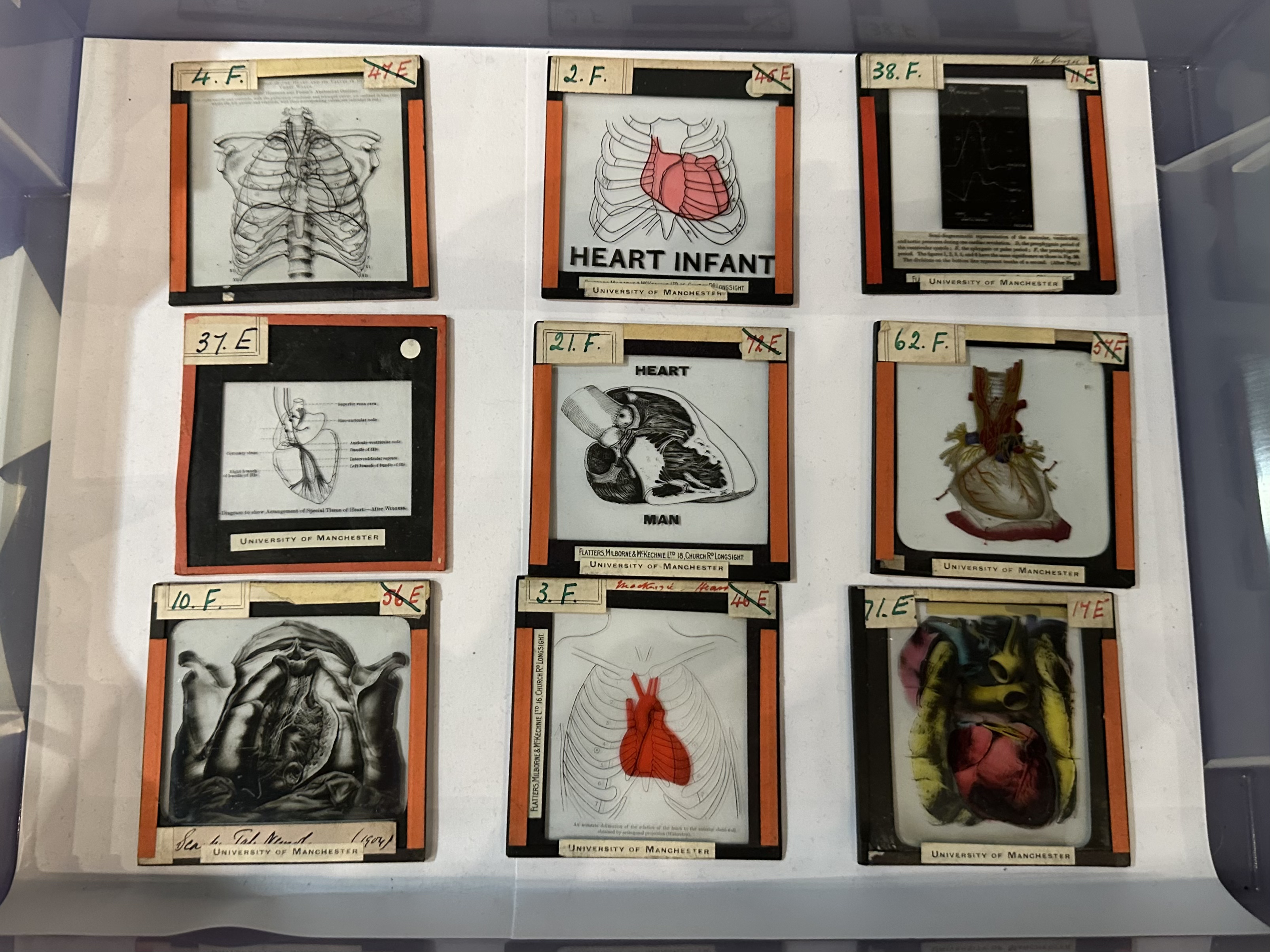
Using donations from the Manchester Medical School, we brought along anatomical wax models of the heart dating from the nineteenth century and a selection of glass lantern slides showing different illustrations of heart anatomy. These beautiful objects made a great contrast with the modern technologies brought by the Division of Cardiovascular Sciences, which included an iPad with 3D models of the internal heart anatomy. Our aim was to highlight some of the developments in medical teaching to the school pupils.
To showcase developments in monitoring heart health, we took two types of medical instruments. The first of these was a sphygmomanometer cuff used to measure blood pressure. This not only created a lot of fun for the pupils to try to pronounce and spell ‘sphygmomanometer’ but also showed the development of an important device still used for medical diagnosis today. We were able to talk with the pupils about why mercury is no longer used in these devices and introduce them to an often-forgotten figure in medical history, Nikolai Korotkoff. This Russian surgeon discovered that by placing a stethoscope on the arm whilst using a sphygmomanometer, sounds could be heard which correspond to the highest and lowest blood pressure readings.
This brought us to our final set of objects: a range of stethoscopes. These included simple wooden tubes which simply created distance between a doctor and his patient’s chest, a metal foetal stethoscope, and a flexible cord and ivory/bone stethoscope. We asked the pupils to place the objects in order from oldest to newest and in doing so, we had conversations about design and materials. We encouraged the pupils to take part in our spelling challenge using letter tiles to spell out ‘stethoscope’ or ‘sphygmomanometer’ as a fun way remembering these words and add a little competition.
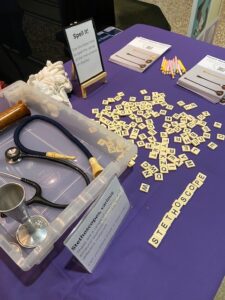
Range of stethoscopes used in the past and letter tiles for the spelling challenge.
I had a fantastic time putting together this stall, researching the different objects we included, getting to practice public engagement and sharing medical history. The Biodiversity Science Fair had a wonderful atmosphere with so many researchers sharing their work with school pupils who were excited to learn.
I would also like to say a huge thank you to Stephanie for all her guidance and support and to our lovely volunteers who helped us run the stall.
Additional Information
Cara Kilpatrick is a post graduate student of the History of Science, Technology and Medicine. In Spring 2026 she completed a work placement organised through CHSTM with the Museum of Medicine and Health. This is a collection of medicinal instruments and equipment reflecting the history of teaching and the practice if healthcare sciences in Manchester and beyond. The museum is part of the Faculty of Biology, Medicine and Health, organised and cared for through Social Responsibility.
Find out more about the Museum of Medicine and Health | University of Manchester
And teaching and learning with the Museum of Medicine and Health Social Responsibility | Learning with the Museum of Medicine and Health < Social Responsibility
0 Comments