
Making Manchester into a Swift City
Blog written by Rachel Zanetti, final-year Environmental Sustainability Project student.
The University has set a target that by 2028, we will have increased the number of bug, bat and bird boxes on campus by 20%. This is listed in the in the University’s ‘Valuing Nature Action Plan’. This initiative has made room for a project led by the Environmental Sustainability team to put up swift nest boxes across campus. This will hopefully be achieved by spring this year (2026), ready in time for the first swifts to arrive at the beginning of May.
But what are swifts?
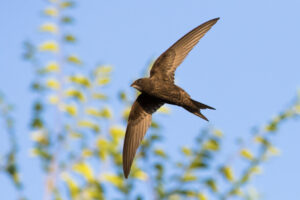 Swifts are migratory birds that make an immense round trip each year from their winter-feeding grounds in Sub-Saharan Africa to their summer nest sites across Europe. This puts around 14,000 miles on the clock, making them one of the great long-distance migrators. They are also the fastest bird for level flight in the UK, reaching a rapid 70 mph!
However, what makes swifts so special is that they spend almost their entire lives in the air, catching insects, drinking, mating and even sleeping mid-flight. They are so well suited to this unique lifestyle that their legs and feet are completely unsuitable for landing on the ground and walking, giving them their Latin name ‘Apodidae’, meaning ‘no feet’.
Swifts only land to nest in the summer, which they do on the eaves and cracks of our buildings. They return to the same site with the same partner for their whole lives, which can be up to 20 years.
Unfortunately, along with other cavity-nesting birds such as starlings and house sparrows, swifts have seen a massive decline in the last few decades. In the UK, we have lost 68% of our swifts since 1995. There are two main reasons for this:
- Insect decline: The UK has experienced a significant drop in insect biomass in the last few decades. Flying insects, the main food source for swifts, saw a 63% decline from 2004 to 2024.
- Loss of nest sites: The renovation and demolition of old buildings mean swifts are losing their existing nest sites in cracks and under eaves. The modern buildings that replace them have no room for cavity nesting birds, leading to a lack of appropriate nest sites.
What can be done to counteract this loss?
As part of the wider movement towards a nature positive campus, there are a number of initiatives around the University that aims to boost the biodiversity of insects. These include wildflower patches such as the one behind the Main Library, green roofs on the National Graphene Building and participation in No Mow May.
What can you do?
As part of the wider University community, both students and staff can play their part in supporting swift populations.
If you are a homeowner or know any homeowners, putting up swift boxes/bricks on the side of your house can provide a forever home for these birds to return to every summer and counteract the loss of nest sites. As well as providing replacement nests in the form of boxes/bricks, it is also necessary to protect existing nests so that these can continue to be used by returning swifts.
If you see a swift flying in and out from under eaves or in cracks in an old building, then you can record this as a swift nest on Swift Mapper. Swift Mapper is a free, easy-to-use conservation mapping tool put together by the Royal Society for the Protection of Birds (RSPB) and several swift conservation groups across the UK. Swifts and their nests are protected by law under the Wildlife and Countryside Act 1981. The data from Swift Mapper can be used to identify where active nest sites should be protected, and where new nests sites should be provided.
Another platform where you can record sightings of swifts is the University’s Biodiversity On Campus Project on iNaturalist. Each sighting contributes to a database that can be used by scientists and researchers to inform future actions and the conservation of swifts.
Finally, you can help support insect populations by planting pollinator-friendly plants. Mow your lawn less frequently, allowing time for flowering plants and wild grasses to bloom and provide food and habitat for critters. Provide water for wildlife by creating mini-ponds or butterfly paddling stations and avoid using pesticides in your garden.
Additional information
Rachel Zanetti is a final-year undergraduate in Biology. Her final-year Environmental Sustainability Project supervisor is Dr Maggy Fostier. Read more about Environmental Sustainability Projects (ESPs) and their contributions to university-wide initiatives.
For more information on her project and swift conservation:
- Guidance on swift bricks
- Guidance on swift boxes and nesting sites
- Guidance on using Swift Mapper
- Guidance on insect friendly planting
To find out more about Environmental Sustainability in FBMH, visit the Faculty’s intranet page, website or contact srbmh@manchester.ac.uk.
0 Comments