
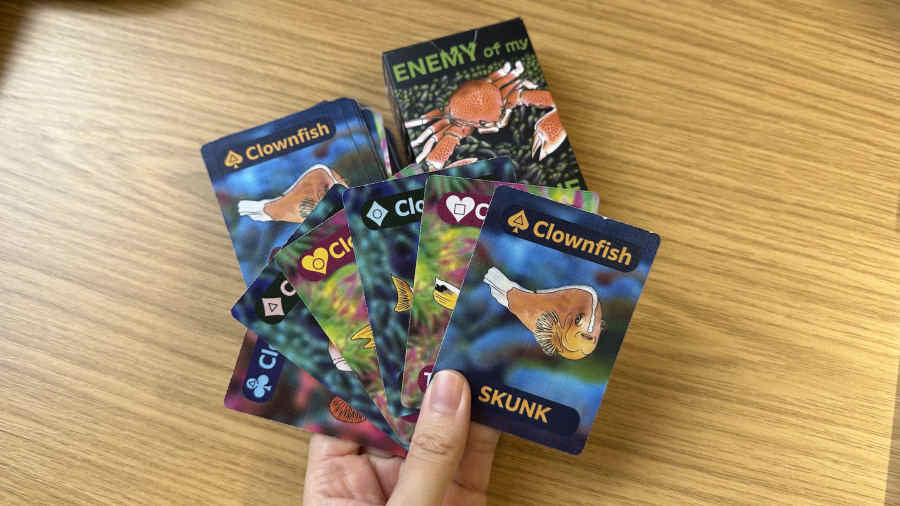
Playing for people and planet: interview with Dr Andrew Angus-Whiteoak
Dr Andrew Angus-Whiteoak is a technical operations manager within the Faculty of Biology, Medicine and Health. In this interview, he shares the inspiration behind his card game, Enemy of My Anemone, bringing together his experience as a genetics researcher, long-time gamer and artist.
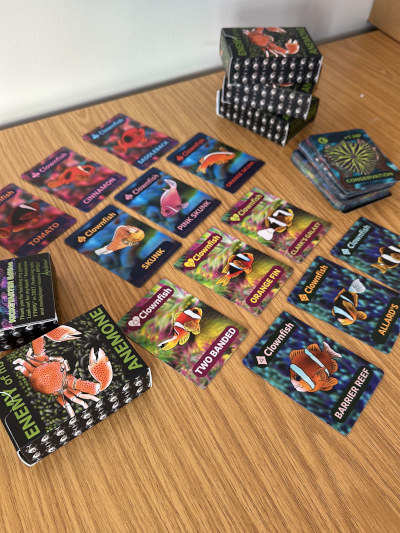
Twelve clownfish cards from the Enemy of My Anemone card game.
Enemy of My Anemone is a fast-paced tactical card game for 2-3 players, where players collect clownfish, protect their anemones and outplay their rivals to survive. Accessibility was built into the game from the start, with features including a clear sans-serif font, large text and high-contrast text boxes, alongside playtesting with people with visual and cognitive impairments. Grounded in real marine science, the game also uses its mechanics to introduce players to marine ecosystems and encourage a deeper connection with the natural world.
Enemy of My Anemone is available to purchase from the Manchester Museum gift shop and online through DriveThruCards.
Behind the game
What sparked your interest in using games to communicate environmental issues?
I’ve been an avid gamer for decades. My first games convention was Gen Con 2004, Indianapolis, USA. The late Gary Gygax, creator of Dungeons & Dragons, opened proceedings by leading an army of Storm Troopers through the trade hall. I was rather socially awkward, and role-playing games allowed me to step outside of myself. That year, I won a prize for “Most Entertaining Player” in a Cthulhu campaign. It included several books, two tickets to an after-party, and a lifetime addiction to gaming.
I’m also a scientist; that’s been my career, and an artist. Rainy days indoors see me painting and drawing. I draw what I love. That tends to be invertebrates and fish. But what do you do with four dozen paintings of fish? Honestly, my family were sick of them.
Then one day, a friend came over with a card game. My partner, who is registered blind, was able to join in. It was a revelation. In all the time we’d been together, card games had always been inaccessible to her. I searched shops and conventions for games that were equally accessible, but not much came up. So, I decided to make my own. That’s where it started. Making it about something I love was the logical resolution.
But again, I’m also a scientist, so the game had to be accurate. I’m not a marine biologist; I could only dream of being that. Life took me down a different path: I’m a geneticist and a diver, so research had to be done. I wanted the game to be as scientifically accurate as possible, without the players needing to know the science. The science built the mechanics that sit in the background. The game focuses on fun, which builds empathy; the same connection I have when diving to see all those amazing creatures. That connection is the first step needed for people to want to learn more.
Why do you think games can be an effective way to engage people with sustainability topics?
It avoids the echo-chamber trap. On social media, there are plenty of followings for environmental and sustainability topics. But for the most part, followers are there because they already care. Most people know we’re in a dire situation with regards to climate change, pollution, overfishing, and habitat loss, but, as with all things dire, it becomes an abstraction. It seems too overwhelming, too negative, or they can’t relate. It becomes preferable to ignore it.
Games don’t ask people to tackle all that head-on. They first build a sense of empathy and relatedness, while people are simply playing and having fun. Once that connectedness is built, the context is in place for people to understand why they should care.
Have you received any feedback from players that has surprised you or changed how you think about the game’s impact?
Yes, honestly, I aimed the game at adults. I did not expect children to love it. I tested it with PGR students at the University, my local allotment society, whose members are predominantly elderly, and role-playing game groups, which are pretty much all adults.
It’s complex. It requires strategy. It’s not what I would think of as a light family game. But after the success of the first Kickstarter, I got a letter from a mum of two eleven-year-olds. She said they were addicted, played it all the time, and had taken a greater interest in science at school because of the game. That was pretty stunning.
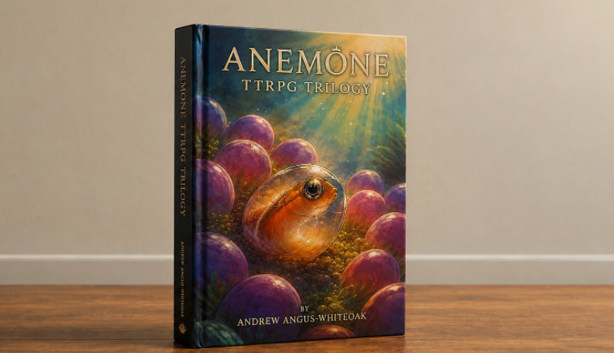
The Anemone TTRPG Trilogy, including three games and three graphic novels.
Are there any future projects you’re particularly excited about?
Absolutely, thank you! I’m currently designing a book of role-playing games using the setting from my card game. The Anemone TTRPG Trilogy combines three games, three graphic novels, and a chapter that relates the games and comics back to peer-reviewed science.
The comics introduce fish as characters with whom people can relate, while building empathy for undersea life and simultaneously explaining game mechanics. The games use real marine biology in their underlying mechanics. Players can enjoy the games without any need for a scientific understanding beforehand. The peer-reviewed literature review then allows those who may have developed an interest to expand further.
I would very much welcome people to join me via Kickstarter (clicking “Notify me on Launch”), where you will receive free fortnightly updates, each with new pages from the comics, as well as news about my progress with the book, with publishers and game distributors, and news from my team at Visibility Magazine, who are currently taking the card game on tour across UK game conventions.
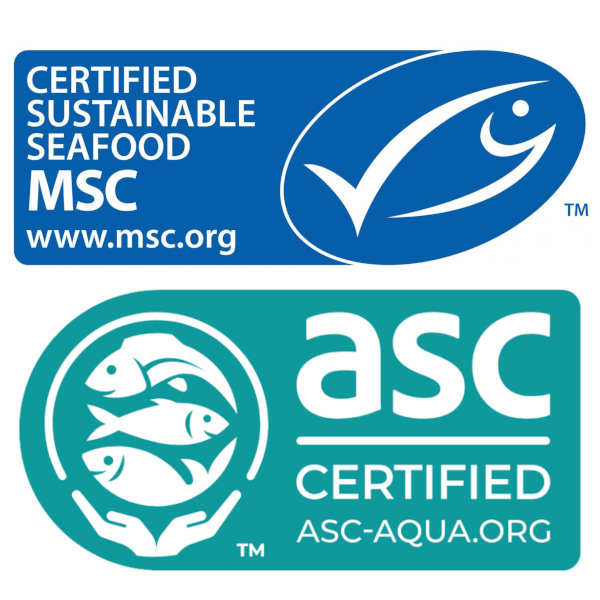
Look for the Marine Stewardship Council (MSC) label (top) and Aquaculture Stewardship Council (ASC) label (bottom) when choosing seafood.
If there was one thing you’d encourage people to do to make a positive difference for the environment, what would it be?
I’d encourage people to choose sustainably sourced seafood. Choose species that are abundant, responsibly managed, and caught or farmed in a way that allows fish populations to recover. Practically, this means choosing Marine Stewardship Council (MSC)-certified wild-caught seafood where available, or looking for Aquaculture Stewardship Council (ASC)-certified farmed seafood.
Try varying the species you eat rather than relying heavily on a few popular species. Choose lower-trophic species such as mussels, oysters, and small pelagic fish, which can have relatively low environmental impacts. Plus avoid seafood from overfished or poorly managed stocks when better alternatives are available.
Thank you for having me.
Additional information
- Buy a copy of Enemy of My Anemone
- Read about the original crowdfunding campaign
- Follow Andrew’s next project, the Anemone TTRPG Trilogy
- Find out more about the game design from an equality, diversity and inclusion (EDI) perspective: Designing for Access – Why Inclusion Should Never Be an Afterthought
To find out more about Environmental Sustainability in FBMH, read our ES Good Newsletter, visit the Faculty’s intranet page and website, or contact us by emailing srbmh@manchester.ac.uk.
0 Comments