
Building capacity for Net Zero: Lessons from Barcelona and Greater Manchester
Cities across Europe share the ambition of reaching net zero, but they do not all pursue it through the same institutional frameworks. Their approaches reflect different governance arrangements, partnerships and policy contexts. Understanding these differences helps us see that progress depends not only on targets and technologies, but also on the capacity to coordinate action, mobilise stakeholders and learn over time.
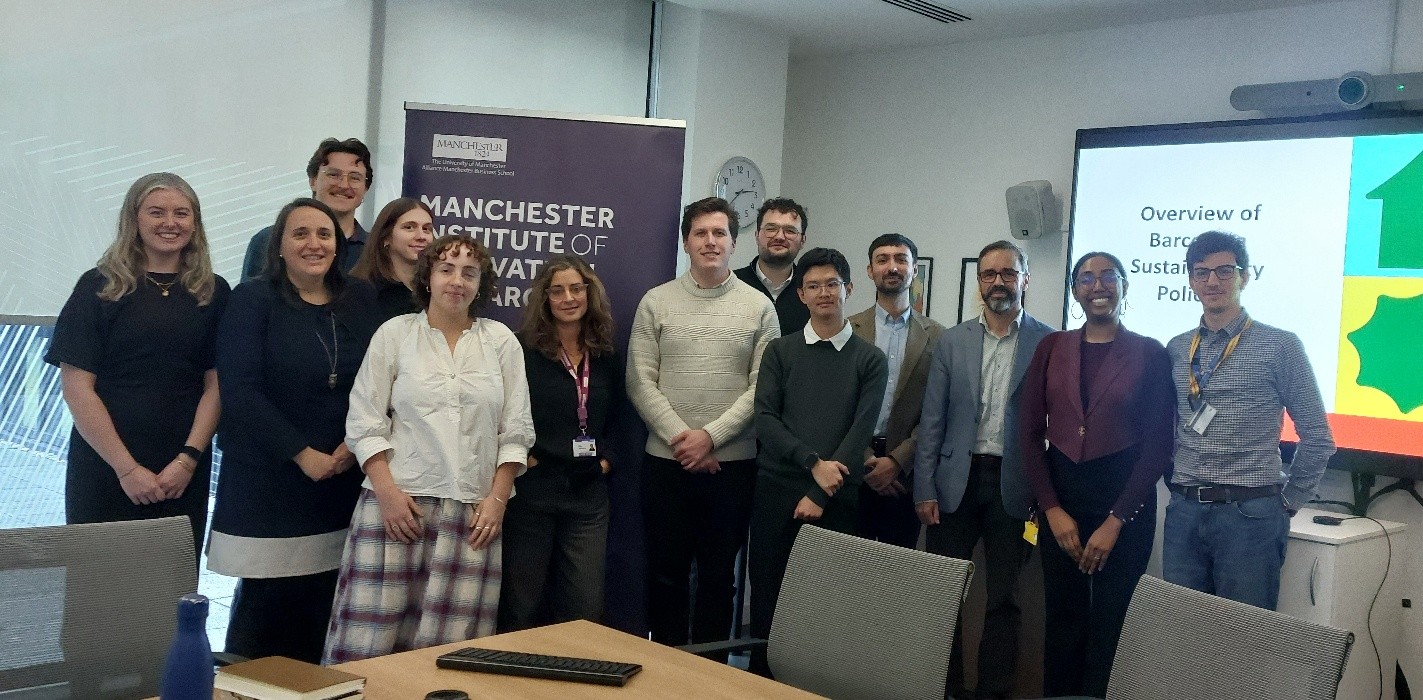
This was the central theme of a recent roundtable organised by the Manchester Institute of Innovation Research (MIOIR) and the Consulate General of Spain in Manchester, with the support of the Office for Cultural and Scientific Affairs at the Embassy of Spain in the United Kingdom. Researchers, policymakers, city leaders and sustainability practitioners discussed how cities build the capacity needed to address complex sustainability challenges. The experiences of Barcelona and Greater Manchester offered a useful comparison: Barcelona is part of the EU Cities Mission, while Greater Manchester is pursuing its net-zero ambitions outside that framework.
Regional readiness: a framework for understanding transformative capacity
During the event, the report Navigating regional readiness: Local Engagement Challenges in the EU Cities Mission, developed as part of the European CATALYSE project, was presented. The report asks whether cities are building the capacity needed to pursue ambitious climate goals and introduces the concept of regional readiness: the ability of a city or region to organise collective action around major societal challenges.
The framework identifies four interconnected dimensions:
- Programmatic readiness: the ability to establish a shared vision and coordinate stakeholders around a common mission.
- Demand articulation: the ability to translate broad societal challenges into concrete demand for technological and social innovation.
- Performance readiness: the capacity to develop, adopt, adapt and diffuse solutions.
- Reflexivity and learning: the capacity to learn from implementation and continuously improve mission delivery.
These dimensions direct attention to practical questions. Can public authorities, businesses, universities and communities agree on priorities? Can climate ambitions be translated into projects and investment? Can successful initiatives move beyond pilots? Are institutions learning from what works and adapting their approach?
Barcelona and Greater Manchester: different pathways to net zero
Net zero requires action across transport, housing, energy, jobs, health and economic development, as well as collaboration between local government, businesses, universities, communities and citizens. This makes institutional and regional capacity central to sustainability transitions. Cities need to establish shared priorities, coordinate organisations with different responsibilities, translate long-term ambitions into practical initiatives, and learn from implementation. These capacities shape whether individual projects add up to wider and lasting change.
Barcelona and Greater Manchester illustrate how cities can build capacity for net zero through different institutional pathways. As part of the EU Cities Mission, Barcelona pursues a broad sustainability agenda spanning mobility, energy transition, building retrofits, climate adaptation, waste reduction and climate justice. Its approach combines long-term ambition with public engagement and cross-sector collaboration.
One example discussed at the roundtable was the Barcelona + Sustainable Network, which connects around 2,000 organisations working towards sustainability goals, creating opportunities for collaboration, knowledge sharing and collective action. The lesson is that city governments cannot achieve sustainability transitions alone. They depend on building coalitions capable of sustaining action over many years.
Greater Manchester has increasingly adopted a mission-based approach to climate action. Since setting its carbon-neutrality ambition, the city-region has sought to integrate sustainability into wider priorities relating to housing, transport, jobs, health, inequality and economic development. Rather than treating climate policy as a separate agenda, Greater Manchester seeks to embed it across areas of policy and delivery, reflecting its own institutional context and the distribution of responsibilities across multiple organisations.
Continuing the dialogue
The roundtable opened a valuable conversation between Barcelona and Greater Manchester about their different pathways to net zero. Although they operate in different institutional contexts, both Barcelona and Greater Manchester show that ambitious targets and technological solutions alone are not enough. Progress depends on the capacity to coordinate organisations, align priorities, mobilise local knowledge and sustain action over time. The value of the comparison lies not in identifying a model to replicate, but in understanding how different governance arrangements and institutional settings shape pathways to net zero.
There is scope to deepen this exchange by involving a wider range of local actors, sharing practical experiences of governance and implementation, and identifying where the two places can learn from one another. Continued dialogue can help translate comparison into collaboration and strengthen the collective capacity needed to move from climate ambition to action.
Contact Us
+44 (0) 161 275 0924


0 Comments