
Professor Nalin Thakkar: Making the leap: The University to Partner With
Every so often, we pause long enough to look up from the day-to-day and ask ourselves a deceptively simple question: What are we about?
Over the past year, as we shaped From Manchester, for the world, that question surfaced again and again. Not in abstract terms, but in very practical ones: How do we want to show up in the world? What do we want to be known for? What kind of university do we aspire and need to be?
For me, one of the clearest answers to this is: we do our best work when we work with others.
This is hardly a new idea. The University was founded as a civic institution, created not to stand apart from its surroundings, but to serve them. Yet, as we look ahead to 2035 and beyond, partnership becomes something deeper than a heritage we celebrate. It becomes a defining leadership choice.
Why partnerships matter more than ever
The world we are moving into is not one where a single organisation, discipline or sector can hold all the answers. Climate change, health inequalities, social fragmentation, AI-driven disruption don’t respect boundaries. They spill across them.
Partnerships matter because they accelerate solutions, combine strengths, and connect ideas with a world that needs them. When we join forces with others, we multiply our ability to create positive change. The most powerful innovations of the next decade in digital health, sustainable energy, advanced materials or education access will emerge from collaboration.
Increasingly, leadership is not about having all the answers but about convening the right people around the right questions. And universities, at their best, can be extraordinary conveners.
The great universities of tomorrow will be those that can bring people together: scholars and citizens, industries and innovators, governments and communities, cities and global networks.
But only if we choose to be.
Partnerships ask something of us: curiosity, openness, humility, patience. They ask us to work differently: often slower at first, often with more uncertainty, but ultimately with far greater impact. They require us to listen before we speak, and to understand that expertise comes in many forms, not only those measured through academic metrics.
As I reflect on the strategy, it is this shift from being excellent on our own to being excellent with others that feels most significant.
What makes Manchester a partner worth choosing
Of course, this isn’t the beginning. Fantastic partner-driven initiatives already make us who we are.
When organisations choose to work with us, it is rarely because we have the biggest building or the most polished presentation. It is because something about Manchester resonates.
They see a university that carries its civic story with pride, one rooted in working-class education, in major scientific breakthroughs, in cultural and political movements that have shaped the modern world. They see a university that is global but grounded, ambitious but purposeful, confident but not closed. They see, I hope, a set of values that are not ornamental, but lived: knowledge, wisdom, humanity. They see excellence combined with purpose.
Looking forward to the next 10 years and beyond, if we wish to be a partner of choice, we must do even better – excel in our performance and show even greater purpose, resonate with our partners and address the needs of a fast-changing world.
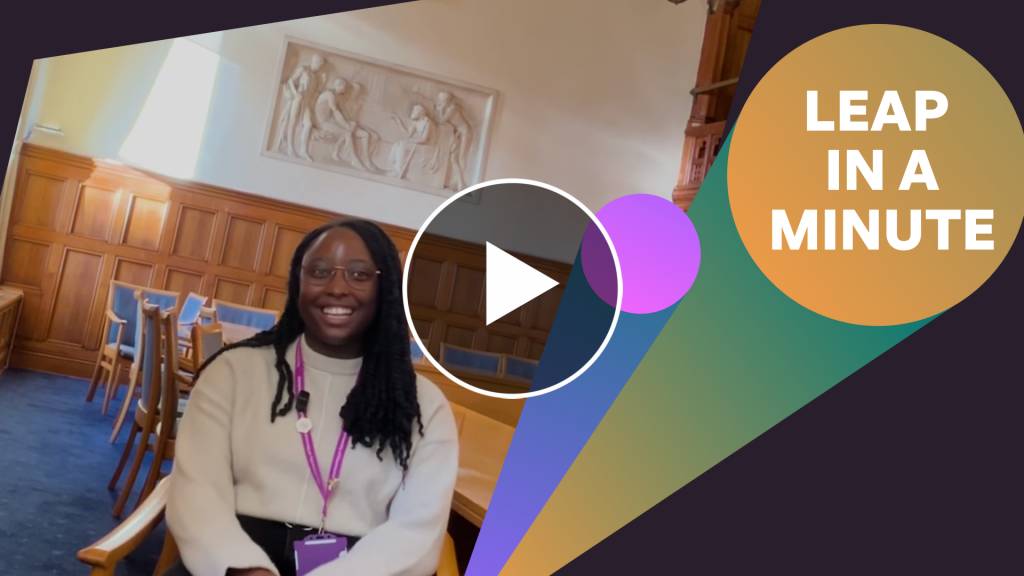
From Manchester for the world, our new University strategy to 2035 has five leaps – bold choices where we’ll go further and faster to become the university the future demands. We challenged our students to explain each in just one minute. Can they beat the clock?
Partnering with donors in a shared mission
Philanthropy is another form of partnership that deserves deeper reflection.
Philanthropy isn’t separate from our academic mission; it isn’t an external resource that supports it from the outside. But our donors are among our most committed partners. They share our belief that knowledge should change lives. They invest not only their resources but their trust, their ambition and often their personal stories in the work we do.
What strikes me most, whenever I meet our donors, is how aligned their motivations are with our values. They are not supporting Manchester because we are large, or old, or prestigious. They support us because they see in our University something of their own hopes for the world.
They see education as a force for social mobility. They see research as a driver of fairness, progress and human wellbeing. They see our civic mission not as rhetoric but as responsibility.
For example, sustained philanthropic support for the Global Development Institute has allowed us and donors to together address some of the biggest challenges facing the world such as global inequality. This has helped shape research that changes policy, transforms communities, and quite literally improves lives across the world.
Partnership with donors is a deeply human form of collaboration. It is built on shared purpose, on mutual respect, and on the belief that impact requires collective effort.
Our recently launched Challenge Accepted fundraising and volunteering campaign is, at its heart, a testament to this, a statement that philanthropy is not an add-on, but a core part of how we will achieve the ambitions of Manchester 2035.
In the years ahead, we will need to deepen these relationships, to listen to our donors as thought partners, to align more clearly around shared priorities, and to recognise that philanthropy is not only about raising funds but about raising our sights.
When donors choose to partner with Manchester, they are choosing the kind of future they want to be part of.
Partnership at the heart of our strategic ambitions
As we developed the strategy, it became clear that partnership isn’t just one aspiration, it’s the thread connecting them all.
Our research has the greatest impact when shaped with those who will use it. Our students learn most deeply when connected to real-world contexts. Our global ambitions grow fastest when anchored in local purpose. Our people flourish when they feel empowered to collaborate across boundaries. Our civic mission is strongest when pursued together with our city and region.
So, partnership is not just the fifth Leap of Manchester 2035. It is the way each of the Leaps become real.
Looking ahead: a leadership choice for all of us
Reflecting on the decade ahead, I do not see partnership as an institutional tactic. I see it as a leadership stance for all of us. A stance that says: we lead better when we lead with others, we learn more when we listen, we grow stronger when we share what we know, we create impact when we create it collaboratively.
Manchester has never been short on talent, creativity or ambition. But what will define us in 2035 is our ability to bring others into that story, to make space, to build bridges, to take risks together.
And that, to me, is the essence of what a truly civic, truly global, truly future-facing university can be.
One question to discuss:
What might each of us do in our roles, our teams, our daily interactions to make this University not only excellent, but collaborative, welcoming, and unmistakably a partner worth choosing?


Reading your piece, I found myself reflecting on what “partnership and philanthropy as expressions of our values rather than just sources of resource” looks like in practice when we follow the money all the way through. On the one hand, we have taken some important steps: for example, our responsible investment work and our commitments around net zero, and decisions to divest from some companies after campaigns raised concerns about their role in human rights abuses.
On the other hand, FOI-based analyses have highlighted that, until recently, the University held significant sums in fossil fuel extraction and related companies, and that we still have several million pounds invested in firms campaigners argue are implicated in serious human rights violations. Investigations also suggest that in recent years we have received substantial new funding from fossil fuel companies, and that our graphene and advanced materials work has involved collaborations with defence contractors and, in the past, organisations linked to foreign militaries. At the same time, our global network is anchored in places whose human-rights records often sit uneasily alongside our commitments to equality, inclusion and academic freedom.
Alongside this, there is the question of philanthropic transparency. Sector-wide reporting has shown that UK universities, including Russell Group institutions, have accepted large sums from “anonymous” donors. Even where the University knows the identity of the donor, the fact that the wider community does not can sit uncomfortably with our claims to openness and accountability. From a staff perspective, it would be reassuring to know that full transparency is the default for significant gifts, especially from governments and high-impact industries, with only narrow, clearly justified exceptions.
I say this not because I think Manchester is uniquely compromised – I don’t. I think, overall, we remain a force for good. But if we want to be “a partner worth choosing” in the fullest sense, I wonder whether we need to be more explicit and transparent about where we draw the line. For example:
How do we decide when a partnership or donation is too closely tied to activities that worsen the climate crisis or undermine human rights, even if the immediate project looks beneficial?
What red lines do we apply to dual-use and defence collaborations, beyond simple legal compliance?
What principles govern our acceptance of anonymous or semi-anonymous donations, and how can staff and students have confidence that these are being applied consistently?
How can staff and students see, and contribute to, the due-diligence process on major corporate and international partnerships, so that “knowledge, wisdom and humanity” are visibly more than branding?
I would really welcome a wider conversation about these questions, because they go to the heart of what you describe: not just being excellent at partnering, but being recognisably Manchester in the partners we choose and the futures we help to build.
Thank you for this thoughtful reflection on partnership and on Manchester as a “partner worth choosing”. I really welcome the emphasis on shared purpose and on values such as knowledge, wisdom and humanity as being “lived”, not ornamental.
Reading this, I found myself wondering how we safeguard that values-led approach in practice, especially when potential partners bring very large resources to the table. From a staff perspective, it can sometimes feel as though the pressure to secure funding or profile risks pulling us towards collaborations where the value alignment is thinner – for example with organisations or regimes whose track records on human rights, environmental responsibility or equality sit uneasily alongside our public commitments.
I would be interested to know more about how we assess and govern these choices: what criteria we use to decide which partners we won’t work with; how we mitigate risks of greenwashing, “dual use” of our research and expertise, or our name being used to legitimise harmful practices; and how staff and students can feed into those judgements. If partnership is to be the thread running through Manchester 2035, it feels important that we are at least as ambitious about who we partner with and why as we are about the scale of the opportunities.