
March Towards Zero Waste: Global Recycling Day and International Day of Zero Waste 2026
Waste is inevitable, and it arises from all parts of life – leftover food, broken electronics, packaging and containers, out-grown clothes, and the list goes on.
As we enter the second half of March, two important days highlight the severity of this global issue: Global Recycling Day on 18 March and International Day of Zero Waste on 30 March.
Aligned with our March theme of ‘Think Big, Innovative Green’, these days also give us a chance to explore bold and creative solutions, from promoting accurate recycling practices to eliminating waste at the source.
Global Recycling Day
Global Recycling Day was established in 2018 by the Global Recycling Foundation, which supports the recycling industry and promotes the vital role of recycling in creating a more circular, sustainable future.
In their original manifesto, the foundation designated recyclables as the Seventh Resource, alongside six of the Earth’s most important natural resources – water, air, oil, natural gas, coal and minerals.
The following statistics highlight the power of recycling. These can be found in the Seventh Resource manifesto and have originated from various studies by the Bureau of International Recycling.
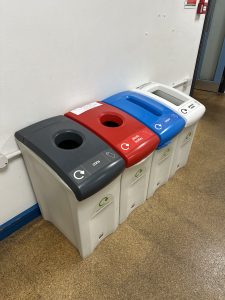
Recycling station in Simon Building, allowing staff and students to recycle cans, plastic bottles and paper easily.
- Recycling cuts carbon dioxide emissions by 700 million tonnes a year.
- Approximately 1.6 million people worldwide are employed in processing recyclables.
- 40% of the world’s raw material needs are met by recycled materials.
By recycling more often, recycling properly, and staying up to date with local recycling guidelines, we can all play a part in harnessing the power of the Seventh Resource and creating a cleaner, more sustainable environment.
International Day of Zero Waste
In 2022, the United Nations (UN) proclaimed 30 March as the International Day of Zero Waste. This is now facilitated by the United Nations Environment Programme (UNEP) and the United Nations Human Settlements Programme (UN-Habitat).
Beyond raising awareness of zero-waste initiatives across the world, this annual observance is part of the UN’s resolution to address the serious consequences of waste, such as plastic pollution. By working towards zero waste, we are also advancing the Sustainable Development Goals 11 (Sustainable Cities and Communities) and 12 (Responsible Consumption and Production).
This year’s theme is food waste, which is not only an environmental issue but also a humanitarian one. Below are some facts that highlight why tackling food waste is so important.
- Every year, we waste approximately 1 billion tonnes of food (one-fifth of all food available to consumers).
- Saving even a portion of the wasted food could feed 1.26 billion people each year.
- 60% of food waste happens at the household level – sources include leftovers, kitchen waste and expired foods.
- Food waste contributes to around 10% all greenhouse gas emissions and 14% of global methane emissions.
Transitioning to a more circular system for food waste could be key to tackling the issue. This could involve redistributing surplus food via food banks and turning inedible scraps into compost or renewable energy, which then supports new food production. Achieving this would require action from all levels – from individuals to businesses and governments.
How to get involved
Easy Eco For All booklet
Most of us are probably familiar with recycling paper, plastics, cans and glass bottles. However, what do you do with your batteries, broken electronics, Tetra Pak cartons, and other less common waste that don’t go into the household wheelie bins?
This downloadable Easy Eco For All guide (p. 3–6) will likely have the answers you’re looking for, including locations of recycling stations across campus and a list of supermarkets that are happy recycle things for you.
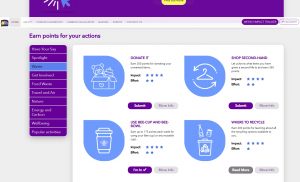
Waste-related activities on the NoTimeToWaste platform.
NoTimeToWaste
The NoTimeToWaste platform allows users to complete sustainability- and wellbeing- related activities in exchange for green points. Users with the most points at the end of each month will be awarded with vouchers.
Some activities relevant to this month include donating used items, buying second-hand, using leftovers, and reusing containers. Register now and check out the full list of actions available.
Furniture4Reuse
Whether you are moving into new accommodation or moving out of an office, consider the Furniture4Reuse store in the Simon Building as your first stop for obtaining new furniture or disposing of unwanted items. By reusing furniture across campus or donating them to charities and external organisations, Furniture4Reuse has saved approximately 140.1 tonnes of furniture in 2022.
Bee Cup and Bee Bowl
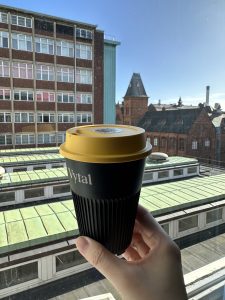
Bee Cup
Most takeaway cups and bowls for hot drinks and food are not recyclable due to their plastic lining. To reduce waste, as well as their associated costs and carbon emissions, the University has launched the Bee Cup and Bee Bowl – reusable alternatives that are free for staff and students to borrow at most University outlets. Start using them by downloading the Vytal app.
To find out more about Environmental Sustainability in FBMH, visit the Faculty’s intranet page, website or contact srbmh@manchester.ac.uk.
0 Comments