
PPIE Award Winner 2025: JointCare – Identifying research questions with children with juvenile idiopathic arthritis and their parents
In this blog series, we will be featuring our award winners and highly commended recipients from the Faculty’s ‘Outstanding Contribution to PPIE’ awards. The awards showcase inspirational and outstanding commitment to PPIE that has made a positive difference to our community and highlights the amazing events, activities, people and groups from across the Faculty.
Our latest blog in this series features JointCare, a project set out to identify the self-management tasks that are deemed most important among children with juvenile idiopathic arthritis (JIA) and other stakeholders. This initiative was a winner in the Inclusive PPIE category at the 2025 PPIE Awards.
Juvenile idiopathic arthritis (JIA) affects approximately 1 in 1,000 children under the age of 16 in the UK. However, many people don’t realise that children can also develop inflammatory arthritis, making research into this condition greatly important.
Managing JIA involves a range of self-management tasks that children and their parents or carers must perform routinely. This may include monitoring symptoms, understanding medication, and dealing with side effects.
Led by Daniela Ghio, lecturer in Psychology at the University, and Emily Earle, public contributor, JointCare aimed to identify priorities for psychoeducational interventions by determining which self-management tasks are the most important to JIA stakeholders. These include children, young people and adults who grew up with JIA, parents and caregivers, and healthcare professionals.
The project was delivered in three stages:
- Online art workshops: In partnership with art-therapy charity Teapot Trust, the JointCare team delivered three online workshops to encourage discussions around self-management. These were children-led but facilitated by art therapists.
- Online discussion groups: These were hosted to gather perspectives and experiences from parents and caregivers.
- Online campaign and voting: JIA stakeholders and patients voted on which self-management areas should be prioritised in research. Clear winners were:
- Dealing with medication: understanding how and when to take them.
- Coping with side effects of treatment.
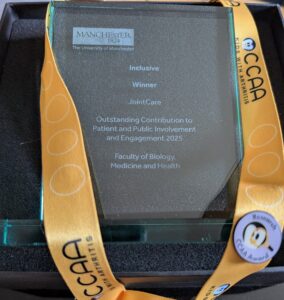
JointCare’s Outstanding Contribution to PPIE Award and CCAA Research Award Badge.
To ensure accessibility and inclusivity, the team:
- Promoted the online workshops and discussion groups widely through The Children’s Chronic Arthritis Association’s (CCAA) networks.
- Provided age and disability appropriate art supplies, such as special clay.
- Included adults who grew up with JIA, enabling them to share valuable childhood experiences.
Recognising the success and potential of this initiative, the NIHR awarded JointCare a £200,000 grant through its Research for Patient Benefit (RfPB) Programme. The funding supported the co-production of psychoeducational resources about methotrexate, a medication used to treat JIA.
These resources aim to enhance children’s understanding of JIA, supporting co-management between child and caregiver as they gradually take a more active role in their own care.
Additional information:
- Research project on methotrexate: The Managing Treatment eXperience (MTX) study
To find out more about PPIE: watch our short film, sign up to the monthly Public Engagement Digest, visit the PPIE blog, or contact srbmh@manchester.ac.uk.
To read more about other PPIE Award winners visit here.
0 Comments