
The third female graduate of Manchester Medical School
Ahead of International Women’s Day we are celebrating the first three medical women graduates from Manchester Medical School. So far, we have met the two Catherines; Dr Chisholm and Dr Corbett.
The final women in our series is Dr Phillips, known as Margaret. After qualifying, Dr Phillips spent the majority of her life working in China, involved not only in medical work but also social work and joining feminist and political groups.
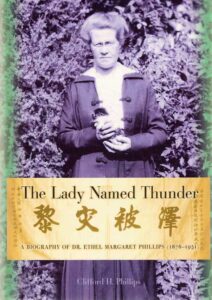
Dr Phillips Biography Cover
Ethel Margaret Phillips BSc MB ChB MSc (1876-1951)
Margaret was the third woman to enter Manchester Medical School. Her early life was fractured, brought up by various relatives and prone to ill health from suspected TB and fibroids. She developed a resilient and tenacious character based on non-conformist Christianity and tales of mission work. She initially trained as a teacher but an interest in ‘science’ encouraged her to enrol for BSc Chemistry at the Victoria University of Manchester in October 1898; she then transferred to the Medical School in 1899. She was intelligent and had few problems with the medical course, winning a number of scholarships and medals, and graduating in 1905. She had decided on a life as a medical missionary in China and received training from the Society for the Propagation of the Gospel (SPG).
Her arrival in Peking on 23rd October 1905 was the start of a career lasting 43 years which was complex and a lifetime of service to the Chinese people. Her mission was to improve the health and life of women and children – especially to fight tuberculosis, smallpox and malnutrition. After establishing the first hospital for the SPG, she was given her Chinese name, Lady of Thunder, because of her resolute character. In 1915 she was awarded a silk banner inscribed, Loving Kindness Shielded the Stricken for her work in 1913 looking after a camp of thousands of famine victims. She learnt Mandarin and translated medical books and taught students, women doctors and nurses. From 1914 Margaret broke from the SPG (she ‘never wanted to join a mission again’) and set up as a private practitioner. She was a popular doctor not only with Chinese women but also the many ex-pats and other nationals living in Peking.
In 1920 Margaret adopted a two-year old English boy, Clifford. She brought him up in China until he was sixteen when he returned to England to complete his education. When WW2 broke out, he joined the RAF and didn’t meetup with Margaret until 1946. She was detained by the Japanese in an internment camp for 1800 civilians. Margaret not only provided medical care but also did her share of daily duties of cooking, chopping wood, sanitary work etc. The mortality was high; Margaret developed beriberi and a bent spine. After liberation she was reunited with Clifford and his family who were now stationed in China. However, after the communist revolution they were repatriated to England in 1948; she stayed with her brother in Bridgwater, but her health never fully recovered from her internment ─ she gradually deteriorated and died from heart failure 17th May 1951.
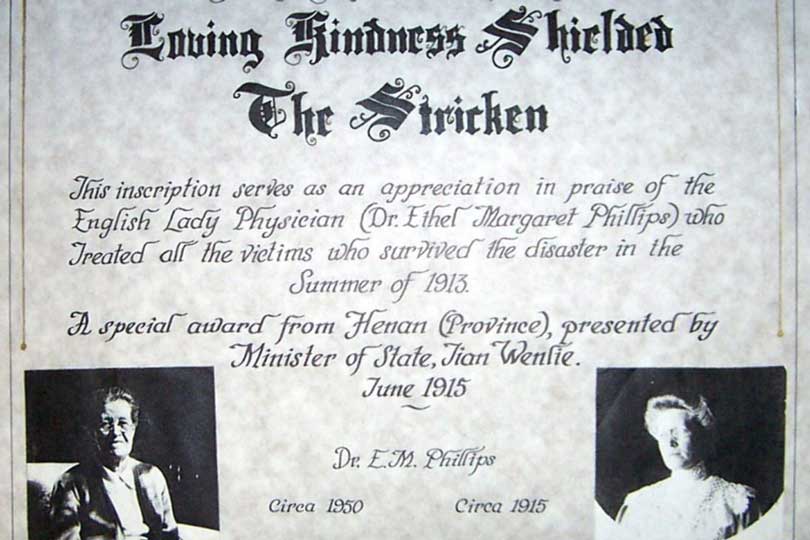
Award to Dr Phillips from the Henan Province.
Research was conducted by Dr Peter Mohr – volunteer at Museum of Medicine and Health, Faculty of Biology, Medicine and Health.
0 Comments