
The second female graduate of Manchester Medical School
A few days ago, we published an article in preparation of International Women’s Day, about Dr Chisolm, first female graduate from Manchester Medical School.
This article focuses on Dr Corbett, our second ever graduate from Manchester Medical School, an astonishing woman who faced war head on and provided medical services for wounded soldiers in WW1. Dr Corbett enrolled at the same time as Dr Catherine Chisolm, and graduated in 1905.
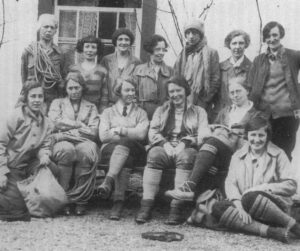
Pinnacle Climbing Club – Dr Corbett (Second from right on front row)
Catherine Louisa Corbett MB ChB DPH (1877-1960)
Catherine Corbett’s parents were strong supporters of women’s education. Her father, Christopher Corbett, was a surveyor and her mother, Sarah, was a mathematics teacher at the Manchester High School for Girls (MHSG). The MHSG had sent a few girls to the London School of Medicine for Women; however Miss Corbett was the first pupil from the MHSG to go to the co-educational Manchester Medical School in 1898. The two ‘Catherines’ (Chisolm and Corbett) seem a lonesome pair among the male medics in their final year photograph. One male student who ‘feared the effeminisation [feminisation] of Owens College’ moved Miss Corbett to write, that ‘women had the same qualities as men and education strengthened women physically, mentally and morally, and educated women were good for society’.
After she qualified in 1905, Dr Corbett worked as a medical officer at the Clapham Maternity Hospital and the Chelsea Women’s Hospital. She took the Cambridge Diploma in Public Health in 1907 and was appointed as a School Medical Inspector (SMI) in Yorkshire. In 1914, she moved back Manchester for a SMI post and to act as honorary secretary at the new Manchester Babies’ Hospital. However, these plans were disrupted by the outbreak of War when she joined the Scottish Women’s Hospitals (SWH); a team of women doctors, nurses and support staff, who sailed with Dr Elsie Inglis to Serbia in 1915.
Her experiences of this trip are recorded in her Diary in Serbia (1916). Catherine was not only medical officer and assistant surgeon, but she was also in charge of transporting the hospital equipment, luggage etc. The work was extremely difficult and dangerous. They were forced to retreat south from Belgrade and were eventually overrun by German and Austrian troops. Although declared as prisoners of war (POW) they were able to continue their work looking after injured Serbian soldiers and civilians, as well as trying to help hundreds of soldiers held in an open-air POW camp outside the hospital. The conditions were appalling; cold, snow, poor sanitation, lack of food, lice and infectious diseases were the norm. Many of the staff became ill and were repatriated, finally the hospital was closed and Dr Inglis, Dr Corbett and remaining SWH staff were ordered out of Serbia and eventually reach England in February 1916.
Once recovered, Dr Corbett join Dr Inglis and a SWH team of eighty based in Russia from October 1916. The work was near the Romanian front, air-raids during the winter forced them to pack-up and relocate several times. The chaos, constant stress, and freezing weather finally broke Dr Corbett and Dr Inglis sent her to a quieter hospital in Odessa. Dr Inglis was also seriously ill and following the Russian revolution it was decided to close the SWH and the group arrived back in Newcastle on 25th November 1917 – sadly Dr Inglis died the following day. Dr Corbett was shattered; for a year she worked as a ‘civilian surgeon’ at the 2000-bed Middlesex War Hospital for soldiers suffering from ‘war strain’. She was decorated by the King of the Serbs for her ‘services to the sick & wounded’ in 1921.
By 1920, she had recovered and resumed her post as SMI for Burnley, a working life of a quiet and efficient routine. She was a keen Medical Women’s Federation member and would often go to the meetings with Dr Chisholm. She was a good rock climber and a founder-member of the Pinnacle Club (1921), a climbing club for women. She died in 1960 and the Club scattered her ashes on Snowdon ‘in memory of Katie’.
PD Mohr, ‘Dr Catherine Louisa Corbett MB ChB DPH, Diary in Serbia’. J. Medical Biography 26 (2018), 242-251.)
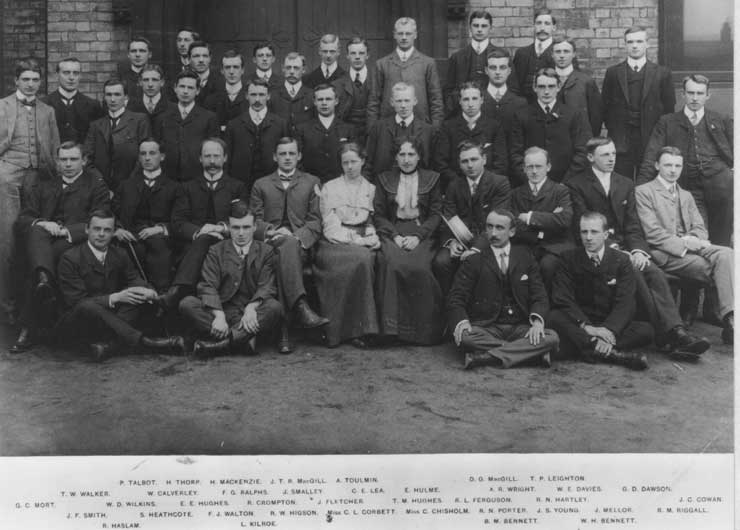
Final Year Medical Students: Dr Corbett (Left) and Dr Chisholm (Right)
0 Comments