

Sami Karamalla Gaiballa: Can AI Help Analyse Student Diversity Open Data?
Disclaimer: work and ideas in the article are author’s own however AI was used to edit the article.
Introduction
Accessing and understanding data in higher education (HE) can sometimes be a challenge: knowing whom to ask, where it’s stored, or who is responsible. Thankfully, the HE sector benefits from several open data sources that anyone can use. With September as Student Data Month on our diversity calendar, let’s explore how AI might help a non-expert gain insights into student diversity trends using these open resources.
Open Student Data
Open data, information freely available to all, has the power to shed light on the experiences of students from diverse backgrounds. For example:
- The Higher Education Statistics Agency (HESA)’s “Who’s Studying in HE?” covers student characteristics like ethnicity, gender, and socioeconomic status.
- The Access and Participation Data Dashboard tracks student recruitment, progression, and attainment.
- HESA’s Graduate Outcomes data explores what graduates from various backgrounds do next.
However, making sense of all this information can be overwhelming. That’s why I decided to test an AI engine—Microsoft Copilot 365 with GPT-5—to see if it could help extract useful insights from some of these datasets. Let’s start with a short definition of AI.
What is AI?
The University of Manchester AI Guidelines describe AI as technology that allows machines to perform tasks typically requiring human intelligence, such as recognising speech or solving problems. Generative AI, like ChatGPT or Microsoft Copilot, can generate new content by training on large datasets. Yet, humans must oversee AI’s work due to potential biases in underlying data and the risk of “hallucinations”—when AI fabricates information.
Using AI with Student Data
For this example, I downloaded HESA’s open data table (*) on student enrolments by provider and disability marker. I uploaded it to Copilot and prompted:
I am a university employee interested challenges that disabled students might face in at university, but I do not have any data analytics background or experience. I would like to know:
-Number of disabled students in the Higher Education sector
-Proportion of disabled students in the Higher Education
Could you provide me with that information based on this data, please?
Copilot returned values and explained its calculations. I double-checked the answer to make sure that it is correct – something you should always do when working with AI:
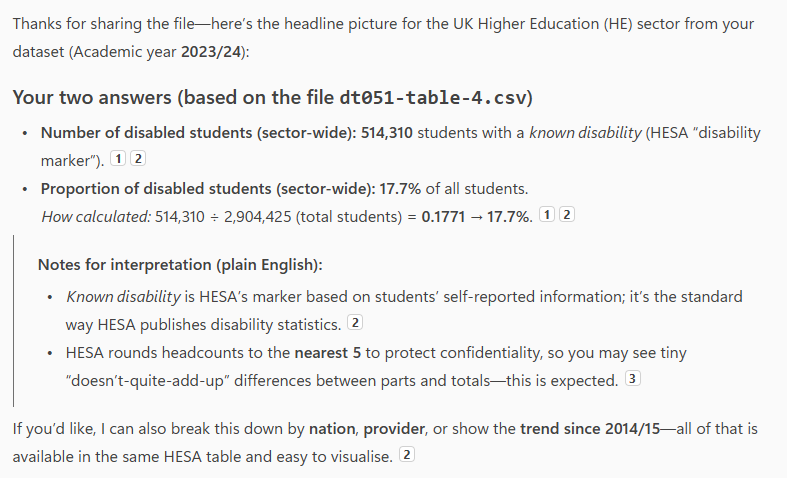
However, Copilot’s claim that all data could be visualised by national breakdown was not strictly correct for this dataset beacuse that field was not there and it would require downloading additional data. This highlights the importance of human oversight.
Next, I asked Copilot: Could you create a bar chart with Top 10 institutions with the highest proportion of disabled students, please? AI provided, a chart and methodology used. In addition, Copilot noted that small institutions could skew percentages, offering to filter by size of insitutions if we would like to:
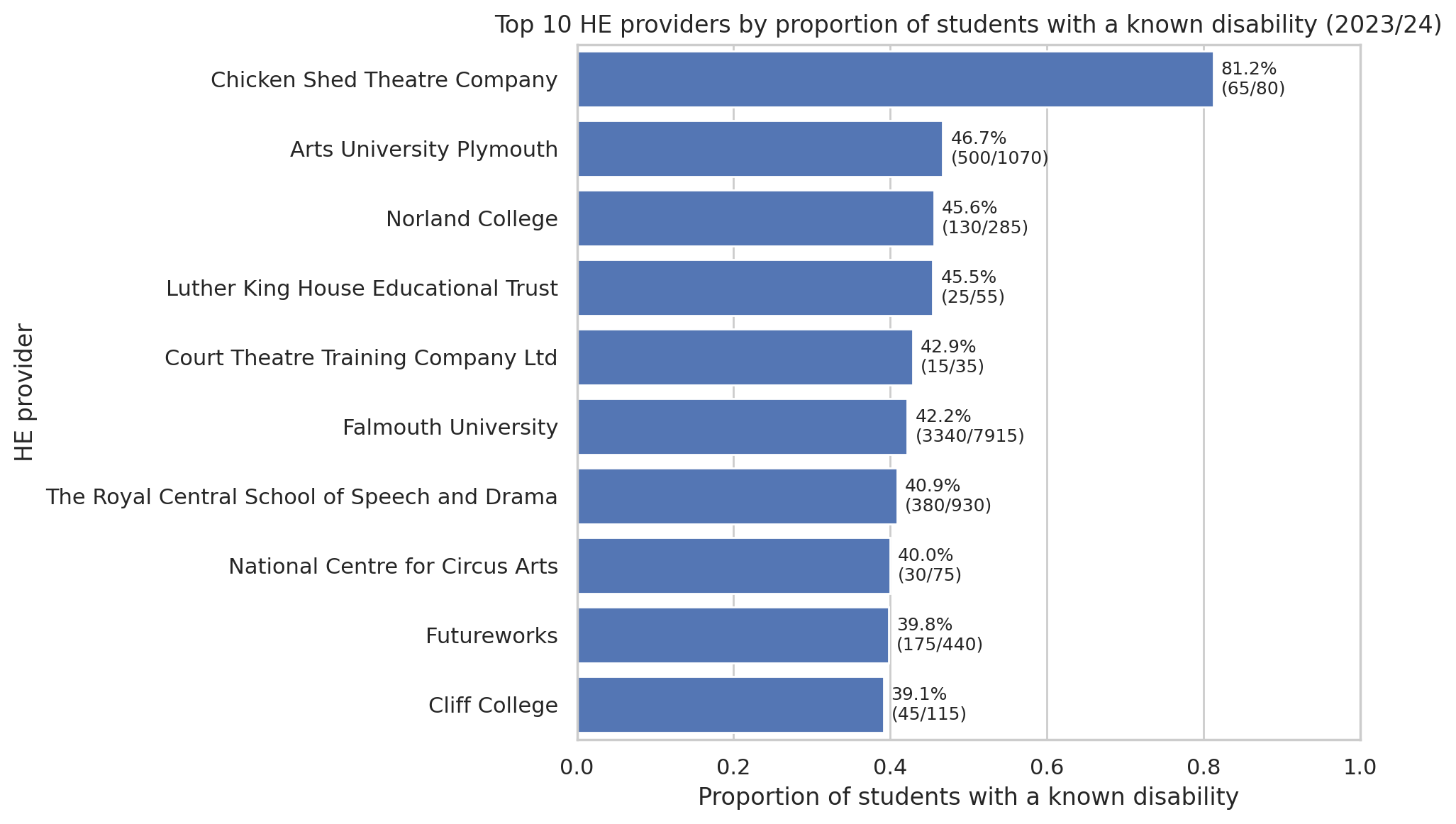
However, AI also suggested filtering by public universities which is a field this dataset did not contain. This again emphasises the need for knowledgeable human guidance.
You can keep the “conversation” by further prompting AI. At some point, we could move on from data and start asking questions such as what are the best practices in recruiting disabled students. Remember to always request references so that you can verify the information yourself.
Conclusion
AI can be a valuable partner in interpreting open student data, but it still requires human oversight and critical thinking to ensure accurate, meaningful analysis. Rembember to always perform a check on the AI output and, if you are a a student or staff at the University of Manchester, to use AI according with the University’s guidance.
Sami Karamalla Gaiballa – EDI Partner and Lead Data Analyst in the Directorate of Equality, Diversity and Inclusion at the University of Manchester
References:
*HESA, Table 4 – HE student enrolments by HE provider and disability marker Academic years 2014/15 to 2023/24 , https://www.hesa.ac.uk/data-and-analysis/students/table-4


Contact Us
+44 (0) 161 306 6000


0 Comments