

Eon Kim: Decolonising in practice: lessons from a diversifying reading list pilot
Decolonising the curriculum has been widely discussed across HE, but what it means in day-to-day teaching is less clear. The idea, examining how colonialism, domination, imperialism, and racism have shaped academic knowledge and excluded non-Western voices in higher education, is well-established in theory (Mignolo, 2017; Stockdale and Sweeney, 2022). Yet I’ve wondered how well our everyday teaching materials reflect these ideas in practice, and how we might translate theory into everyday pedagogical work.
This small pilot review looked at reading lists across five criminology modules, covering 571 readings and 979 authors. While the findings were not surprising, they made visible what many of us already suspected. Around 74% of authors were White, 69% were male, and nearly 70% of the research came from Europe. Work from Africa and Asia was almost absent. For a discipline that studies inequality and justice, this imbalance is hard to ignore.
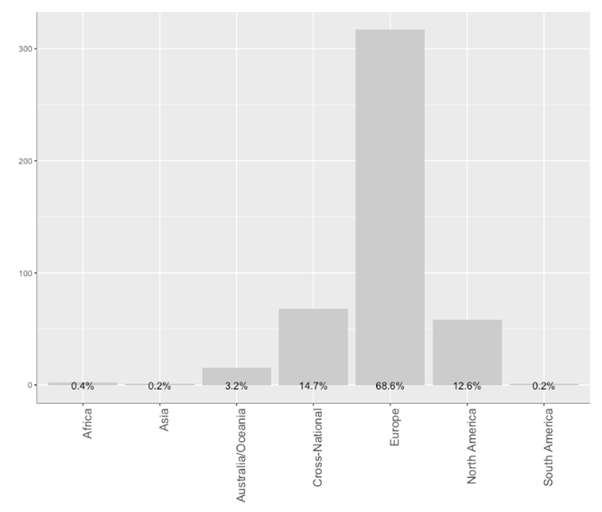
As Ferguson and her colleagues (2019) notes, “decolonising learning prompts us to consider everything we study from new perspectives. It draws attention to how often the world view presented to learners is male, white, and European.” These disparities matter because White and Eurocentric perspectives shape what students see as valid knowledge. This limits not only the range of ideas and research methods we expose them to but also the kinds of assumptions they carry into professional practice (Elhinnawy, 2021). For students from communities most affected by the criminal justice system, those absences especially matter (Davanna et al., 2025).
The pilot also showed how hard it is to change things in practice. Colleagues often struggled to find relevant, high-quality work from non-Western contexts, especially in specialist areas. Library databases tend to prioritise Western journals, and time pressure during module preparation often leads staff back to familiar sources. To address this, we tried a small collaborative approach, crowdsourcing readings from faculty, students, and an external network to build a shared list with library support. The list was organised by topic and theme so that colleagues could more easily integrate the crowdsourced readings into their syllabi. It worked in principle, but engagement remained limited, and the manual collection process was slow.
These limitations point to what needs to happen next. Individual efforts, while valuable, are difficult to sustain without broader institutional systems. This could mean library tools that highlight and recommend readings from under-represented regions and groups, programmes that help staff recognise and use such work, and institutional incentives that value inclusive curriculum design. Our pilot was a starting point, showing both what is missing and what kind of infrastructure could help fix it. This work reminded me that decolonising is a continuing practice shaped by institutional systems and by ongoing reflection on whose knowledge we teach and whose we leave out.
By Eon Kim Lecturer in Crimonology (digital Tech), Faculty of Humanities, UoM
Thanks to Michelle Corallo for her help with the reading list review.
These toolkits offer small, practical steps, a good starting point for anyone interested in doing similar work: University of London, SOAS [LINK], University of Salford [LINK], and Manchester Metropolitan University [LINK]
Davanna, T., Miller, E., Ojimba-Baldwin, P., & Shepherd, B. (2025). Decolonising Criminology: A Toolkit for Inclusion. Springer Nature.
Elhinnawy, H. (2023). Decolonising the curriculum: students’ perspectives in criminology. Race Ethnicity and Education, 26(5), 663-679.
Ferguson, R., Coughlan, T., Egelandsdal, K., Gaved, M., Herodotou, C., Hillaire, G., Jones, D., Jowers, I.,Kukulska-Hulme, A., McAndrew, P., Misiejuk, K., Ness, I. J., Rienties, B., Scanlon, E., Sharples, M., Wasson, B., Weller, M. and Whitelock, D. (2019). Innovating Pedagogy 2019: Open University Innovation Report 7. Milton Keynes: The Open University.
Mignolo, W. D. (2017). Coloniality is far from over, and so must be decoloniality. Afterall: A journal of art, context and enquiry, 43(1), 38-45.
Stockdale, K. J., & Sweeney, R. (2022). Whose Voices are Prioritised in Criminology, and Why Does it Matter? Race and Justice, 12(3), 481-504.


Contact Us
+44 (0) 161 306 6000


0 Comments