
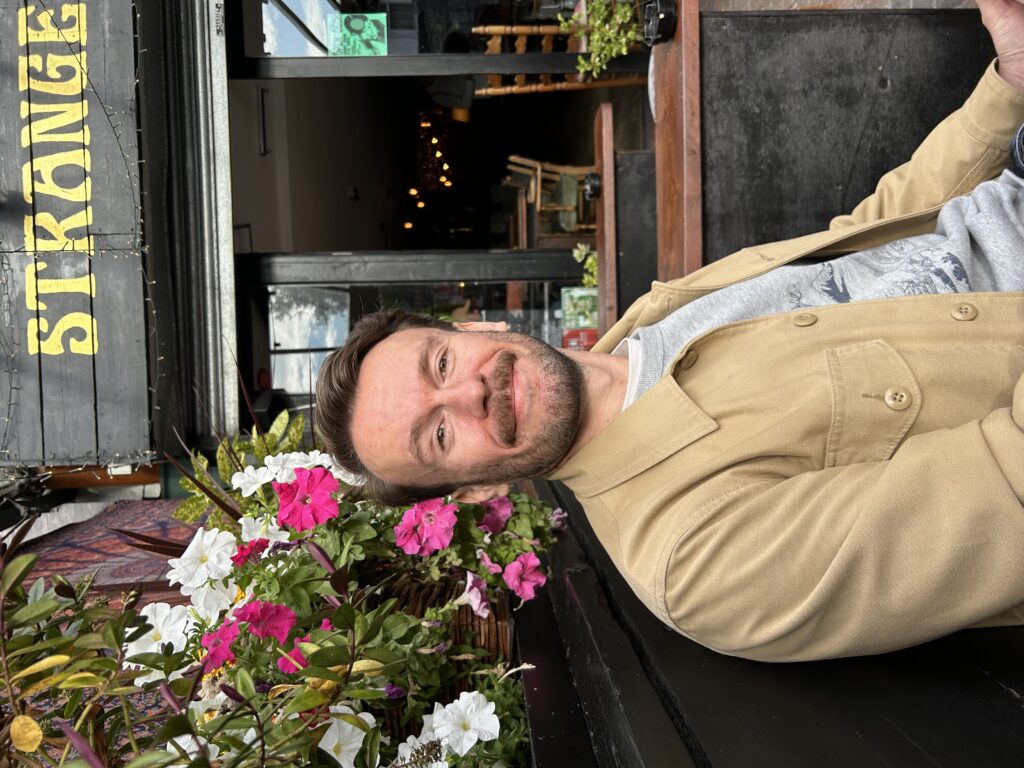
Andy Porter: Colleague Wellbeing – Men’s Mental Health and Emotional Vocabularies
Following a tragic event in 2025, I took several months away from work to look after my own wellbeing. As anyone who’s ever had to go to the GP and opening up can attest, it felt like a monumentally difficult thing to do. In hindsight, the decision was obviously the correct one and I benefitted from this time in many ways, yet I spent so much time and energy worrying about whether I should take the leap and advocate for myself that it made some of the more significant, immediate, emotions even worse. This worry can be so huge for many of us that often, we simply don’t do take the leap.
Data tells us that men in particular struggle to advocate for their own mental health and physical wellbeing. According to the UK Mental Health Foundation, men are less likely to access psychological therapies compared to women, with only 36% of referrals to the NHS for therapy being male. Suicide remains the biggest killer for men under 45, and men are up to 4 times more likely to die by suicide than women. According to one report, one in 10 men efel that they have nobody to rely on for emotional support, compared to one in every 20 women.
But why, exactly, do men often find advocating for their own wellbeing so difficult? At an early age, young men and boys are taught express their emotional needs in a certain way – usually by being quiet. “Stop crying” and “be a man” are phrases often said to young men expressing their sorrow or pain. For parents, this can lead to the damaging myth that “boys are easier to raise than girls”. Parents in a young boys’ life often see their lack of emotional expression as a lack of emotion entirely, and boys’ emotional expressions reduce the further they age into adolescence.
As a result, boys’ emotional vocabularies become stunted. Without appropriate words or actions to communicate how they feel, and when crying has long been decided as unacceptable, boys retreat to the safety of silence.
The social conditioning of male emotions can begin even earlier in life. In the documentary Silent Men (2024), a trauma specialist cites a study in which babies wrapped in blue blankets were touched for significantly less time than babies in blankets of other colours. There’s a double implication; not only do adults assume that babies wrapped in blue blankets must be boys, but that because they are boys, they require less physical touch and affection than girls. “What are we doing in our culture,” the specialist asks, “about socialising boys to not be touched as much, not be seen as vulnerable, not need emotional support as much as girls?”.
Men’s emotional silence doesn’t need to be a cultural issue, and this doesn’t absolve many men of their abuses of power, or acts of gender-based discrimination. But men have a responsibility to improve their emotional vocabularies. Studies have shown direct causal links from male loneliness to processes of online radicalisation, into extremist views centred around the manosphere and Andrew Tate-inspired “alpha” masculinity. In turn, these ideologies are linked to real-world acts of violence and discrimination against women and girls.
Our wellbeing is our own; we can’t expect our families and friends to know our emotional needs any better than we do. Men’s silence doesn’t serve anyone.
Some small, simple tips I’ve found that can be hugely beneficial:
- Name it out loud: “I haven’t been sleeping as well this week.” “My usual routines are different.” “I can’t seem to control myself in the ways I usually can.” Defining the traits can lead to a better understanding of what’s really happening.
- Do a one-minute check-in: “What’s going on in my body?” “What kinds of things am I feeling?” “What one thing could I do today to make things easier?”. Solutions sometime reveal themselves when you ask yourself a question.
- Tell one person a small truth: “I don’t need fixing, just someone to listen” can be a powerful start to conversation.
At the Male Allies Network, we’re committed to building colleagues’ confidence in engaging with issues of masculinity and gender roles both inside and outside of the workplace. We’re building a community of staff colleagues interested in male allyship and gender advocation in all forms – challenging discrimination, raising awareness of harmful behaviours, and advocating for colleagues’ mental health and wellbeing. If any of these issues affect you and you’d like to get involved, or know a colleague who’s interested, please get in touch at male-allies@listserv.manchester.ac.uk.


Contact Us
+44 (0) 161 306 6000


0 Comments