
John Walker: Empowering Inclusivity – New Comprehensive Accessibility Training for a More Inclusive Digital Environment
As part of our commitment to creating an inclusive digital environment, the IT Services Directorate, in collaboration with the Equality, Diversity, and Inclusion (EDI) Directorate, has invested in comprehensive role-based accessibility training provided by AbilityNet, a renowned leader in accessibility services. The training empowers our staff with the knowledge and tools needed to ensure our digital platforms are accessible to all.
Aishah Rashid: Breaking Barriers – The Role of Networks, Solidarity and Allyship in Higher Education
In a time of heightened social unrest and urgent calls for justice, the workplace is no longer just about employment. It’s become a space where allyship and solidarity play a pivotal role – particularly for those just beginning their career.

Doron Cohen and Stacey McKnight: Teaching Sensitive Content: Balancing Compassion, Accuracy, and Inclusivity
Academics, especially those in the social and health sciences, are often tasked with teaching some of society’s most sensitive and uncomfortable issues. These include discussions about systemic inequalities in health, employment, and education that arise from discrimination based on race, religion, sexual orientation, ethnicity, gender, and class. As social psychologists specialising in teaching sensitive content, we (Doron and Stacey) frequently find ourselves in a unique position where we must balance the responsibility of providing accurate, evidence-based education with the moral imperative to honour the lived experiences of those most affected by these issues.

John Roache: The marginality paradox (and how student partnership might help us to solve it)
A recent sociological study defines ‘marginality’ as the ‘involuntary position and condition of an individual or group at the margins of social, political, economic, ecological, and biophysical systems’. While there are other (and sometimes contradictory) ways to discuss the term, it nonetheless represents one, important critical ‘lens’ through which researchers and policymakers have long been attempting to understand inequality in education.

Rebecca Phillips: ‘Empowering future generations’: understanding EDI in primary and secondary schools through our annual MIE initial teacher education inclusion conference.
The annual UoM Manchester Institute of Education’s (MIE) ITE inclusion and inspiration conference provides opportunities for UoM trainee teachers on our primary and secondary PGCE and SCITT programmes, early career teachers and researchers from the University of Manchester to join together to explore, discuss and debate current practices and recent research relating to EDI in education.

Christopher Sutton: Inclusive visual healthcare resources
How we visualise health informs how we treat people.

Emma Shiels: The beautiful game, the ugly truth: my struggle with misogyny in football (part 2)
As a working-class woman from Manchester – supporting my football team whilst facing misogyny from male football fans is a troubling and paradoxical concept. Football is integral to my culture, class and history. And yet, how should I navigate the troubling research that shows 68% of male football fans hold openly misogynistic views?
Emma Shiels: Who is football for? History of Women and Football (part 1)
Mary, Queen of Scots, wrote about football in her diary. In fact, the world’s oldest football was found in her belongings. Did she play? Most likely not. But she most certainly watched. So, when did women first pick up the ball and start playing?
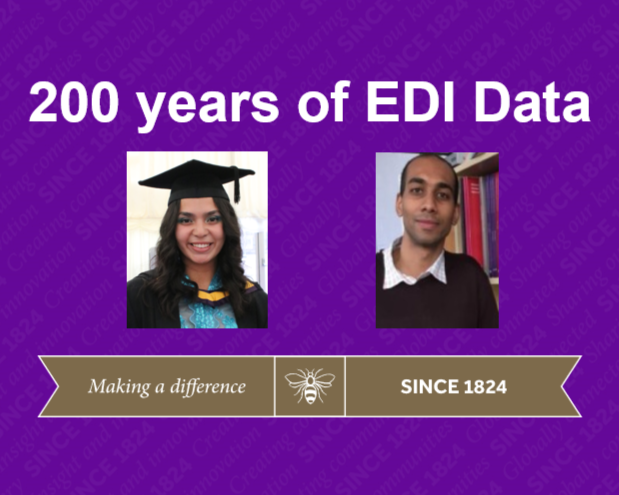
Lauren Stella: 200 years of EDI Data Workshop and the Importance of Representation through Data
I am the Data Analyst Assistant working within the Equality, Diversity, and Inclusion (EDI) Directorate. In this blog post, I will re-cap on the “200 years of EDI Data Workshop” I presented alongside Sami Karamalla-Gaiballa (Data Analyst Lead and EDI Partner) in our EDI Conference in June. As we celebrate 200 years of the University of Manchester, this workshop was purposed to demonstrate how data collection has changed over the past 200 years using examples of the UK Census and our own University.
Heather Lennox: Learning about Asexuality
As part of my L5 CIPD HR apprenticeship, I was tasked with developing and implementing a people strategy with a focus on celebrating equality and diversity. With little scope to do so within my own role, I reached out to the EDI directorate to see if there were any upcoming projects I could get involved with. The response and support I received was brilliant and reflects how collaborative UoM colleagues are.


Contact Us
+44 (0) 161 306 6000


Recent Comments