
“We need to show people that there is a place for them in this transition”: reflection on Green Jobs and Skills public talk
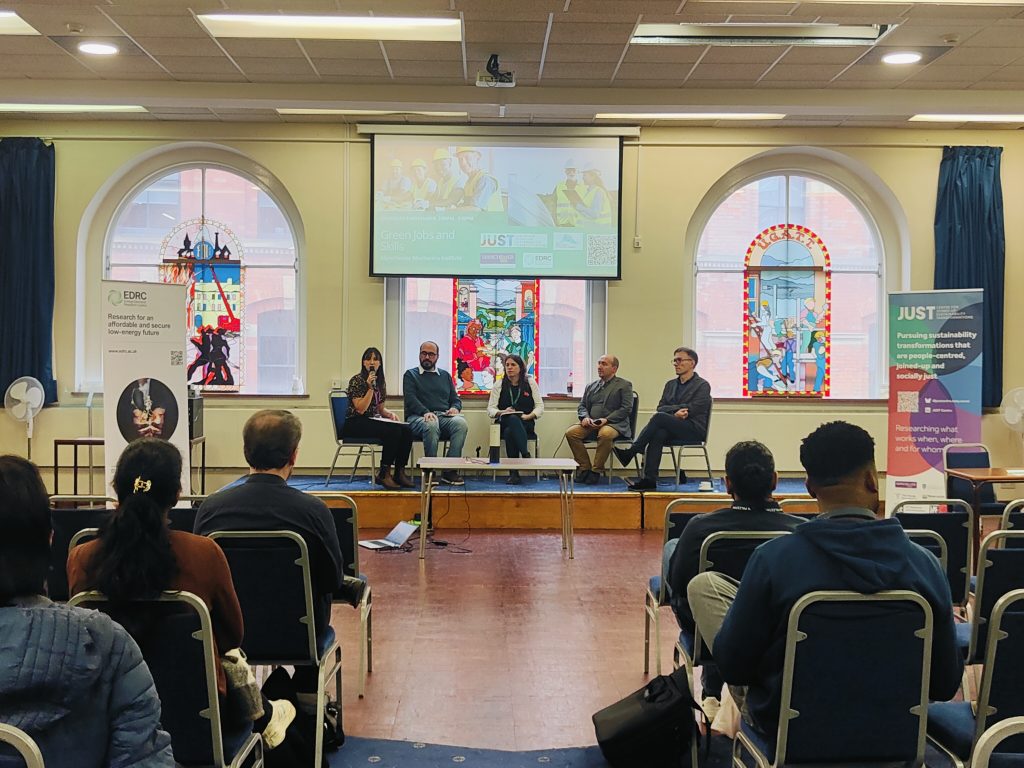
On 6 November 2025, experts held a panel discussion on green jobs and skills as part of the ESRC Festival of Social Science, debating the urgent need to redefine ‘green jobs’ and coordinate local efforts to build a truly inclusive green workforce.
Text by Surabhi Mantha
The conversation around a greener economy often sparks one big question: what does a green economy truly look like, and who gets to be a part of it? The panel brought together expert researchers, policymakers, educators, and community leaders to unpack how the transition to sustainability can be made more inclusive, coordinated, and just. It was hosted in collaboration with EDRC (Energy Demand Research Centre) and the JUST Centre (Centre for Joined-up Sustainability Transformations). The event featured Christian Calvillo from the University of Strathclyde, Venetia Knight from Groundwork Greater Manchester, Simon Joos from the Manchester City Council, and Stefan Bouzarovski from the University of Manchester and hosted by Katherine Sugar. A spirited discussion with a few inputs from the audience led to some key themes: redefining green jobs, closing the skills gap, and ensuring that the transition to sustainability leaves no one behind.
What is a green job?
As Christian Calvillo put it, the idea of a green job is far broader than what people often think. Anything and everything will be a green job, because everything has to change as part of the transition. While renewable energy roles tend to dominate headlines, Calvillo pointed out that traditional jobs like welders, plumbers, and electricians – people who build and maintain the backbone of low-carbon infrastructure – are just as crucial to a sustainable future. There will always be a significant demand for basic trade skills such as these across all sectors.
As the Director of Employment and Enterprise at Groundwork Greater Manchester, Venetia Knight offers a tried-and-trusted yet ever-changing definition of a green job: a role that directly or indirectly contributes to achieving net zero emissions, restoring nature, or mitigating climate change risks. Green skills are the technical skills, knowledge, competences, and behaviours needed to deliver this work. All panelists agree that the focus should be on how to embed and embrace this principle in the learning landscape.
Bridging the knowledge and skills gap
Despite the growing enthusiasm for a green economy, there’s still a worrying lack of clarity about how many people are needed, where they are needed, and what skills they should possess. A Climate Change Committee (CCC) report concluded that current estimates for the number of net zero jobs in the UK vary dramatically anywhere from 1,00,000 to at least 7,00,000, which is a large margin, leaving policymakers and educators without a clear picture.
From a local governance standpoint, Simon Joos spoke about the practical challenges cities face. As part of Manchester’s Climate Change Action Plan (2025–2030), the council is pushing toward a 2038 net zero target, but the road isn’t simple. Without a clear goal and a collectively owned roadmap, we won’t achieve it. There is a need for coordination between national and local organizations to align training, education, and job creation efforts for this to work.
It’s all about inclusive and local transitions
Representing the third sector, Venetia Knights brought a grounded, community-focused perspective. Connecting local residents to green training and employment opportunities, serving as a bridge between policy and people, is the way for a just and successful transition to a sustainable future. Yet, she warned, several barriers still hold communities back: complicated education systems that make it hard to navigate life choices as information like that isn’t easily available, limited career advice, and outdated perceptions that green jobs are either ‘dirty work’ or are poorly paid. “We need to show people that there is a place for them in this transition; transitions must be local to make sure good accessible jobs are created everywhere,” – Knight said. For example, the NHS has about 237 different jobs, but most people are familiar with doctors and nurses, while options like sustainability managers, climate and health economists, product managers, and many other such jobs go unnoticed. Her call to action was clear – invest in better career guidance, work at community levels, create inspiring opportunities for young people to meet employers to demystify the industry, and design tailored programs that help disadvantaged groups gain confidence and the right skills.
Manchester as a sustainable city
Simon discusses the transitioning of the City Council’s own fleet to electrical vehicles and how that is their way of scaling up green provision and working within the UNESCO Global Network of Learning Cities movement to align learning provision with sustainable goals. As we transition to a low-carbon economy, there is a noticeable lack of engagement with the 2038 net-zero mission. If the goal is unclear and the roadmap is not collectively owned by the community and businesses, it will not be achieved. The inability to define and map green skills nationally makes it almost impossible for local governments to create an effective pipeline of talent suited to the evolving green economy. Achieving this goal requires ingenuity, innovation, and collaboration across every asset the city has.
Role of education and connected form of learning towards the big green shift
Reflecting on how universities and colleges are only beginning to catch up with the pace of change, Stefan Bouzarovski notes that while awareness is growing, institutions often separate technical training from social and community engagement. Stefan emphasizes that the future lies in a more connected form of learning, with programs that recognize the full ecosystem of green jobs—not just engineers and scientists, but also communicators, organizers, and community leaders who make real-world impact possible. This includes people who mediate, like energy advisors, or even people helping with energy bills, repair cafes that could provide training skills, and informal labour activities done within communities. Venetia chimes in about Groundwork Manchester’s Green Community Hubs, which are a one-stop shop for community activists and residents to take action around the range of issues in green spaces.
Concluding thoughts
By the end of the panel discussion, one message rang loud and clear. The green transition is well underway, but without shared definitions, coordinated policy, and inclusive access progress will remain uneven. The optimistic thread running through the conversation was the belief that collaboration between researchers, educators, local governments, and communities is key to unlocking a thriving green economy. As Manchester and cities around the world move toward net zero, these conversations remind us that sustainability isn’t just about technology and huge solutions; it’s about connecting people, finding purpose, and building partnerships that start small. It isn’t just about creating new systems but rather about reimagining the ones we already have, making them fairer, more inclusive, and ultimately, more human.
You can watch the panel discussion on YouTube: https://www.youtube.com/watch?v=ImXlatDOtLg
Green Jobs and Skills was part of the ESRC Festival of Social Science 2025, supported by funding from the Economic and Social Research Council (ESRC), which is part of UK Research and Innovation (UKRI).
The event was sponsored by the newly established People, Place and Energy Research Centre (PPERC), based within SEED at the University of Manchester.
Contact Us
+44 (0) 161 275 0189


0 Comments