
“Not a drive to the future we imagined” SCI annual lecture with Professor Dame Henrietta L. Moore.
SCI Annual Lecture: reflections on car dependency and solutions to overcome its social and infrastructural challenges.
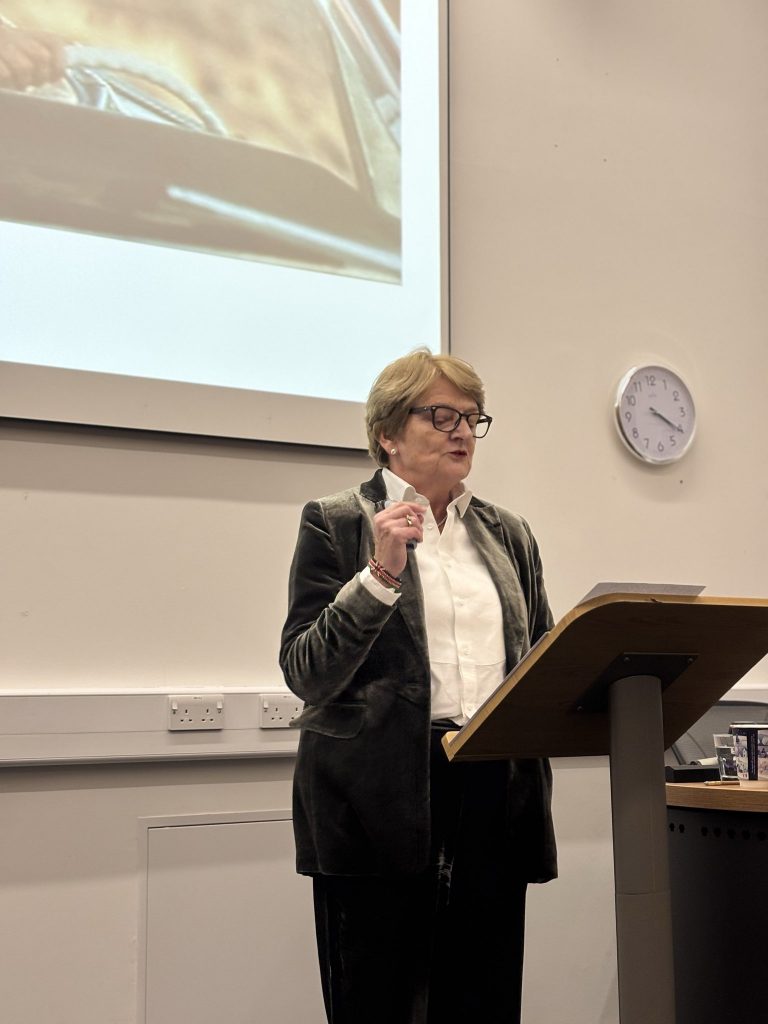
On 2nd December, the SCI hosted its annual lecture with Professor Dame Henrietta L. Moore, Founder and Director of the Institute for Global Prosperity and Chair in Culture, Philosophy and Design at University College London. Professor Moore discussed her recent book Roadkill: Unveiling the True Cost of Our Toxic Relationship with Cars (co-authored with Arthur Kay).
“Astonishing Harm”
Moore began her lecture by presenting data on the “astonishing harm” caused by cars in various spheres, painting quite a dark picture. From a death toll of car-accidents – approximately two billion animals are killed on roads annually, and a person dies in a car-related incident every twenty-six seconds – to the impact on health and wellbeing, where rising noise pollution also contributes to severe health impacts, including links to dementia.
Beyond the quantifiable, Moore examined how car dependency shapes society, where freedom of choice equates with the freedom of consumption choices and consequently car ownership.
Sense of Autonomy?
The car, Moore argued, is “one of the few things that offers people a sense of autonomy.” As a result, social, infrastructural, and economic norms have been shaped around the assumption that people will own and use cars, which eventually lead to our relationship with cars becoming “toxic”. The sense of autonomy is, in many ways, an illusion. For decades, cars have been associated with mobility and comfort, yet in practice, car dependency has created significant barriers to alternative modes of transport, such as buses and bicycles, making urban movement more difficult. Traffic congestion highlights the fallacy of the mobility that cars were supposed to bring. Instead of enabling freedom, they often constrain it: for instance, today, average traffic speeds in London are the same as those of a horse‑drawn travel in the city in the Victorian era.
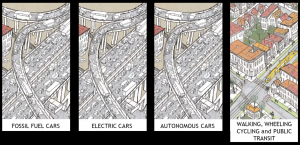 Moreover, driving is sometimes not a genuine choice but the consequence of not having a choice. Limited or unavailable public transport makes cars a necessity rather than a preference, reinforcing the narrative that cars are symbols of freedom. And, in many cases, people pay the price of car‑centric culture – exposure to traffic, noise, and pollution – even when they can’t afford a car themselves. At the same time, cars spend 96% of their time not moving, yet still occupy valuable space that could be used in more socially beneficial ways.
Pawan Srikanth, a researcher at the Sustainable Consumption Institute, who attended the lecture, reflected: “The seamless convenience of having a car shifts our collective focus toward individual convenience while obscuring the broader consequences of a motorized world – such as a fundamentally divided society created through sprawling infrastructure.” Moore argues that we should rethink the concept of freedom for the 21st century. While 20th‑century lifestyles centred on car ownership, this model is no longer viable.
“Non-biodegradable Glitter”
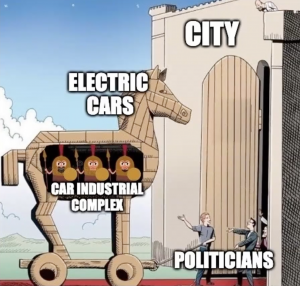
Moore argues that discussions about changing car-related policies frequently face backlash, revealing how even low levels of mistrust in science hinder efforts to find suitable solutions for the current polycrisis. This results in a situation where industry solutions dominate the public imagination – technological fixes such as replacing fossil fuel cars with electric and autonomous vehicles.
However, these alternatives are far from a complete solution. Roads and cars continue to occupy vast amounts of space; the risks of collisions remain; and environmental pollution persists—not necessarily from combustion engines, but from tyre wear or brake dust. Crucially, these technologies also fail to address the underlying issue of lack of mobility choice. Moore refers to such ‘sustainable’ solutions “non-biodegradable glitter,” arguing they are problematic precisely because they prioritise the preservation of existing industries over the health of the planet.
“Free Homes for Cars” or Affordable Housing for People?
Is there any hope, especially when it comes to applying research to local governance? In the talk, Moore illustrated how this dependency on cars has shaped urban infrastructure. Over the past seventy years, cities have been designed primarily for vehicles rather than people. Cities allocate vast spaces for roads and parking, effectively creating “free homes for cars” while housing for people becomes increasingly expensive. This dynamic disproportionately affects poorer renters, with eighty percent of cities lacking affordable housing. Everyone pays the price of car culture – especially those who cannot afford a car themselves.
Commenting from the audience, Geraldine Coggins, Green Party councillor for Altrincham on Trafford Council, noted the phenomenon of “coupling”housing and car-parking in local development, and working “to decouple housing from parking.” Coggins argued: “Many of the objections people have to new homes being built nearby are about the impact on the already stretched parking situation. When resident parking is introduced and new builds are not given any spaces, those problems are mitigated. However, this only works where we have really good ways of getting around without cars – or at least without so much parking.”
Automobility – Continuity or Transition?
In terms of global solutions, Moore advocates for “placing social collectivity at the core of urban design”, making policy accountable to the interests of all groups. This set the direction of the discussion following her talk. “In her lecture, Henrietta Moore set out particular challenges in the relationship between car and society and also provided some ways of re-thinking this relationship,” commented Professor Michael Hodson, Director of the SCI, who chaired the discussion. “This led to a panel discussion that focused on the future of mobility and whether this would see continuity in the dominance of the current automobility system or transition in or away from it. The panel of three University colleagues – Professor Hannah Knox, Dr Ransford Acheampong and Professor Karen Lucas – discussed the role of local infrastructure in any transition from car dependency, whether digital technology can realistically facilitate at-scale mobility alternatives to the car, and whether ‘15-minute cities’ are a convincing proposition for addressing car dependency”.
Stories about Cars: Large, Loud, Toxic VS Freedom, Luxury, Status
Topo Mokokwane, a researcher in Sociology whose work examines how linguistic practices shape the environments we inhabit, expanded on Moore’s points about our car dependency by connecting them to language and the ways in which “stories about cars” shape our cultural orientations. “The car is one such storied technology whose tale continues to drive people today. The story of the car – as freedom, luxury, and status – has been convincing. Not only has it endured, but over time it has become written into languages and the very landscapes we inhabit. The average city dedicates 20-30% of its footprint to roads, without accounting for the land devoted to parking. We now speak of avoiding rush hours, of LA traffic, and dream cars… The enduring story of the car – as a beacon of freedom, status, and luxury – proves the immense power of storying” – argues Topo. “Yet, this story is compelling precisely because of what it leaves out: the paradox of restricted mobility and traffic jams, the social costs borne by the bothersome pedestrians, and the tragic ecological shadow of pollution, habitat fragmentation and roadkill. This tale of individual achievement and autonomy has come at the cost of collective and environmental health”.
The lecture offered an opportunity to reconsider the stories and narratives surrounding the car, that sustain our dependency on it despite the harm it causes. As Hannah Knox, Professor of Anthropology noted, the SCI annual lecture with Moore was a “powerful redescription of the car.”
You can watch the lecture recording on the SCI YouTube channel here: https://www.youtube.com/watch?v=pqWcoYI9QZs.
Contact Us
+44 (0) 161 275 0189


0 Comments