
Why we’re warming up: a review of the freezer Chill Up movement
Why did some labs increase their ULT freezer temperatures?
The move to raise ultra-low temperature (ULT) freezer temperatures began after the Faculty’s Environmental Sustainability Showcase 2023, which featured Martin Farley, UK Research and Innovation (UKRI) Associate Director of Environmental Sustainability and co-founder of the Laboratory Efficiency Assessment Framework (LEAF). He presented the evidence behind the Chill Up movement, demonstrating that many biological samples can be safely stored at –70 °C rather than –80 °C, with significant environmental benefits. (see ref 1)
Following this talk, several colleagues across the Faculty took the decision to increase their ULT freezer temperatures. Among the early adopters of the Chill Up movement are:
- Stuart Pepper, Chief Laboratory Officer at the Cancer Research UK (CRUK) Manchester Institute, who led the adjustment of 55 out of 61 ULT freezers from –80 °C to –70 °C.
- Lydia Wunderley, Gold LEAF Champion in the Woodman Lab, who coordinated temperature adjustments across 5 ULTs in a shared freezer farm.
- Nisha Nair, Environmental Sustainability Lead for the School of Biological Sciences and LEAF champion at the Centre for Musculoskeletal Research, who has raised the temperatures of approximately 22 ULT freezers within her group.
Before looking at outcomes of the movement, it’s useful to outline the reasons why labs chose to chill up in the first place.
1. It saves a significant amount of energy.
ULT freezers are among the most energy-intensive pieces of equipment in the lab. Based on a typical four-bedroom house consuming 11.2 kWh/day in the UK, on average, ULTs set to –80 °C consume the equivalent of 1.2 homes. Stuart’s measurements showed that raising the temperature from –80 ºC to –70 ºC generated an average saving of 2.7kWh per freezer per day. Across the 55 freezers, this saving is equivalent to the daily consumption of 13.3 four-bedroom UK homes.
Using less energy leads to obvious economic benefits, but more importantly, it’s also better for the environment and supports the University’s carbon reduction goals.
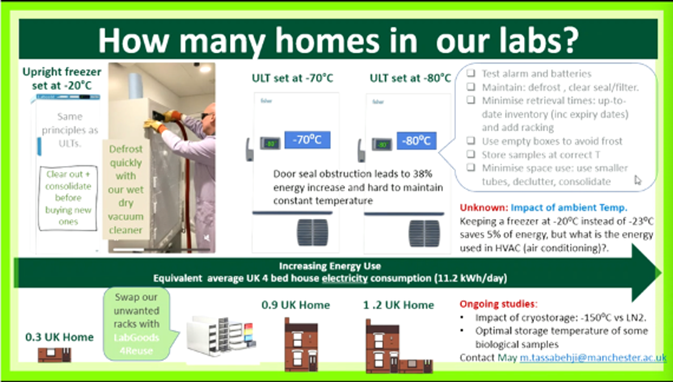
Visual comparison of laboratory cold storage energy use at –20 ºC, –70 ºC and –80 ºC.
2. It aligns with the LEAF criteria and the University’s sustainability goals.
The University’s Environmental Sustainability Strategy 2023-28 outlines a commitment to have all labs achieve a LEAF accreditation. Several LEAF criteria pertain to freezers: Criterion #24 for the Silver award specifically encourages raising freezer temperatures where possible.
By embracing the Chill Up movement, labs move closer to a LEAF accreditation and directly contribute to the University’s sustainability goals.
3. The standard used to be–70 °C.
According to Lydia, all the professors in her lab area recalled a time when –70 °C was the typical setting for ULT freezers. The later shift to –80 ºC was not due to new evidence on sample stability, but simply because manufacturers began producing freezers capable of reaching lower temperatures.
This means that returning to –70 °C is not a new compromise, but rather a return to a previous, well-established standard for a wide variety of samples.
However, samples are ultimately precious, and decisions around freezer temperatures should always align with LEAF’s first principle: do not waste experiments and be guided by data. Reassuringly, there is a large, long-term inventory study from the University of Colorado Boulder that supports sample storage at –70 ºC (Bousema et al., 2020). This work draws on data from laboratories that have operated ULTs at –70 ºC for over a decade, with no observed negative impact on a wide range of biological samples.
Within FBMH, May Tassabehji is also leading a similar long-term project to examine the integrity of less conventional samples at different cold storage temperatures. While the results of this work are still emerging, it is helpful to look at the experiences of those who have already implemented Chill Up in their labs.
Have labs experienced any issues after increasing ULT freezer temperatures?
Almost two years after the initial chill up movement, we asked Stuart, Nisha and Lydia to comment on their observations so far. Overall, they reported very few issues after raising ULT freezer temperatures.
Stuart (CRUK Manchester Institute)
Following the temperature increase, Stuart reported no noticeable operational impact and no increase in false positive alarms, equipment faults or staff concerns.
It is of note that he has also led work to enable the storage of Human Tissue Act (HTA) samples at higher temperatures. Approximately 20 of the ULT freezers in the CRUK Manchester Institute contain such samples, including solid (normal and tumour) samples, serum and other fluids. However, not all of these freezers have been turned up to –70 ºC, as discussed below.
Lydia (Woodman Lab)
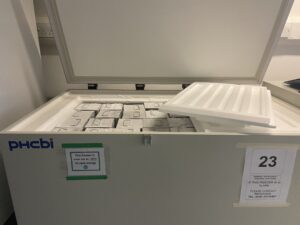
A chest freezer in the Woodman Lab. It is fully racked with a full inventory kept in a folder on top of the freezer for easy access.
All five freezers in the shared freezer farm of Lydia’s lab area were adjusted to –70 ºC by a lab technician in their group, making the transition quick and straightforward. These freezers mainly store recombinant proteins and competent Escherichia coli bacteria.
The only issue Lydia noticed is that cells that should have been transferred to liquid nitrogen promptly after storage in the freezer showed increased cell death upon thawing.
However, the issue highlights the importance of appropriate storage practices and doesn’t reflect a problem with the chill up movement itself.
Nisha (Centre for Musculoskeletal Research)
Nisha’s lab group primarily stores human-derived samples at –70 ºC. This includes DNA, serum, plasma, urine, buffy coat, and blood tubes.
They have not observed clear negative effects since switching, but the differences are difficult to tell due to several reasons:
- Some samples have been stored for many years, making changes difficult to attribute.
- There are other confounding factors such as freezer failures and decanting samples to another freezer.
- Certain samples (e.g. serum) naturally lose viability with every freeze-thaw cycle, regardless of the storage temperature.
Does raising temperatures extend freezer life span?
Although the Faculty’s Chill Up movement is still in its early stages, other organisations have been operating at higher freezer temperatures for many years, and their long-term data provide valuable insight into whether higher temperatures contribute to longer freezer life spans.
One example comes from Julie Oxton and Rob Oliver the Salford Biorepository Facility (SBF) at Salford Royal. They have been running 12 ULT freezers at –75 °C for over 10 years, storing a wide range of HTA‑regulated human samples. Over this period, they report no adverse effects on their samples and noted that many of their freezers have remained operational for more than 12 years.
Experience within FBMH also suggests that operating ULT freezers at higher temperatures may lead to extended lifespans, but other factors are also at play. As Nisha noted, some freezers in her area have been in service for nearly 20 years, having operated at –80 °C for much of that time. It is well established that regular annual maintenance may be as important as temperature settings in supporting long‑term freezer performance and reducing energy consumption (see Ref 2)
What should labs consider before deciding to chill up?
Despite the positive outlook, there are still barriers that may prevent some labs from joining in on the chill up movement. Combining testimony from Stuart, Lydia and Nisha, we’ve identified several factors that labs may want to think about before raising ULT freezer temperatures.
1. Regulatory and governance requirements
While Stuart had chilled up 55 out of 61 ULT freezers in the CRUK Manchester Institute, no progress has been made on the remaining freezers yet. These all contain HTA samples, where regulatory requirements are more complex and the samples themselves are particularly precious. As a result, decisions around these freezers require closer engagement with HTA governance processes and additional reassurance before changes can be made.
Stuart has since discussed this with the Institute’s HTA governance team, and progress is expected later this year, although no concrete changes have been implemented yet.
2. Sample type and viability
Nisha noted that many labs would want to know whether their specific sample types will remain viable at the higher –70 ºC setpoint. Every lab works with different sample types, with some more temperature-sensitive than others.
Providing sample-specific reassurance can therefore be very helpful in building confidence and encouraging adoption of chill up across diverse research teams.
Labs that would prefer additional reassurance or testing before chilling up may wish to connect with May about her long-term project examining sample integrity at different cold storage temperatures.
3. Practical and operational considerations
Some labs may worry about the time and effort required to adjust multiple ULT freezers. Nisha suggested a practical solution to this: ask your maintenance engineer to change the temperatures during annual servicing. This saves staff time while ensuring the adjustments are carried out correctly.
Beyond Chill Up: Join the Freezer Challenge
As the testimonies above demonstrate, raising ULT temperatures can be both safe and impactful. One opportunity to build on this momentum is to take part in My Green Lab’s international Freezer Challenge.
Through friendly competition, this challenge encourages laboratories around the world to improve their cold storage efficiencies and reduce running costs. While the Chill Up movement focuses on temperature settings, the Freezer Challenge promotes a wider set of good practices aligned with the LEAF criteria:
- Ensure freezer alarms are working via regular battery checks. It is paramount to ensure we protect our freezer content with functioning alarm systems.
- Reduce door-open time
- Keep an up-to-date inventory
- Use rack space efficiently and declutter regularly
- Defrost freezers and clean filters regularly [why don’t you try our wet dry hoovers?]
- Retire unnecessary units
- Store samples at the right temperatures
Support is available across the Faculty to help with some of these actions. For example, wet-dry hoovers can be borrowed to make freezer defrosting quicker and easier.
The competition takes place virtually between January and June every year, and it offers an easy yet structured framework to improve lab sustainability. Find out more about the Freezer Challenge by visiting the My Green Lab website or watching this promotional video from King’s College London.
Additional Information
Further reading:
- ULT Freezers: Why -70C isn’t as scary as it seems (PowerPoint presentation on the benefits of raising ULT freezer temperatures)
- Unveiling the Optimal Temperature: A Comprehensive Literature Review on Biological Sample Storage in ULT Freezers (Exeter University)
If you want to explore potential savings in your own lab, plug-in energy meters are now available for loan at several FBMH buildings. Find out more about the plug energy meters campaign.
A University-wide LEAF SharePoint site is now available, acting as a central space for guidance, support contacts, resources and case studies. Find out more about the LEAF SharePoint launch.
To find out more about Environmental Sustainability in FBMH, visit the Faculty’s intranet page, website or contact srbmh@manchester.ac.uk.
0 Comments