
TIN-Bee Staff: 1996-2026: 30 years of Intersex Awareness Fortnight
From Intersex Awareness Day:
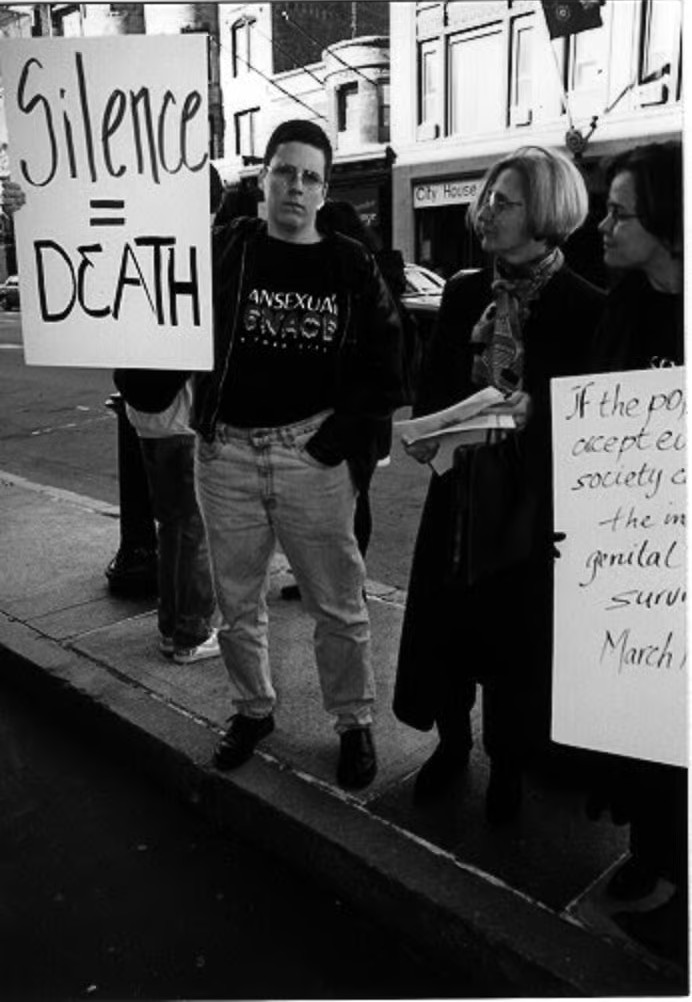
Originally the day of a protest in Boston, Massachusetts, October 26th 1996, drew attention to the harmful practice of non-consensual genital surgery performed on intersex children to make their bodies conform to a gender binary, despite any lack of medical necessity. this was the first visible public act of defiance and brought the issue of intersex bodily autonomy and rights to the forefront.
To Intersex Day of Remembrance:
The birthday of Herculine Barbin (November 8th 1838). Herculine was assigned female at birth and identified as female throughout life. However, her relationships with other women drew unwanted attention from the medical community, who examined her and reassigned her as male. This was a legal and social reclassification that forced her out of her profession, community, and relationships. In 1868, she died by suicide in Paris. Her memoir, published in the 1970s, speaks of a powerful desire to be remembered not as a medical specimen but as a human being with emotions, attachments, and struggles. This illustrated an early stage of medical authority over sex, where classification itself (not surgery or hormones) was the tool of control. A few decades later, medicine shifted toward physical interventions on intersex bodies.
Since 1996 the fortnight is observed to:
- Raise awareness about what it means to be intersex and the challenges intersex people face.
- Campaign for an end to non-consensual surgeries and hormone treatments on intersex people, and for the right of self-determination.
- Shift the focus away from dehumanising discussions of intersex variation as medical curioisties for exploitative public interest.
- Challenge stigma and promote understanding that being intersex is a natural form of human diversity.
A Brief History:
1870s to 1920s: Advances in anatomy, pathology, and early surgery saw intersex people increasingly examined in hospitals. The approach was mostly diagnostic and descriptive as a curiosity for medical journals. Legal and social systems demanded binary sex designation. Rare surgeries were performed but these were often dangerous.
1930s to 1960s: The development of hormone endocrinology led doctors to believe they could “fix” intersex variations. Estrogen or testosterone treatments were given to children to reinforce the sex assigned by doctors. Surgery on children became more common. Doctors enforced that children must be “normalised” early, and raised unambiguously in a chosen sex. An individual’s own identity or consent was not considered.
1970s to 1990s: Following John Money’s research at John Hopkins University, parents were encouraged to hide the truth about their children’s bodies to “ensure stable gender identity”. This, paired with now widespread non-consensual surgery and hormone treatment, had traumatic consequences as suicide tolls rose. Intersex voices began to emerge, criticizing this as harmful and abusive.
Below: Photo from the 1996 Protest

2000s to 2010s: UK support and advocacy groups emerged: The UK Intersex Association, founded in 2000, played a key role in raising awareness. Despite this, the NHS continued surgical and hormonal interventions in line with a medical “normalisation” approach.
2016: The UN Committee on the Rights of the Child raised concerns about UK medical practices, urging protection of children from unnecessary, non-consensual surgeries.
2017: The Women and Equalities Committee (WEC) in the House of Commons launched an inquiry into transgender inequality, which for the first time in Parliament included consideration of intersex issues.
2019: The WEC published a report explicitly recommending government action to protect intersex children from non-consensual medical interventions.
2021: The government stated that it did not plan immediate legislative change, However it did acknowledge the existence of intersex people by allowing the term ‘Variations of sex characteristics (VSC) sometimes also known as intersex’ to appear on the 2021 consensus. Meanwhile, non-consensual surgeries were banned Germany, Portugal, and Greece.
2025: There is still no UK law banning non-consensual medical interventions on intersex children which still occurs in the NHS. There is a stronger emphasis on psychological support, and a shift away from attitudes of hiding the condition from the chidren affected. It is argued that parliamentary scrutiny remains active.


Contact Us
+44 (0) 161 306 6000


0 Comments