
TIN-Bee Staff: The Manchester Method – How Trans Activists Reshaped UK Law
Manchester is widely recognised as the birthplace of trans activism in the UK. It was the home of Press for Change (PFC), the organisation that became the most influential trans rights lobbying group in British history. PFC was founded in 1992 by two Manchester-based trans activists. Christine Burns was a 38-year-old IT consultancy director at Cheshire Computer Consultants, and Stephen Whittle was a 36-year-old self-employed builder who was studying for a Masters in Law. By bringing together Christine’s experience in political lobbying with Stephen’s expertise in legal strategy, they built a campaign that reshaped the legal landscape for trans people.
PFC’s work led directly to some of the most important legal victories in UK trans history. Their campaigning helped secure the Gender Recognition Act 2004, which allowed trans people to change their gender on essential documents. They also played a significant role in securing comprehensive protection for trans people in the Equality Act 2010.
Their core approach was simple but powerful. They used the law as the main tool for political and social change. Rather than relying on large demonstrations, they focused on education, evidence gathering, and building a strong archive of discrimination cases. In the early years they created guidance materials, collected testimony about daily discrimination, and wrote to every MP after the 1992 General Election. They built relationships with politicians and civil servants, giving them accurate information about trans lives that had never been heard in Westminster before.

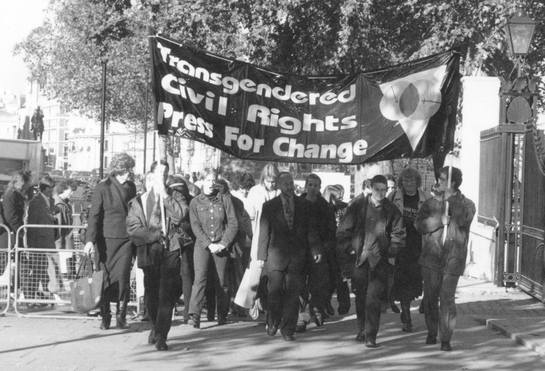
Picture: Press for Change at Ten Downing Street
Much of their legal advice and training was free. The aim was to build a collection of cases that could be taken to court to challenge discriminatory laws and win new rights. Their work was funded through donations and community fundraising, not through charging vulnerable people for legal support. This approach supported their mission to seek respect and equality for every trans person in the UK.
Their first major breakthrough came in 1996 with the case of P. v S. and Cornwall County Council. A trans woman had been dismissed after telling her employer she was undergoing gender reassignment. The European Court of Justice ruled that this was a form of sex discrimination and breached the Equal Treatment Directive, which protects dignity and freedom. This outcome effectively outlawed employment discrimination against trans people across the European Union. The UK government had to respond, and this led to the Sex Discrimination Regulations 1999 which became the first statutory protections for trans people in the UK. From this point on, PFC became an official contributor to the government’s Interdepartmental Working Group on Transsexual People, providing expert evidence and policy advice.
Their next landmark case was Christine Goodwin v. United Kingdom in 2002. Goodwin had faced serious problems because her affirmed gender had no legal recognition. This affected her employment, pension rights, social security, and her ability to marry. PFC had supported many similar cases in the past, but after the 1999 regulations they were able to show a clear European trend in favour of trans rights. The European Court of Human Rights ruled that the UK was violating Article 8 (the right to private and family life) and Article 12 (the right to marry). Because ECHR rulings were binding, the government was legally required to act.
After this victory, PFC intensified their lobbying and media work. As the Gender Recognition Bill went through Parliament, they countered hostile media stories with factual, humanising information. They continued their quiet and persistent behind-the-scenes work with MPs, civil servants, and advisers. Their evidence was thorough and fact based. Within two years, the Gender Recognition Act 2004 was passed. It created the Gender Recognition Certificate and allowed a trans person’s sex to be legally changed for all purposes. This was the pinnacle of PFC’s achievements.
Their final major goal was the creation of a single, unified anti-discrimination law.
PFC and other groups helped produce comprehensive research on trans people’s experiences, published in the Engendered Penalties report in 2007. This evidence strengthened the case for including trans people in the newly formed Commission for Equalities and Human Rights. Between 2008 and 2010, PFC worked closely with government as the new Equality Act was drafted. They ensured that gender reassignment was clearly included as a protected characteristic. When the Equality Act 2010 became law, it brought together all earlier anti-discrimination legislation and confirmed strong protections for trans people in employment, education, and everyday services across the UK.
Throughout all of this, PFC’s activism was defined by lobbying and litigation rather than public protest. They understood that the trans community was small and often targeted, and that mass demonstrations could easily be twisted by hostile media. Their approach became known as the Manchester Method. It described a model of activism based on quiet professionalism, careful legal work, and persistent political engagement. It was effective exactly because it avoided the kinds of confrontational tactics that might have produced backlash and stalled progress. By keeping a low profile in the media, they protected their work from sensationalism and maintained crucial political support.
Today, as we face new challenges in the UK, including the harmful and regressive elements of the EHRC’s 2025 draft proposals, PFC’s story offers powerful inspiration. Their success shows that determined, informed, and well-organised activism can move even the most resistant institutions. It reminds us that trans people have reshaped the law before, and we can do it again. PFC proved that dignity, evidence, and strategic action can secure real change. Their legacy encourages us to keep fighting for fairness, to stay united, and to insist that trans rights are human rights.



Contact Us
+44 (0) 161 306 6000


0 Comments