
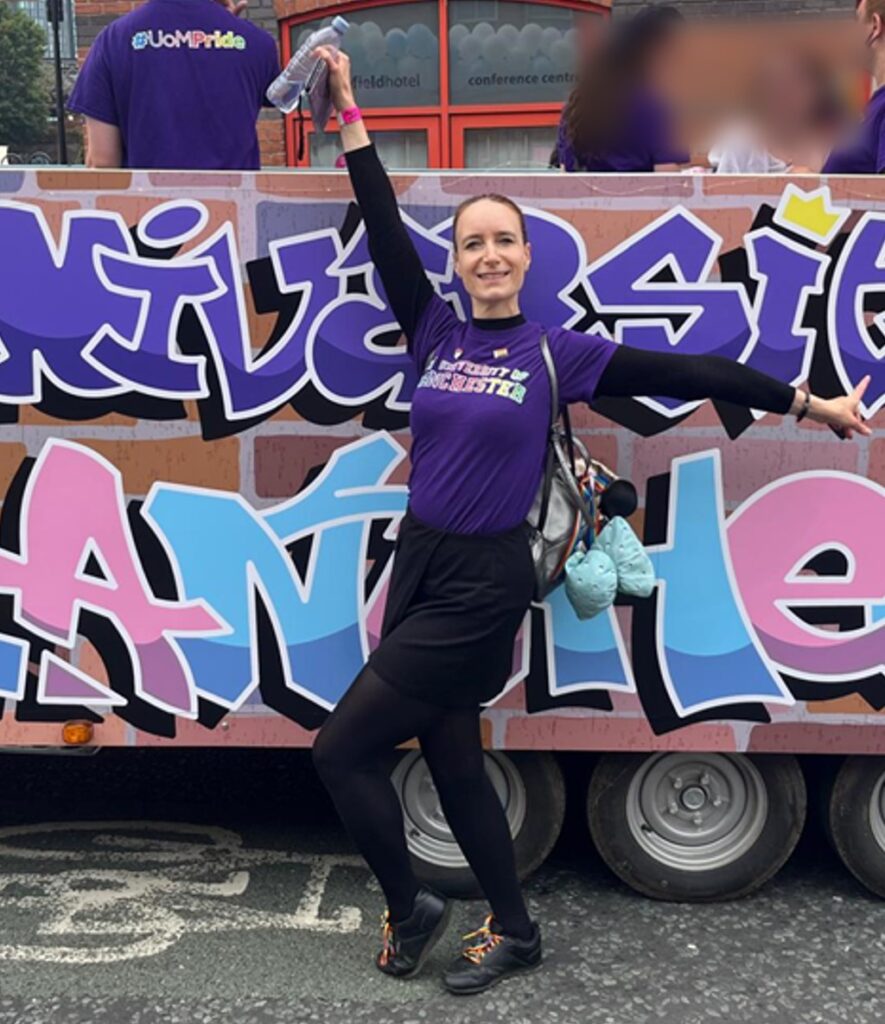
Heike Holubek: International Asexuality Day
What do you imagine when you hear a person is asexual?
a) Do you imagine the trauma that might have “caused” their asexuality, the poor mental health that requires treatment or do you imagine the person as very religious?
b) Would you imagine an asexual teenager practising dance steps and splits, university flatmates cleaning to the soundtrack of the “Time Warp”, or a student partying to Ricky Martin?
c) Do you imagine an asexual person as being very undesirable?
d) Do you imagine someone in a little black dress at a Janelle Monáe concert, or rather in jeans and checked shirt at an Ezra Furman gig?
e) Do you imagine an asexual person exercising at the gym while reading the newspaper, and then finding respite while watching a steamy show like Bridgerton?
f) Do you imagine an asexual person being absorbed playing Fortnite or Call of Duty?
Personally, I do not connect with a), c) and f), but I have experienced b), d) and e).
Most of my life I felt as an outsider and quite dis-connected from society. To most people I come across as a rather well-adjusted, straight, cis-gender woman. Very well-meaning people have been telling me that the feeling of disconnection must be purely in my head. I have always been busy with studying, working, competitive sports, exercising and lots of cultural and intellectual interests with little time for a significant other. I have developped crushes on people at times, but whereas my friends managed to turn their crushes into relationships and find some fulfillment in them, I always knew that I would never be able to match the expectations of any of my crushes and I would lose a big part of my identity if I had to compromise on my varied interests. Did this just mean I had not really grown up and become a mature adult, am I not vulnerable or confident enough or too selfish? How can I be fixed?
The term asexuality has been coined most likely in the late 19th century but I only enountered it a few years ago. In my own initial image, an asexual individual has no interest in sex, sexuality, is sex-averse and this image certainly did not apply to me. Only when reading that Alice Oseman, an asexual and aromantic writer, had written the very romantic TV show and series of graphic novels Heartstopper, I started connecting with the word. Here seemed to be someone else who loved to fantasise about romance and love but did not experience it themselves.
I finally realised that I had been living my life as a grey-sexual and grey-romantic person who is also on the bi-/pan sexual and -romantic spectrum. Whereas I can develop a certain connection to people of any gender, rarely does this feeling convert into sexual attraction or strong romantic feelings.
Finally, the impression of being an outsider to society made sense and I could stop trying to fix that part of me. Immediately afterwards I began feeling so much lighter. I could focus on the things that bring real purpose and joy to my life, from which others could also benefit, without having to question whether I should focus more on finding a partner. Many people around me noticed a significant positive change, I got a promotion at work, became a Harrassment Support Advisor and student coach and signed up to improv and acting courses.
What is asexuality?
06 April is International Asexuality Day, a day with the purpose of raising the awareneness of the asexuality spectrum. As Cosgriff & Schneckenburger (2024) state, asexuality is an invisibile sexual orientation within the colourful LGTB+ community.
An asexual person does not experience sexual attraction to anyone, grey-sexual people very rarely experience sexual attraction to anyone and there are many more identities discussed within the “ace” community. Research into asexual orientation has been limited up to now, but depending on different surveys it is estimated that between 0.5-4% of the general population could be asexual.
Being asexual has nothing to do with low libido or celibacy. Celibacy is a conscious choice to abstain from sexual interactions. Research such as Brotto & Yule (2009) suggests that in a laboratory experiment the psychophysiological sexual response of asexual women did not differ from allosexual* hetero-, bi- or homosexual women, meaning asexual women responded to sexual content with similar physical and psychological reactions as allosexual women, indicating that the difference of reaction is not rooted in physical dysfunctions.
Based on the American Sexual Health Association Hypoactive Sexual Desire Disorder (HSDD) is defined as the absence of sexual fantasies and thoughts, and/or desire for or to sexual activity which causes a person distress or difficulties in relationships. In contrast, asexual individuals do not feel distressed about the lack of sexual desire. It is up to an individual’s preference to what extent they might experience sexual fantasies, masturbate and have sex when engaging with asexual or allosexual partners.
Challenges facing the asexual community
Last year on International Asexuality Day a certain famous author posted on social media about “Happy International Fake Oppression Day “, mocking asexual people in multiple posts.
Being asexual might not be illegal, however, the “lack of sexual orientation” is missing from the list of protected characteristics of the UK Equality Act 2010. Thus, asexual people are not automatically protected from discrimination, hate crime, forced medical interventions and conversion therapy. As outlined in Stonewall’s ACE in the UK report, asexuality is still a pathologised sexual orientation in the UK under the WHO International Classification of Diseases. This means medical staff often prescribe asexual people “treatment” with hormon therapies, surgeries or psychosexual therapy, at times as a condition to obtain other medical treatment or therapy. This attitude is also prevalent in the more general population. A study by Sanders, Hirneis & Benoit, 2025, suggests that 20-25% of respondents believe asexuality to be a mental health problem and nearly a third believe that it can be “cured” by therapy.
According to the 2018 National LGBT survey asexual respondents show one of the lowest life satisfaction within the LGTB+ community and they are the least likely LGBT+ group to be out to their friends and neighbours. Angela Chen’s interviews in ACE: What Asexuality Reveals About Desire, Society, and the Meaning of Sex (2022) showcase how societal norms and pressures contribute to poor life experiences. Her cultural analysis also outlines beautifully how challenging societal norms, limits and re-evaluting the importance of different forms of relationships (romantic, familial, friendships) could be useful to society overall.
*= not asexual


Contact Us
+44 (0) 161 306 6000


0 Comments