
One Step Forward, Two Steps Back? Reflections on the role of Optimism and Pessimism in taking action on Sustainability
Sam Toscano, Sandra Barragan, Tetyana Solovey and Usman Aziz on emotion, trust and the concept of ‘anti-governance’ in discussions about sustainable futures.
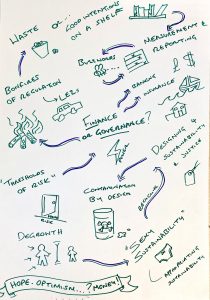
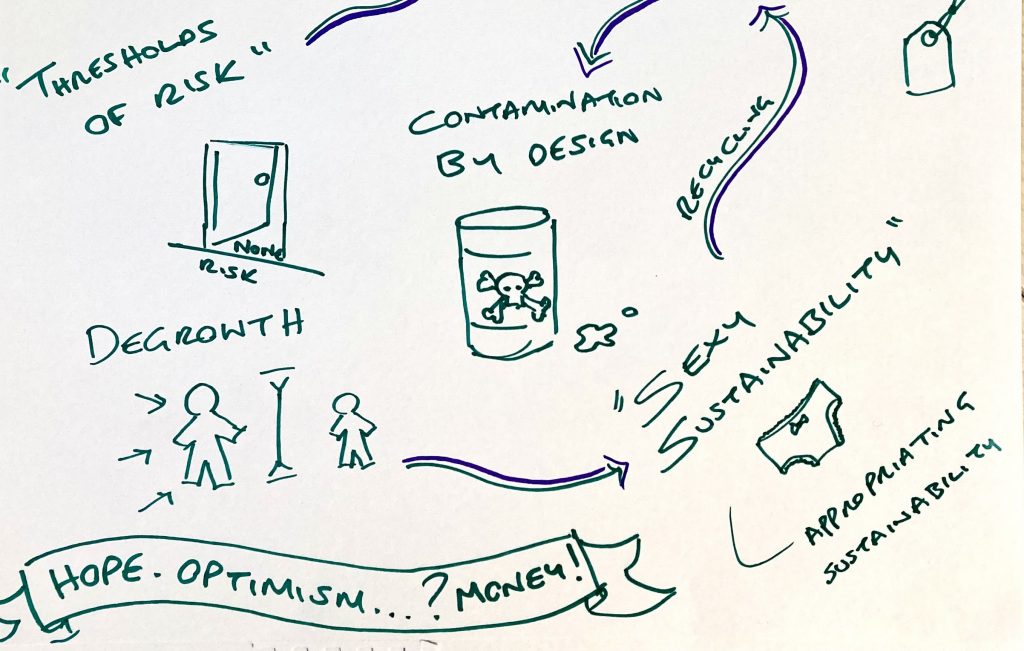
The drawing was produced during a group discussion on sustainable transitions during the SCI workshop on 24.02.2025
There is frequently a tension between optimism and pessimism in conversations about sustainability. It is clear that pessimism and frustration towards current national and global governance dynamics is shared across geographies and disciplines, by both academics and their students. Some believe that sustainability is now a strong discourse without enough action, while others argue that significant actions have been taken towards sustainability in certain contexts without a strong discourse that gains wider popular acceptance. Either way, efforts towards sustainability have not gained traction commensurate with the social and environmental challenges that the world faces, and there is little evidence that this is going to change. Even though there is no clear solution to rising obstacles to decarbonisation and other environmental objectives, keeping track of these obstacles to sustainability is itself worthwhile.
In this blog we highlight three key ideas in relation to the tension between optimism and pessimism which we suggest warrant further exploration in discussions about sustainable futures – communication, emotion, trust and the concept of ‘anti-governance’, which we further explore and explain with references to our own research below.
The problem with optimism in sustainability communication
Optimistic and pessimistic narratives emerge through the communication of sustainability. Optimism is central to many corporate sustainability discourses. Consultancies, such as Global Optimism, claim that we will not overcome obstacles to sustainability without an optimistic mindset. They advise companies to communicate this optimism to their stakeholders and consumers. In this view, people are deeply innovative and resilient. If we all approach our sustainability challenges together with genuine positivity, surely we will find a way through the climate crisis. Or so their thinking goes. But it is important to ask: why are sustainability communicators so keen on optimism?
Optimism suits corporations well because it avoids the systemic drivers of climate change. When businesses and consumers are optimistic about finding solutions, they look towards exciting futures of green technology and renewable energy. These allow business to roll on as usual, not questioning its role in environmental crises. Swap out dirty fuels for clean ones, cut down on waste and carry on extracting and polluting. Optimistic communications do not invite us to ask difficult questions about business itself. What forms of production and consumption are really necessary? But surely there is a way to approach sustainability issues without pessimistic fatalism and without strengthening the status quo.
Trust no one or trust strategically? Collaboration in green transitions
In relation to trust, an important debate is the extent to which communities and citizens can – or should – trust and collaborate with governments and corporations to achieve sustainable outcomes. Given that companies are primarily driven by profit-making imperatives, and that these imperatives make them adopt sustainability discourses and practices only insofar as they align with shareholder interests, some activists and scholars highlight that trust in these actors might be misplaced and partnerships should be avoided to evade co-optation or tokenistic practices. Governments, meanwhile, see themselves constrained by political-economic systems that prioritise economic growth and short-term political gains over meaningful sustained ecological action.
Against this backdrop, avoiding collaboration with these actors seems a sensible approach. However, this also raises difficult questions and dilemmas: if communities and citizens completely disengage from the institutions and corporations that hold significant structural power, how can we exert pressure to transform them? Can systemic change be achieved avoiding those who control the majority of large-scale infrastructure, investment, and policy?
In the context of green energy transitions and energy justice, this tension is acute. Corporate-led energy transition initiatives, such as large-scale solar and wind parks, have caused deforestation and land dispossession in various rural areas, particularly in the Global South. This has caused individuals to call out greenwashing practices and communities to lose trust in corporations and governments supporting these projects. Bottom-up approaches – rooted in community resistance, grassroots organising and community energy projects – emerge as promising pathways for more equitable and democratically controlled transitions. These, however, often lack the resources to shift entrenched energy regimes alone. A potential path for transformation may therefore require both resistance and engagement – that is, resisting co-optation and tokenism while engaging strategically to hold incumbent actors accountable.
This view speaks to a cautious optimism within sustainability debates – the belief that, despite deep flaws, institutions and corporations can be pressured, reimagined, and transformed through persistent and strategic public engagement. Building alliances between communities, cooperatives and sustainability-committed allies in public and private sectors is possibly the only way for transformative change.
The trouble with faith in the market
The idea of ‘anti-governance’ is used by Mathew Archer in his book, “Unsustainable”. He draws attention to the phenomenon of shifting responsibility not onto consumers or individuals, but onto the market itself. His research shows how the call from sustainability professionals was not for greater and more expansive environmental action. Instead, it was for greater and more expansive environmental data collection. More accurate data collection and reporting might feed the market with the knowledge it needs to deliver better impacts. Archer suggests that this ceding of responsibility is an example of anti-governance. Allowing companies and investors to kick the can down the road, the market becomes the agent that ought to organically find solutions. Could this dynamic become increasingly important in today’s context of polycrisis? Or could it even be interpreted as one of the contributing factors to intensifying the associated turbulence and consequences for businesses and everyday life?
The fashion industry serves as a good example of the phenomenon of “anti-goverance”. The sector is characterised by a prevailing and strong expectation that the market and large conglomerates will not only implement sustainable practices but also make them fashionable—thanks to their branding power—and in doing so, shift industry discourse. This mindset is also reflected in the way tech-driven, scaled, closed-loop recycling solutions are positioned as solutions in the industry. These often overlook the socio-cultural benefits of reuse practices such as repairing, reselling, and remaking and divert clothes from reuse in the network such as charity shops and ‘making’ enterprises to name a few (Grose, 2015). However, such industry-focused expectations often fail to acknowledge multi-stakeholder initiatives and alternative practices that offer valuable contributions to the sustainability discourse. Moreover, the market fosters a kind of ‘psychological black-boxing’ (Middleton, 2015: 264) of fashion, where consumers feel unqualified to engage with their garments—despite the fact that basic clothing repair is far more accessible than, say, repairing tech devices. Instead, consumers are discouraged to make any creative interaction with clothes, which often leads to premature disposal. This, in turn, inhibits alternative ways of engaging with fashion—like fostering a “making” mindset (repairing, mending, darning, sewing, knitting, upcycling etc) which opens new forms of engaging with fashion beyond mere consumption of new clothes, as reflected in range on studies of making and craft from sociological and design perspectives.
Final thoughts
Should ‘bad voices’ be silenced? What are the consequences of refusing to engage with companies or governments that permit or promote unsustainable practices? Or should we focus on urging government agencies to coordinate more effectively in implementing sustainability policies already negotiated and outlined in official documents. These decisions require and engender different levels of trust, of collaboration and ultimately of optimism.
In any case, whether we possess an optimistic or pessimistic view of possible sustainable futures, we must be reminded of our responsibility to keep trying. The phrase of Mike Davis, scholar and activist, “Fight with hope or without hope, but please do fight” strikes us as a vital mantra in these turbulent times of polycrisis and growing climate despair. Even if hope falters, our only choice is to keep striving for a future that safeguards humanity and nature from catastrophe.
Acknowledgment This piece was inspired by discussions at the SCI workshop “Governing Polycrisis and Sustainabilities”, held on February 26th, 2025. We thank SCI members and guest speakers for their insights and perspectives. Additional thanks go to Jo Mylan for her comments on an earlier version of this piece.
Contact Us
+44 (0) 161 275 0189


0 Comments