
Why the World Needs a Fossil Fuel Treaty: Building a Fast and Fair Transition
Yusra Suedi and Clare Cummings explore the Fossil Fuel Treaty as a potential roadmap toward a fast and fair energy transition.
Humanity stands at a crossroads. Despite decades of climate diplomacy, surging investments in renewable energy, and countless pledges to “keep 1.5°C alive,” the global energy system remains overwhelmingly dominated by fossil fuels. The science is unequivocal: the extraction and burning of coal, oil, and gas undermine progress toward all 17 Sustainable Development Goals — from eradicating poverty and achieving gender equality to promoting peace, health, and environmental protection. Yet, in defiance of this knowledge, the world continues to expand fossil fuel production at alarming rates.
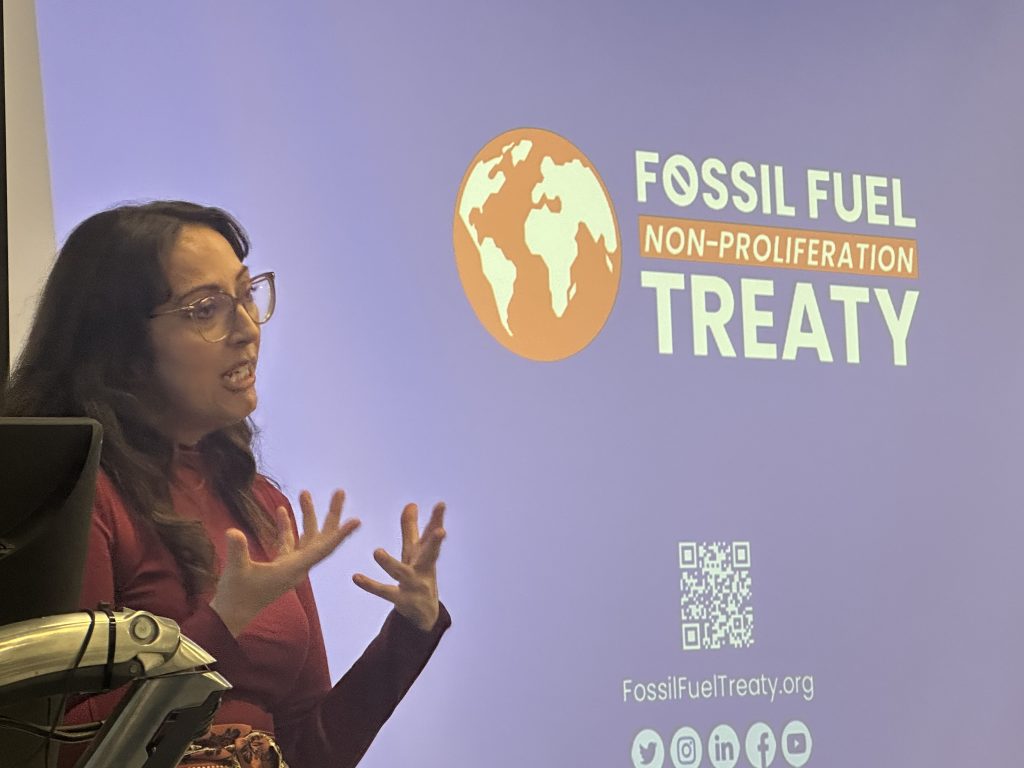
On Monday 6 October 2025, Dr Amiera Sawas, Head of Research and Policy at the Fossil Fuel Non Proliferation Treaty Initiative, gave a lecture organised by the University of Manchester’s Climate & Justice Group where she made the case for a Fossil Fuel Treaty (1), discussed the problems with international law (2) and shared some silver linings and hope for the way forward (3).
The Case for a Fossil Fuel Treaty
The proposed Fossil Fuel Treaty rests on three essential principles: a just transition that supports countries and communities as they move away from fossil fuel dependency; non-proliferation, which would halt any further expansion of coal, oil, and gas production; and a fair phase-out of existing operations aligned with global climate goals. Together, these principles represent a roadmap for an energy transition that is both fast and fair — one that protects workers, communities, and economies while safeguarding the planet.
Despite notable growth in renewable energy capacity, the global share of fossil fuels in total energy demand has barely changed over the past decade. Investment continues to flow disproportionately toward oil, gas, and coal, crowding out resources that could accelerate clean energy transitions. Moreover, the absence of a coordinated international plan risks a chaotic and unequal transition, where Global South countries producing fossil fuels are left with stranded assets and face economic shocks. This heightens social and financial instability, exposes workers and communities to deep insecurity and reproduces stark global inequalities in energy access, economic development and capacity to respond to the climate crisis.
Recognizing these dangers, a group of climate activists, academics, and policymakers have rallied behind the idea of a Fossil Fuel Non-Proliferation Treaty: a new international mechanism designed to manage a just and orderly phase-out of fossil fuels. Seventeen countries, led primarily by Small Island Developing States, are already participating in the discussions, calling for a cooperative framework that would guide the world through this monumental transformation.
Struggles Within International Law
While political barriers to a treaty on fossil fuel phase out are many, the role of international law is key. Unsurprisingly, then, international law has only recently broken its silence on fossil fuels. For decades, global climate agreements avoided naming the problem directly — it wasn’t until COP28 in Abu Dhabi in 2023 that the words “fossil fuels” appeared in an outcome document for the first time, marking a long-overdue acknowledgment of their central role in driving the climate crisis.
Other areas of international law have also been slow to make progress. Negotiations for a Global Plastics Treaty, for instance, have reached a deadlock as of August 2025, demonstrating how vested interests can paralyze urgent environmental action. Likewise, the investor-state dispute settlement system continues to give corporations the power to sue governments for enacting climate policies that threaten their profits, effectively discouraging states from taking decisive action against fossil fuels.
Silver Linings in a Difficult Landscape
Amid these daunting realities, there are rays of hope. The United Nations Framework Convention on Climate Change, despite its many flaws, remains the largest and most inclusive global platform for civil society engagement on climate issues. Momentum is building around proposals to recognize “ecocide” as an international crime under the jurisdiction of the International Criminal Court. Excitingly, the advisory opinion from the International Court of Justice in 2025 has further clarified states’ obligations in addressing climate harm and the first international conference dedicated to the phase-out of fossil fuels, scheduled for April 2026, promises to mark a historic step toward global coordination.
While the upcoming COP30 in Brazil is not expected to produce the international agreements on fossil phase out that are so urgently needed, the efforts of advocates and allies for an equitable fossil fuel treaty provide valuable support to Global South delegations. Ultimately, the call for a Fossil Fuel Treaty is not simply about ending the age of coal, oil, and gas. It is about reimagining the global order — one that shifts from competition to cooperation, from extraction to restoration, and from profit-driven growth to shared wellbeing. The question is no longer whether the transition should happen, but how — and who will be left behind if we fail to act collectively.
A video of Dr America Sawas’ lecture is available here.
Find out more and join the Climate and Justice study group here.
Contact Us
+44 (0) 161 275 0189


0 Comments