
Politics, turbulence, and UK climate politics
Matthew Paterson argues that growing political instability in the UK presents both opportunities and challenges for future climate policy.
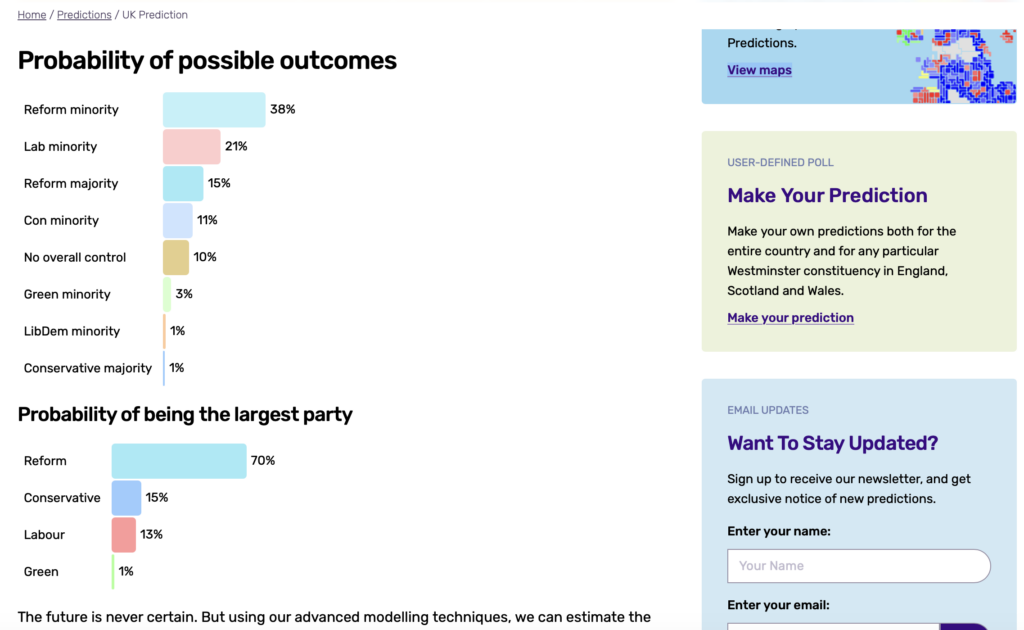
Image: Possible outcomes in the next UK general election. Source: Screenshot from the Electoral Calculus General Election Prediction tool (https://www.electoralcalculus.co.uk/).
That UK politics is in a state of turbulence is perhaps a banality. We have had a few years of unprecedented change in electoral dynamics, with the rapid rise in the number of competitive parties, wild swings in polling for different parties, and acute challenges for those seeking to reproduce some sense of stability in the UK polity.
For those seeking to pursue climate action it provides obvious challenges, but also a fair few opportunities. On the one hand the rise of Reform UK, and the switch in tack by the Conservatives towards opposition to climate action create a significant risk that UK climate action – still inadequate but nevertheless ‘world-leading’ in many ways – will be undermined.
On the other hand, the rise of the Green Party places significant pressure on the Labour government not to roll back climate action. Labour is now losing more votes to the Green Party than it does to Reform.
Understanding “turbulence”
But, as the SCI has been thinking about for a while, can the turbulence become something more than a buzzword? It is clearly a useful metaphor, or heuristic device, to capture the sense of bewildering, non-linear, disruptive change, that people have used variously to describe changing geopolitics, electoral upsets, radical techno-economic shifts, as well as accelerating climate impacts themselves.
But it is a concept that can be grounded more fully in underlying theoretical frameworks that might start to give us more purchase in understanding how the world is changing and how interventions towards sustainability within that changing world might be usefully pursued.
In terms of the UK’s contemporary politics, here is idea as to how we might go about that. The starting point for each is to think about the grounding of the term turbulence in systems-theoretic ideas. Turbulence is in this sense a particular state of a system when its underlying organising structure no longer reproduces some sort of stable system operation. All systems have some underlying organising principles that can be simple and predictable (a Newton’s cradle is the classical example), or complex and dynamic (but nevertheless for the most part self-reproducing – a mature ecosystem for example). But each of these types of system will have limit conditions – if you push them beyond those they will shift to other states or become turbulent – take the starting marble above 90°, or introduce a radically new nutrient flow into the ecosystem.
Why the UK electoral system is becoming more volatile
The UK electoral system can be understood in these terms. It has some basic rules that make it a system. Candidates are elected in individual constituencies and all they need to get is more votes than anyone else to be elected (first-past-the-post). Candidates are organised into groupings we call political parties, that serve as means for voters to decide which one to vote for. Governments are formed from groupings of candidates (parties) that can secure a majority of MPs that are elected.
This system typically produces a system where two parties become dominant, compete with each other, and crowd out smaller parties. This is referred to as ‘Duverger’s law’. Parties have an incentive to be ‘broad churches’, i.e. to attract a broad swathe of the electorate, to maximise the chance that they win in as many constituencies as possible. Typically, this then increases the share of seats gained by the two largest parties compared to their vote share. In the 2024 general election for example, Labour and Conservatives between them got 55% of the vote, but 82% of the seats in parliament.
However, there are limit conditions to this, and when breached, the volatility increases, or the system becomes turbulent. We can expect wild swings in electoral outcomes and much greater difficulty in forming governments. We have learned in the last 2-3 years of some of these conditions. First, voters are no longer sufficiently attached to one of the ‘two main parties’ to reproduce the two party system. Second, five parties are now competitive in UK-wide elections (with of course two others competitive in Scotland and Wales specifically). This reduces the threshold for being elected in any given constituency and increases the likelihood of election-to-election volatility. Third, in this context, the impact of single issues (Brexit having been the biggest one in the last decade) has recomposed voter coalitions drastically and in messy ways. Fourth, there are widely diverging geographical patterns in voting, giving more latitude to regional parties or effective campaigning candidates. Finally, this makes the arithmetic for majority government much more difficult to establish.
Psephologists (those political scientists who study elections) have various ways to measure electoral volatility. One is the effective number parties in the system, defined as parties that can compete nationally in elections. In the UK, this has gone from a steady number around 2.3 in the post-WWII, rising to 3 in 1980 (the resurgence of the Liberals and the founding of the SDP) but has shot up since 2000 and is now at 4.5.
The other is known as the Pedersen index, which measures the aggregate percentage of voters who switch party between one election and the next. For the UK, we have figures going back to 1830 for this. It was stable at under 10% in the 19th century, then had two periods of volatility in the inter-war period (especially the 1918 and 1931 elections) which were to do with the rise of the Labour Party and then the formation of a national coalition government in response to the 1929 economic crisis. It was then again stable at around 10% through to about 2010, but has risen dramatically. In the 2024 election it was 21.8, close to the level for 1931: i.e. 21.8% of voters in 2024 voted for a different party for the one they voted for in 2019.
And remember that was before we saw the rise of Reform to a leading place in the opinion polls, followed later by the Green Party. We can fully expect that number to be higher still in the next election, representing dramatic volatility in the electoral system.
What does this mean for climate action?
This is one way to think about turbulence more fully in theoretical terms. There are others, to be sure. But the patterns we see in British politics are similar elsewhere, with the exception that in most places the electoral system (mostly proportional ones) have dampening effects on electoral volatility not intensifying effects.
I have strayed somewhat from the question of sustainability perhaps. But it is critical to the pursuit of sustainability in the UK. The policy basis for environmental policy in general, and climate policy in particular, in the UK, has been the backdrop of a relatively stable political climate, with Duverger’s Law operating, and competition between Labour and Conservatives being mostly about who can do climate policy most effectively. We now face a very different political environment for pursuing the next phase of climate policy.
Contact Us
+44 (0) 161 275 0189


0 Comments