
Following the Fibre: South-South Innovation Exchange between Nepal and Kenya
Sönke Mestwerdt draws on fieldwork in Nepal and Kenya to explore how social innovations travel across the Global South and the conditions that enable new ideas to take root in different settings.
Photographs: courtesy of Sönke Mestwerdt
 What does a discarded banana stem in Nepal have to do with a workshop near Nairobi? Quite a lot, as it turns out, and connections like this are exactly what our research project on Global South-South social innovation replication sets out to understand. Together with colleagues ESCP Business School and Copenhagen Business School, we currently work on a study that aims to understand how organisations in the Global South collaborate and exchange knowledge and innovation directly with one another. In this post, we share first insights from our two field trips in 2026: to Nepal in January and to Kenya in April, supported by the Manchester Institute of Innovation Research Small Grant.
A blind spot in innovation and sustainability research
Innovation research has long described knowledge as flowing from the Global North to the Global South, through technology transfer, diffusion and, more recently, “reverse innovation” travelling in the opposite direction. Sustainability research, in turn, champions South-South cooperation as a principle of fair and context-sensitive transitions, yet rarely examines empirically how such collaborations between organisations. In both fields, flows between Global South contexts remain largely undertheorised.
At the same time, development agencies increasingly promote open knowledge platforms. On these platforms, organisations publish white papers, manuals and guidelines on their social innovations, so that others can replicate them to create and scale social impact around the world. The implicit assumption is that innovation can travel through documentation. Our project asks what happens when it does.
At the same time, development agencies increasingly promote open knowledge platforms. On these platforms, organisations publish white papers, manuals and guidelines on their social innovations, so that others can replicate them to create and scale social impact around the world. The implicit assumption is that innovation can travel through documentation. Our project asks what happens when it does.
The case: from banana waste to menstrual health
 For our study, we work with two organisations that share a resource logic but differ in almost everything else. In Nepal, a non-profit turns banana stems (an agricultural residue left after harvest) into the absorbent core of compostable menstrual pads. It combines this with local employment, much of it for women, and with educational work against menstrual stigma, which is a big challenge in Nepal.
In Kenya, an enterprise near Nairobi already processes banana fibre into hair extensions and woven carpets, seeing itself as a commercial not necessarily social enterprise.
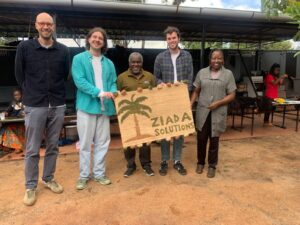
The Kenyan organisation found the Nepali innovation documented on such a platform and set out to adopt the pad production. What began as the replication of a single product has since developed into a broader, reciprocal exchange: delegations have travelled in both directions, and the exchange now extends to other fibre products and organisational practices.
Following the innovation: our fieldwork
 In our work, methodologically, we follow the innovation itself across sites, combining interviews, observation, photography and document analysis in a qualitative, longitudinal design. In Nepal, we worked in Kathmandu, Bharatpur, mountain villages and Susta, tracing the value chain from the banana fields through fibre extraction to pad production. We interviewed machine operators, engineers, managers and workers, as well as educators and the women who use the pads, and joined the team on field visits to rural communities.
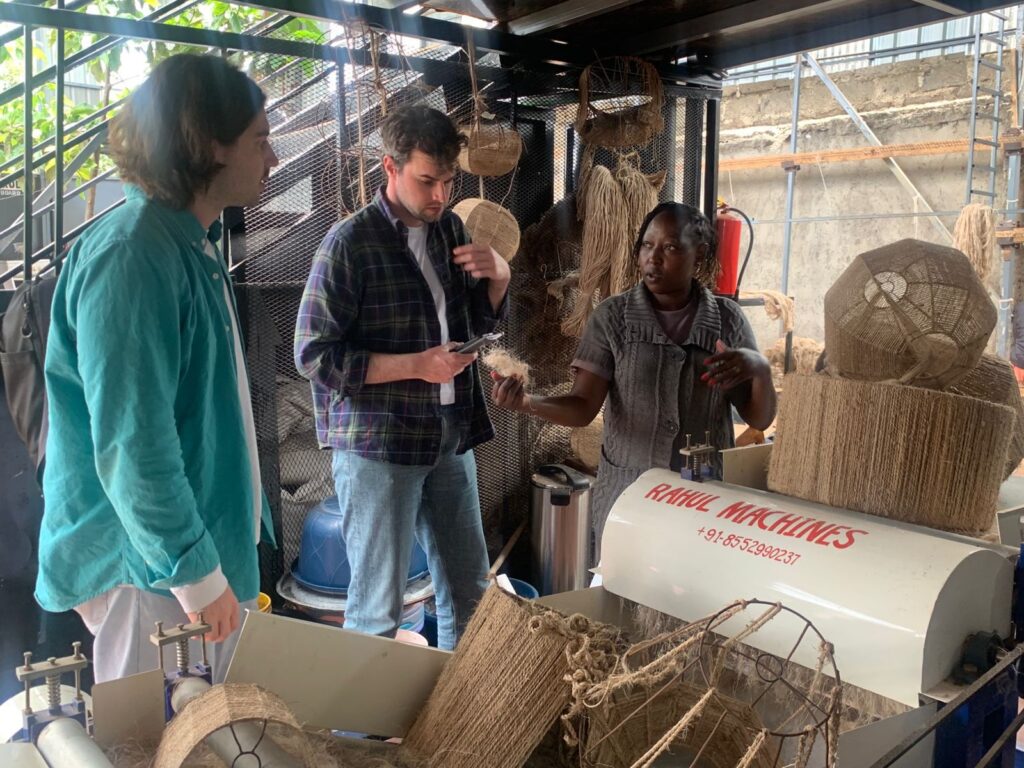
In Kenya, we visited the partner’s production sites around Nairobi, spoke with its leadership and observed how existing fibre capabilities might accommodate the new product. White papers, company documents and regular online check-ins between trips allow us to follow the collaboration as it unfolds.
Emerging insights
Although the project is still in its initiation phase, three observations stand out. First, documentation opens the door but does not carry the innovation through it. The platform material made the Nepali solution visible, but much of the knowledge that matters about how fibre behaves, how machines are tuned, how menstrual stigma is addressed in communities is tacit and travelled only through visits and conversation.
Second, adoption builds on existing capabilities. The Kenyan organisation’s experience with banana fibre gave it the absorptive capacity to engage with the innovation. Rather than “scaling”, the process resembles re-rooting where the idea is adapted to a new market, material base and institutional setting.
Third, the flow became reciprocal. Replication turned into mutual learning, in which both organisations act as sources and recipients of knowledge, a dynamic that linear diffusion models struggle to capture.
Why this matters
For sustainability scholars, the case shows a circular bioeconomy solution developed and diffused entirely outside Northern institutions, linking waste valorisation, plastic reduction and women’s health. It raises questions about whose knowledge is recognised and funded in just transitions. For innovation scholars, it points to the limits of codified knowledge, the brokering role of digital platforms and the need for theories that treat South-South exchange as a phenomenon in its own right.
Next steps
Over the coming months, we will continue to follow the collaboration and observe the unfolding. We are particularly interested in what is adapted, what is reinvented and how the relationship between the two organisations evolves. We look forward to sharing further findings with both the MIoIR and SCI communities.
Dr Sönke Mestwerdt is Assistant Professor of Entrepreneurship at Alliance Manchester Business School, The University of Manchester, and a member of the Manchester Institute of Innovation Research (MIoIR) and the Sustainable Consumption Institute (SCI). His research focuses on entrepreneurship and innovation in emerging markets. We gratefully acknowledge MIoIR’s financial support for the Kenya fieldwork.
Contact Us
+44 (0) 161 275 0189


0 Comments