
Feeling Transitions: Key Themes from the SCI Workshop
Pawan Srikanth and Tetyana Solovey on interdisciplinary themes and discussions that animated the “Emotions and Affect in Transitions” workshop.
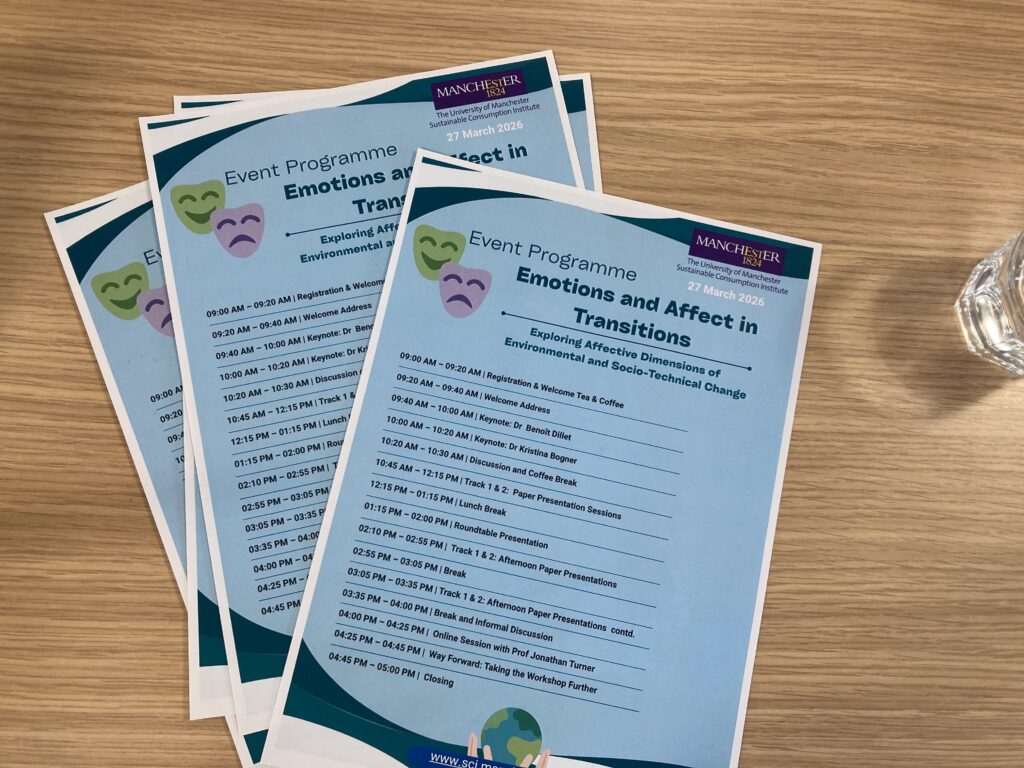
The “Emotions and Affect in Transitions” workshop, held on 27 March 2026 at the Sustainable Consumption Institute (SCI), University of Manchester, brought together interdisciplinary scholars to explore how affect shapes environmental, socio-political, and socio-technical change. As part of the organising team, I had the opportunity to engage not only with the intellectual contributions, but also with the affective atmosphere of the event, marked by curiosity, openness, warmth, constructive criticism, and moments of productive enthusiasm. A central insight emerging from the workshop is that affect operates across different levels of social life, from individual experience to community dynamics to broader structural/governance levels. The structure of the workshop naturally moved across scales. Importantly, this wasn’t just something we realised afterwards. It was intentionally built into how the workshop unfolded.
Climate Politics, Affect, and the Problem of Technological Hope
The presenters and participants in many ways reflected the growing tension in climate politics, especially the backlash against energy transition policies. This tension reflects a wider conflict between what some scholars describe as the “fossil coalition” and the “climate coalition” (Charbonnier 2025, cited by Benoît Dillet). What appears irrational in these conflicts becomes more intelligible when viewed through the lens of affect: emotions shape how people attach to or resist climate action.
A recurring theme across the workshop was the emotional dimension of human–technology relations, reflected in two key notes speakers Benoît Dillet and Kristina Bogner. This connects to broader scepticism toward tech‑driven solutions in green transitions – visible in debates about car dependency, optimism and pessimism in sustainability, anti‑net‑zero populism, and imaginaries of green futures. What this workshop added was a focus on the affective dimension of technological solutions and how these emotions circulate between humans and non‑humans, shaping political positions and public imaginaries of the future.
Benoît Dillet showed how affects such as shame, joy, and excitement energise competing technological futures, from the celebratory extraction politics of “drill, baby, drill” to the anxieties surrounding green transitions. Drawing on Günther Anders, he contrasted Promethean shame, which reinforces faith in technological perfection and delays climate action, with Epimethean shame, a reflective stance that acknowledges entanglement, harm, responsibility and a mode of “thinking after” catastrophe (Dillet 2026). Kristina Bogner extended this affective perspective by drawing on feminist affect theory and Lauren Berlant’s concept of cruel optimism, showing how hope invested in technological solutions promises sustainable futures yet often blocks the systemic, cultural, and low‑tech transformations needed for socially just transitions. Together, these keynotes underscored that technologies are never neutral. Affective attachments to technologies have political consequences: they are emotionally charged, shaping which futures feel desirable, possible, or inevitable.
How Do We Study Emotion?
 Methodological questions were another key thread throughout the workshop. Mari Martiskainen and Steve Hall reflected on how emotions are often overlooked in energy research. While theoretical framings of emotions in energy transitions are diverse, they are still frequently reduced to a binary of rational decision‑making versus emotion. Much existing research relies on individualised, self‑reported, or small‑scale methods, prompting their call for more robust approaches capable of capturing how emotions shape decision‑making. Jo Hamilton extended this discussion by examining the marginalisation of emotions in professional and organisational contexts, where “urgency over agency” often dominates. She showed how emotional dynamics within climate‑related work reflect broader power relations and structural pressures, arguing for the need to de‑marginalise emotions in climate change research and practice.
The roundtable session created space for conversations across different approaches, from traditional social science methods to mixed-methods and emerging computational tools. Participants reflected on how techniques like oral histories, text analysis, surveys and psychological tests can work together to better capture the emotional side of transitions. A clear takeaway was the value of combining methods (considering epistemic compatibility – of course!) when studying something as complex as affect. At the same time, the discussions highlighted the importance of working ethically (and emotionally) with communities, especially in co-creative research settings.
How Emotions Shape Governance, Finance, and Community Transitions
The workshop’s sessions, led by keynote and lead speakers, set out the bigger picture, offering macro-level perspectives on governance, politics and transition. In Track 1, sessions led by Mihaela Mihai, Benoît Dillet and Dan Degerman set the tone by foregrounding the political life of emotions, from Mihai’s exploration of ecological grief, anger, and hope as forms of political expression, to Degerman’s analysis of “emotion extraction” and the injustices involved when feelings are shaped, suppressed, or compelled within institutional contexts. Meanwhile, Felicia Liu and Ben Eyre showed how feelings like trust, fear, “green buzz” shape sustainable finance, and importantly, how the absence of emotions like shame and guilt is itself revealing in how finance mobilises affect. Because finance is future‑oriented and inherently speculative, the process of speculation is always infused with feeling. Emotions become part of calculation and planning (shaping “how the market feels”) reminding us that markets are not purely rational systems but deeply emotional ones.
Several presentations move between individual experiences and community dynamics. The discussions also reflected the tension between individual lived experiences and collective community interactions. For instance, Sara Melasecchi’s “Understanding emotions in LTNs implementations – East Bristol Liveable Neighbourhood” demonstrated how these individual emotional responses aggregate into collective tensions, divisions, and solidarities within communities. Her work further showed how what is often labelled as “emotional resistance” can in fact reflect deeper structural inequalities, particularly around mobility, access, and everyday constraints. Similarly, Deborah Lane’s “Climate Emotions, Mental Health and Climate Action” focused on how climate distress is experienced and supported in practice, highlighting the role of eco-psycho-social approaches, nature-based methods, and community spaces in helping people process difficult emotions. Her sharing of seeds collected during her fieldwork added a small but powerful reminder of the care, connection, and more-than-human relations at the heart of her work.
Across the workshop, several presentations highlighted the darker or more ambivalent side of emotions and the connections between power, and justice. Emotions were seen as important signals of social tensions and inequalities, but also something to approach with care. They can reveal injustice, but they can also obscure it – empowering some groups while marginalising others depending on the context. This ambivalence was a useful reminder that affect needs to be engaged critically, rather than treated as a straightforward measure of social outcomes.
A fitting closing thread came from Jonathan H. Turner, who, despite joining from California amid a few connectivity hiccups, helped tie the discussions together through his decades-long work on emotions. He emphasised that emotions play a fundamental role in shaping language, culture, and societal progress, reminding us that if we want to build better societies, we need to take emotions seriously.
Contact Us
+44 (0) 161 275 0189


0 Comments