
Longing for the “Spirit of Seattle”: As the climate and global politics heat up, a curious calm reigns at the WTO Public Forum 2026
Silke Trommer and Yeqi Jin from the Department of Politics discuss the WTO Public Forum 2026 and its alarming lack of engagement with issues of trade and social justice, and sustainable development.
The World Trade Organization (WTO) Public Forum celebrated its 25th anniversary this year, having been originally convened in 2001 as the Symposium on Issues Confronting the World Trading System. During the infamous 1999 Battle of Seattle and what came to be known as the “WTO legitimacy crisis”, feminists came together with workers, environmentalists, developmentalists and other groups to challenge the institutional set up, political power and corporate-centric rationale of trade governance in the neoliberal era.
 Yet, at the WTO Public Forum 2026, only those around long enough to have experienced the WTO’s politicised and conflictual past could have known about this critical history. While banners in the main lobby celebrated the 100th anniversary of Centre William Rappard – the building that housed the International Labour Organization from 1926 to 1975 before becoming home to the WTO’s predecessor, the General Agreement on Tariffs and Trade, in 1977 – no commemorations marked the 25thanniversary of the Public Forum. This absence occurred despite the fact that the Forum, in the WTO’s own words, remains one of its key public transparency mechanisms and an opportunity for all of its stakeholders to voice their views on “latest developments in global trade” and on “ways of enhancing the multilateral system”.
Yet the WTO Public Forum 2026 failed to serve the event’s original purpose of providing space for participation, contestation and deliberation. The 2026 Forum was a day shorter than in previous years, while session times had been cut from 60 to 75 minutes. This set up gave the WTO Director-General (DG) Ngozi Okonjo-Iweala the opportunity to state that 2026 was the biggest WTO Public Forum ever, while individual participants testified informally on WTO corridors that they felt the Forum had never been this placid, with few in-depth discussions or relevant questions on the session floors.
Topics that once animated WTO critics and that remain alive and pressing, such as trade and (global) social justice or trade and sustainable development, remained on the margins of the Public Forum agenda. (For example, see the word cloud generated from 2026 WTO Public Forum session titles in image below).
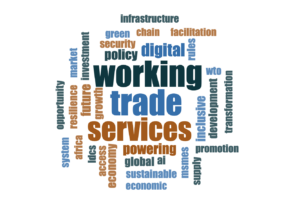
Here, we look at gender and trade/inclusive trade and trade and environment/climate specifically.
Inclusion without redistribution
At this year’s Public Forum, a trend from 2025 continued, whereby gender and trade debates – which had been front and centre of the Forum programme over the previous ten years – only featured on 12 out of 114 session titles. Instead, services and digital trade were central to discussions. These topics are, however, far from separate issues. The fact that the digital transformation of the global economy and society entails a profound restructuring of global economic relations, including gender relations, was not lost on a small number of sessions, where panellists considered the ways in which trade regulators may empower women entrepreneurs and traders to share in the gains from digital trade and digital services trade in particular.
Yet, the wider and well-detailed risks of the currently dominant digital economy model received scant attention. These risks include, among others, gender bias in algorithms, gender-based and intersectional discrimination and violence online, exclusion of marginalised genders in digital governance and technology development, exploitation of feminised paid and unpaid labour, and the digital economy’s destructive relationship with nature. As a participant on a session regarding the trade case for considering women remarked, in the current digital trade model, we risk “efficiency without redistribution”. 
Such remarks on people’s lived experiences outside of the strict confines of digital marketplaces were spectacularly rare at the Forum. Indeed, there was only one panel, co-organised by Friedrich Ebert Stiftung and the main German development agency, Deutsche Gesellschaft für Internationale Zusammenarbeit (GIZ), that asked wider questions of “gender justice”. For the most part, sessions advocated plugging women or otherwise marginalised entrepreneurs into existing digital markets and digital economy models, despite risks of reproducing gendered and intersectional inequalities inherent in market-based and corporate centric gender mainstreaming approaches.
Sustainability without nature
In sharp contrast with previous years, the original environmental concerns of sustainable development – famously a stated goal of the WTO – was also diluted at the Forum, ironically at the end of Europe’s hottest summer on record. A panellist on a circular services and economy session pointed out that sustainability was no longer as prominent on the agenda as it had been three years ago. Sustainability, green trade, and/or climate action themes featured only in 9 out of 114 session titles. This paucity leaves a worrying governance gap, not least because the Director of the WTO’s Trade and Environment Division warned on a service trade and climate action session that trade was barely discussed within climate governance frameworks such as the UN’s annual COPs.
The trade/environment governance gap is exacerbated when considering that in Forum discussions, terms such as “sustainability”, “ecosystem”, and “environment” were often used in a business context. Speakers using these terms were not referring to ecological processes or nature, but were calling for stronger interconnections among business actors, the development of supporting secondary industries, and the coordination of industrial regulations. These concepts were thus increasingly devoid of their original environmental content.
At the same time, digitalisation and AI-driven development received considerable attention and unquestioned optimism in their potential to support environmentally friendly trade sectors, including the circular economy and green services. While much of the discussion focused on how AI and digital technologies could power a more sustainable future, the sustainability of the digital and AI transition itself was rarely questioned. Audience questions around the documented high energy consumption, intensive extraction and use of raw material resources, including water, and growing electronic waste received speculative and at times puzzling answers from policy-makers. The latter included the suggestion, made on the trade case for considering women session, that AI may help expand water access.
Longing for the Spirit of Seattle
Overall, the WTO Public Forum showed a spirit that WTO negotiations have long been lacking, namely that of consensus. Unfortunately, this consensus was achieved by largely bracketing out or de-politicising some of the most pressing problems of our time.
 As one WTO official remarked: “We need the spirit of Seattle”. Instead, blind faith in technological solutions to global crises was common among global policy elites convening at the WTO Public Forum. Yet, it is misplaced and in need of disruption. As DG Okonjo-Iweala passed on her message that the WTO needs stronger public engagement in a meeting with civil society representatives, one can only hope she agrees.
Authors:
Silke Trommer, University of Manchester and Women in Development Europe+: silke.trommer@manchester.ac.uk
Yeqi Jin: University of Manchester: yeqi.jin@postgrad.manchester.ac.uk
Contact Us
+44 (0) 161 275 0189


0 Comments