
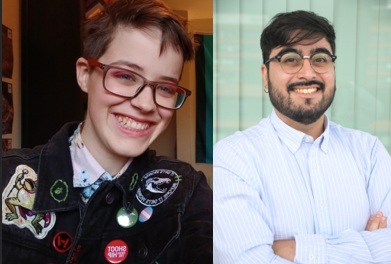
Dr. Francisco Espinoza and Jasper Samuels: The LGBTQ+ Politics staff and students network trip to People’s History Museum
The LGBTQ+ Politics staff and students network recently visited the Re/Assemble exhibition at the People’s History Museum. As a group of undergraduate students, PhD students, and lecturers, we participated in a guided visit to a new exhibition that brings together historical banners from Manchester-based organisations, video and photographic archives, legal documents, and newly commissioned artworks.
The exhibition centres on the 1988 protest against Section 28 in Manchester, which stands out as a critical reminder of the institutional constraints placed on LGBTQ+ lives. Introduced in 1988 under Margaret Thatcher’s premiership, the legislation stated that local authorities such as schools “shall not intentionally promote homosexuality” or present “the acceptability of homosexuality as a pretended family relationship”. The possibility of discussing identity, sexuality, and lived experience in schools was severely restricted, and teachers and students were silenced.
Pieces on display included historical items such as banners made by protesters, such as a banner for ACT UP! (AIDS Coalition to Unleash Power) created around 1989, framed documents such as the Local Government Act of 1988, which contained Section 28, and a nun’s habit belonging to one of the Manchester Sisters of Perpetual Indulgence, an LGBT group that still exists today and focuses on “spreading joy and happiness”, “fighting for good causes”, and “lending a helping hand”.
The exhibition also included contemporary artworks specially commissioned. These include a tower of fabric showing the faces and faceless of those who protested Section 28 by the artist Yuen Fong Ling, and the textile artwork by Sarah-Joy Ford and Rachael Field featuring an LGBTQ+ couple standing in front of censorship and waving Palestinian flags.
These pieces were a call for action. It reminds us that resistance has always been part of this history: organisations mobilised, protested, and created spaces of solidarity in the face of exclusion, and that legacy certainly matters for how we think about higher education today. Almost four decades on from the introduction of Section 28, and over twenty years since its repeal in England, the challenges facing LGBTQ+ people in educational institutions are far from being over.
Recent developments, such as the Supreme Court’s interpretation of the Equality Act 2010 limiting trans rights and the government’s guidance to schools, advocating a “very cautious” approach to allowing trans students to socially transition, serve as a reminder that progress is neither linear nor guaranteed. Discrimination, surveillance, and exclusion continue to shape many LGBTQ+ lives, reinforcing the need to keep these conversations active within our institution.
For us, the visit was both reflective and pedagogical. It connected directly with our teaching, where we engage with topics such as sexuality, media representation, grassroots organising, and protest. We could also connect it with our research, bringing the UK experience in a comparative perspective, contrasting it with cases such as China and Latin America. This exhibition provided the opportunity to visualise and contextualise the study of LGBTQ+ movement by engaging with the documents, banners and images of protesters in person.
This was an opportunity to create an inclusive learning environment. Events and spaces like this visit are important because they allow us to connect the history of the LGBTQ+ movement with our own experiences, turning them into valuable learning opportunities. This reminds us that equity, diversity, and inclusion are principles we practice collectively and continuously, making a real difference for marginalised groups.


Contact Us
+44 (0) 161 306 6000


0 Comments