
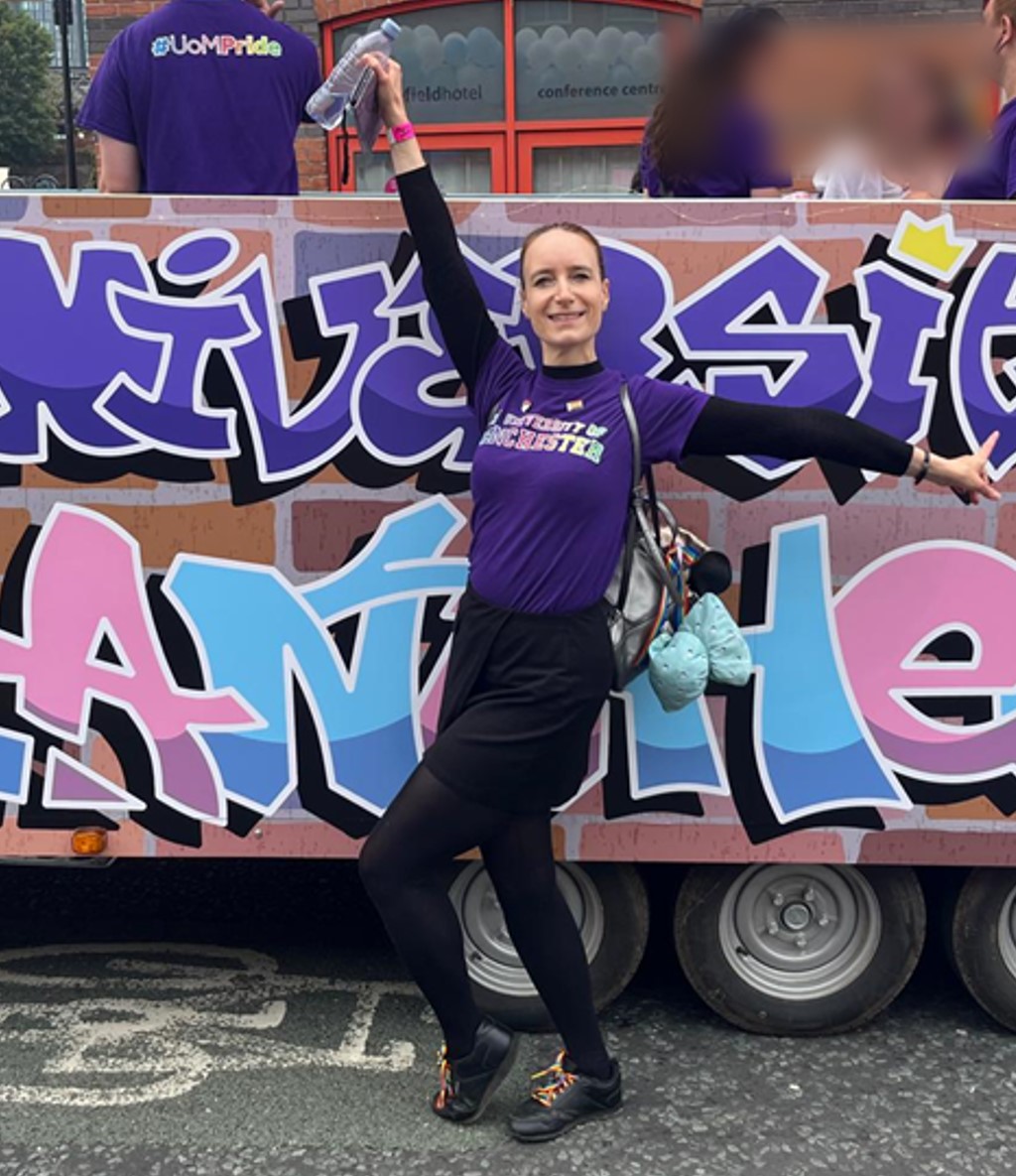
Heike Holubek: Aromantic Visibility Day 05 June 2026 – Challenges of living in an amato-normative society
In my previous blog I focussed on the grey-sexual part of my identity. This follow up’s topics refers to the grey-romantic aspect of my identity.
I was sure from an early age that I was never going to marry, but, of course, everyone thinks you will change your mind, at least once you have met the “right” person. Every nut has its bolt, hasn’t it? Once grown up, matured, etc. every “normal” person will want to settle down with a spouse and start building their nuclear unit.
What if a person feels the benefit of their wider interests in the worlds much more deeply than any sexual or romantic encounter or values relationships with their friends and family members more than any romantic encounter. How many decades do we have to wait for the “right” person, how many efforts to fix ourselves do we have to undergo before we are allowed to acknowledge that a lot of societal expectations do not work for everyone.
We live in an amato-normative society. Most people in our society have an assumption, consciously or unconsciously, that every person strives for an ideal relationship that is filled with romance, emotional and sexual experiences and that such types of relationships are considered essential for a healthy and happy life and dominate over other relationships (Glass, 2022)
An aromantic person does not experience romantic attraction to anyone, grey-romantic people very rarely experience romantic attraction to anyone. Some people are both, aromantic and asexual, but people can be either or just one to a certain extent.
Misconceptions about Aromantic people
There are a lot of misconceptions about the aromantic community. Many people seem to think that if you are unable to fall in love in a romantic way, you must be a lesser human being. For instance, in 2021 Yasmin Benoit, the UK’s most prominent asexual and aromantic activist, created a video for Stonewall on how to be a good ally to the aromantic community and consequently, her social media accounts were flooded with hate comments. Aromantic people are often labelled as narcissists, psychopaths, as people with unresolved traumatic experiences, serious mental health or developmental issues and who generally must be unable to experience any form of love and emotions. Respondents to the Fowler et al. (2024) qualitative investigation into the aromantic community reported they have been misconceived as generally incapable of experiencing any feelings and love, as having an unfulfilled life, and specifically allosexual aromantics are often labelled as sexual predators.
What is love?
This rather philosophical question is one I as a grey-romantic person probably ask myself a lot more than many in the average population. Is romantic love really the most important kind of love and is it justified to prioritise it over other kinds of love?
We grow up with fairy tales about true romantic love, read novels about the joys and difficulties of finding and maintaining romantic and sexual relationships, have endless songs and poems about romantic yearning and heartbreak, and watch movies and TV shows where at least one character needs to get their act together and settle down by finding their “person”.
These stories can often be really enjoyable, even soothing, but why does our culture and society seem to rate familial or platonic love as less important and less interesting when we think about happiness and fulfilment in life? For most of us the love towards parents, siblings and children and our friends plays an incredibly important role in our lives and helps us to forge lasting communities. Just because a person does not fall in love with a romantic partner very easily, they most likely are very much capable of showing and experiencing love towards their family and friends. Yet, this seems to come across as less important when rating the emotional matureness of an aromantic individual. Without a primary romantic partner, friends tend to play a bigger than average role for aromantic people.
Asexual and aromantic people often use the split attraction model to describe their experiences and relationships in quite thoughtful terms. Some aromantic individuals call deep friendships queer-platonic relationships.
Research by Isolani et al. (2026) suggests a new Multidimensional Attraction Measure that distinguishes between seven forms of attraction experienced by individuals: intellectual, aesthetic, emotional, platonic, sensual, romantic and sexual. The idea is that different forms of attraction can occur separately from each other and contribute in different ways to creating different affectionate bonds with the people we feel attracted to.
The challenges of living single
Single living might be a rather common living situation, particularly for a middle-aged person. When I was younger it was as likely for my friends from school and university to spend an evening or a holiday trip with me and other friends as they did with their romantic partners. However, once they formed new households with their partners friendship patterns started to change quite drastically. Couples spend more time with other couples, parents with other parents, etc. I have been very happy for my friends to find fulfillment in their new chapters, but I also realised that I had moved somehow to the fringes of my community. Many in my environment had the best intentions but couldn’t realise how significantly their and my life experiences had diverged. Without a significant other you often have to choose to either meet up with couple friends and risk the feeling of being a third wheel or to be confident in doing things on your own and to look for new connections.
How much the amato-normative society dominates our thinking is also reflected in the media. In Heartstopper episode 3×02 Isaac who is an asexual and aromantic character joins his friends for GCSE results day as they all had planned to go together for a meal. After his friends decide last minute to change their plans, they quickly apologise and leave to hang out with their girlfriends. Isaac is left on his own at the school gate. In the unbearable loneliness” of aromanticism video essayist Rowan Ellis discusses similar experiences that her aromantic followers had shared with her.
There are also financial implications. There is no one to split rent or mortgage with, there are no tax rebates for singles. Council tax discount is only 25% and most household bills have the same rate for a single household as for a family. There are less holiday options on offer for lone travellers and these are usually more expensive. In order to communicate and socialise in person, single people most likely need to leave the house to engage in activities that cost money, such as going to the cinema, the pub, the theatre or an exercise class.
It is also difficult to find good medical and mental health support. I was fortunate enough that I found and could afford a good supportive counsellor, but many medical and mental health practitioners have the same misconceptions on how to “fix” aromantic people as the rest of society and many people cannot afford to pay for a counsellor out of their own pocket. It can also be a tricky decision who to nominate as your emergency contact.
Building community in an amato-normative society
Finding community outside the nuclear family is very difficult in our present days, and it helps being a rather self-sufficient person. However, as Soraya Chemaly writes in The Resilience Myth, “we cope, change, survive, and thrive together, in inter-dependent, mutual caring relationships” with our families, local communities, neighbourhood, etc. It takes a village not only to raise a child, but also to nurture many grown-ups. Based on my experience being of use to people in and outside of work, friends and family helps to sprout new connections. Living on the fringes of norms in our society tends to give outsiders often a unique analytical perspective on anyone struggling with societal norms.
Heike Holubek: Aromantic Visibility Day 05 June 2026 – Challenges of living in an amato-normative society
In my previous blog I focussed on the grey-sexual part of my identity. This follow up’s topics refers to the grey-romantic aspect of my identity.
I was sure from an early age that I was never going to marry, but, of course, everyone thinks you will change your mind, at least once you have met the “right” person. Every nut has its bolt, hasn’t it? Once grown up, matured, etc. every “normal” person will want to settle down with a spouse and start building their nuclear unit.
What if a person feels the benefit of their wider interests in the worlds much more deeply than any sexual or romantic encounter or values relationships with their friends and family members more than any romantic encounter. How many decades do we have to wait for the “right” person, how many efforts to fix ourselves do we have to undergo before we are allowed to acknowledge that a lot of societal expectations do not work for everyone.
We live in an amato-normative society. Most people in our society have an assumption, consciously or unconsciously, that every person strives for an ideal relationship that is filled with romance, emotional and sexual experiences and that such types of relationships are considered essential for a healthy and happy life and dominate over other relationships (Glass, 2022)
An aromantic person does not experience romantic attraction to anyone, grey-romantic people very rarely experience romantic attraction to anyone. Some people are both, aromantic and asexual, but people can be either or just one to a certain extent.
Misconceptions about Aromantic people
There are a lot of misconceptions about the aromantic community. Many people seem to think that if you are unable to fall in love in a romantic way, you must be a lesser human being. For instance, in 2021 Yasmin Benoit, the UK’s most prominent asexual and aromantic activist, created a video for Stonewall on how to be a good ally to the aromantic community and consequently, her social media accounts were flooded with hate comments. Aromantic people are often labelled as narcissists, psychopaths, as people with unresolved traumatic experiences, serious mental health or developmental issues and who generally must be unable to experience any form of love and emotions. Respondents to the Fowler et al. (2024) qualitative investigation into the aromantic community reported they have been misconceived as generally incapable of experiencing any feelings and love, as having an unfulfilled life, and specifically allosexual aromantics are often labelled as sexual predators.
What is love?
This rather philosophical question is one I as a grey-romantic person probably ask myself a lot more than many in the average population. Is romantic love really the most important kind of love and is it justified to prioritise it over other kinds of love?
We grow up with fairy tales about true romantic love, read novels about the joys and difficulties of finding and maintaining romantic and sexual relationships, have endless songs and poems about romantic yearning and heartbreak, and watch movies and TV shows where at least one character needs to get their act together and settle down by finding their “person”.
These stories can often be really enjoyable, even soothing, but why does our culture and society seem to rate familial or platonic love as less important and less interesting when we think about happiness and fulfilment in life? For most of us the love towards parents, siblings and children and our friends plays an incredibly important role in our lives and helps us to forge lasting communities. Just because a person does not fall in love with a romantic partner very easily, they most likely are very much capable of showing and experiencing love towards their family and friends. Yet, this seems to come across as less important when rating the emotional matureness of an aromantic individual. Without a primary romantic partner, friends tend to play a bigger than average role for aromantic people.
Asexual and aromantic people often use the split attraction model to describe their experiences and relationships in quite thoughtful terms. Some aromantic individuals call deep friendships queer-platonic relationships.
Research by Isolani et al. (2026) suggests a new Multidimensional Attraction Measure that distinguishes between seven forms of attraction experienced by individuals: intellectual, aesthetic, emotional, platonic, sensual, romantic and sexual. The idea is that different forms of attraction can occur separately from each other and contribute in different ways to creating different affectionate bonds with the people we feel attracted to.
The challenges of living single
Single living might be a rather common living situation, particularly for a middle-aged person. When I was younger it was as likely for my friends from school and university to spend an evening or a holiday trip with me and other friends as they did with their romantic partners. However, once they formed new households with their partners friendship patterns started to change quite drastically. Couples spend more time with other couples, parents with other parents, etc. I have been very happy for my friends to find fulfillment in their new chapters, but I also realised that I had moved somehow to the fringes of my community. Many in my environment had the best intentions but couldn’t realise how significantly their and my life experiences had diverged. Without a significant other you often have to choose to either meet up with couple friends and risk the feeling of being a third wheel or to be confident in doing things on your own and to look for new connections.
How much the amato-normative society dominates our thinking is also reflected in the media. In Heartstopper episode 3×02 Isaac who is an asexual and aromantic character joins his friends for GCSE results day as they all had planned to go together for a meal. After his friends decide last minute to change their plans, they quickly apologise and leave to hang out with their girlfriends. Isaac is left on his own at the school gate. In the unbearable loneliness” of aromanticism video essayist Rowan Ellis discusses similar experiences that her aromantic followers had shared with her.
There are also financial implications. There is no one to split rent or mortgage with, there are no tax rebates for singles. Council tax discount is only 25% and most household bills have the same rate for a single household as for a family. There are less holiday options on offer for lone travellers and these are usually more expensive. In order to communicate and socialise in person, single people most likely need to leave the house to engage in activities that cost money, such as going to the cinema, the pub, the theatre or an exercise class.
It is also difficult to find good medical and mental health support. I was fortunate enough that I found and could afford a good supportive counsellor, but many medical and mental health practitioners have the same misconceptions on how to “fix” aromantic people as the rest of society and many people cannot afford to pay for a counsellor out of their own pocket. It can also be a tricky decision who to nominate as your emergency contact.
Building community in an amato-normative society
Finding community outside the nuclear family is very difficult in our present days, and it helps being a rather self-sufficient person. However, as Soraya Chemaly writes in The Resilience Myth, “we cope, change, survive, and thrive together, in inter-dependent, mutual caring relationships” with our families, local communities, neighbourhood, etc. It takes a village not only to raise a child, but also to nurture many grown-ups. Based on my experience being of use to people in and outside of work, friends and family helps to sprout new connections. Living on the fringes of norms in our society tends to give outsiders often a unique analytical perspective on anyone struggling with societal norms.
0 Comments
Contact Us
+44 (0) 161 306 6000


0 Comments