
Reflect on Capturing Student Experience with Journey Map
Delilah Trotter
Test and learn #3: Can Journey Map support our reps to initiate deeper conversations to learn holistically about students’ learning experiences? In this blog an Academic Rep shares their thoughts on the process:
On the 16th of October, myself, and a number of my peers participated in a workshop led by Chiachi Ming and Iria Lopez Garcia. This provided a key opportunity for the postgraduate international education student representatives to get to know each other. We bonded over pizza, chitchat, and our inability to turn on the lights in our meeting space! We discussed our motives for pursuing this role, including meeting new people, becoming more involved in the student experience, and putting in face-time with our faculty.
We learned from our program leads that representatives have been tackling the problem of ensuring students feel that their feedback is being used effectively. Most of us know the feeling of filling out a survey and wondering what on Earth the purpose was! To combat this, we practiced using journey maps for the first time. Journey maps result in a personalized and in-depth picture of student experience. With this method, we can really get to the bottom of where students need more support. We all know students are stressed about their studies, but if we know specifically why, we can help them.
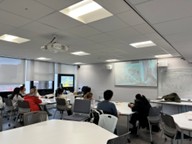
As students, we are all on separate journeys. Some are long-term and broad, such as graduating. Some are short-term and specific, such as getting a good grade on a paper. The journey map helps to track how a student approaches obstacles. We started out our practice by using our own personal experiences to understand this method.
One student discussed his journey of overcoming stress and confusion about an assignment’s instructions. He wrote on a post-it-note that he was worried about completing an assignment due to complicated instructions that he was unfamiliar with. He was asked what steps he took to alleviate this stress, to which he answered that he asked the professor for further instructions. After this conversation, he felt slightly less confused, but still not entirely confident. He then made the decision to talk to friends in his course to clarify the project. After this, he was feeling mostly confident. We used the post-it-notes he had filled with details about his experience and how it made him feel to create a diagram on poster board.
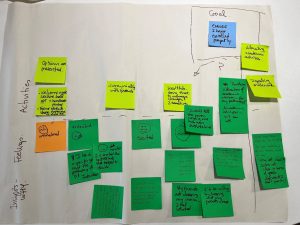
This was an excellent example of how the journey maps could benefit our ability to collect feedback. His experience showed what he found helpful, but also identified the areas in which he needed more support. We as student reps could use this data to find other ways to help students like him, such as hosting a workshop about completing this type of assignment. The journey map allowed us to dissect each step of his process and his related feelings, which is a helpful alternative to something like a survey, which is broader and more ambiguous.
We left the session feeling prepared and excited to engage with our fellow students. We can’t wait to see where this year takes us and how we can make a difference in our community!
The Student Change Lab is a collaborative space where students and staff work together to explore how human-centred design approach and tool can implement meaningful improvements in teaching and learning, especially in the student voice and engagement. Through co-creation, experimentation, dialogues and skill trainings, our lab aims to empower students and staff to shape educational experience and drive positive outcomes across the university.
Want to know more about the project? Have a look on Student Change Lab (SCL)! Or join our LinkedIn group to stay updated.
Further reading:
- Test and Learn #1: Learning & Co-design to Unlock our Reps’ Creativity
- Test and Learn #2: How to Best Analyse Feedback – My Experience at the Student Change Lab Workshop

TEA is a place where we can share practice and experience around teaching and learning with colleagues, students and the wider public – how we Teach, Explore, Apply
We’d really like to hear your responses to the stories we feature – if you want to respond, please email the ITL team at teaching.learning@manchester.ac.uk, or the University’s Teaching and Learning Online Network (TALON) on Yammer is a great place for you to carry on the discussion of any practice you find really interesting.


Contact Us
+44 (0) 161 306 6000


0 Comments