
Supporting Student Academic Development: Content, Comfort and Communication
 Dr Amir Rahbarimanesh (Lecturer in Engineering Project Management (EPM) in the Department of Civil Engineering and Management within the School of Engineering, FSE) is a frequent winner of UMSU’s student-nominated academic awards for his teaching, student support and employability-enhancing activities. He teaches undergraduates and PGTs in classes of c. 50 – 200 students. In this post he shares his approaches to teaching and to academic advising, and what motivates him.
You won the Student Union award for Excellence in Supporting Student Academic Development* this year. This recognises outstanding support in areas such as tutoring, academic advising and/or mentoring. What do you think won you this nomination from your students?
Well, my discipline is Engineering Project Management, and I strongly believe that we as educators need to bring in practical experience from any business we’re teaching about. After I finished my PhD at Manchester, I went and joined the manufacturing industry in the UK. I worked as Head of Research and Development (R&D) and R&D project manager for about five years, and then came back to the university to take up a teaching role. I always wanted to come back – basically that was my plan – but was also willing to keep the connection with my previous employers and wider professional network live. So, my first recommendation is to always keep track of what’s going on in business, or in your area of practice. Things are changing in business so fast so we need to make sure that all teaching materials are being updated on a regular basis accordingly.
We also need to bear in mind that content is something they [the students] are looking for – it needs to be up to date and relevant, because they want to find a job based on that. It’s good to think about the teaching methods, methodologies active learning etc. but it’s the content that can make a big difference.
The content also needs to be given to students in manageable ways. It’s like eating food. When you share it little by little, students are going to digest it better.

You want them to eat all that? It’s too much!
So my next recommendation is to reduce the amount of teaching material. We’ve got 12 weeks to deliver a course, and the students are doing several of them. You can ask yourself, “Is this something that is really in line with the learning outcomes of this unit?” And if a Professional, Statutory and Regulatory Body (PSRB) mandates that you must cover certain things, then you have to make the content precise and efficient. Don’t overcomplicate it.
What advice would you give to other members of staff who are looking to provide excellent academic development support for their students?
Well, very important is the way we communicate with the students of this new generation in particular. They need you to be approachable: if you appear very serious, formal, like a parent just giving orders, or being too self-centred in your expressions then they’re not willing to take in the material. They want a more flexible, more friendly and kind type of communication. They should feel comfortable from the very beginning so they can engage with the material. I know exactly how the students are feeling in my classes and will follow up with them to make sure they understand, and feel comfortable asking for help if they don’t get it straight away. You can see that students have different types of learning style: some of them are very quick and just get what you say very quickly, some of them take a little time, and some of them are very slow. So as a lecturer, I need to think about that. I will spend time, either speaking after class or following up with them via email or LinkedIn on their progress, bearing also in mind that some don’t like speaking but will communicate by email and text very well.
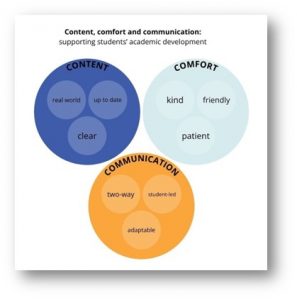
Content, Comfort, Communication (3 Cos): 3 essential elements of Amir’s approach
From your perspective, are there any links between what you do as an Advisor and what you do as a Teacher?
In an Advising context you need to be even more friendly, because you want the students to be willing to continue the conversation with you next time. For some students, particularly international ones, if they have a bad experience they can be afraid to talk to their parents: they may come from another country quite far away and know that their parents would become very worried. So, they come to the Academic Advisor. The way we communicate with them should mean that they feel they can share anything, get any advice, it doesn’t matter on what.
That’s interesting. So in the classroom context it’s very much the idea that you’re not ‘in loco parentis’: you’re consciously creating a non-hierarchical environment and trying to meet them as a sort of equal interlocutor, whereas in the advising context, in the absence of them being able to speak to a parent, there may be an element of that parenting or mentoring role that comes into it?
This is more about the degree of being in loco parentis and we need to leave it to them, to the students, how they want to see this advising session working at the end of the day. We should allow each individual student to let us know: is it going to be more serious, parental-type advice or is it going to be more of soft advice? We (as advisors) should give them that choice and we should have the emotional intelligence and flexibility to understand their individual needs and offer the best advice we can.
But also, I would say this is the key point – where we communicate with the students, whether in class or in advising, it should be little by little. It should be conversational at the very beginning of the semester or new academic year, and then going forward. They’ve just come to university, they may be quite resistant – we have to take them on that journey over time, and after one year you will see that they become much more open, they can be absolutely a different person in terms of communication.
And finally, what motivates you?
It’s about the passing on of knowledge to students who are going to be the next generation of professionals and we (as educators) have the ethical responsibility to put them in the right direction, professionally and mentally. My natural sympathy towards people is the source of my motivation and this probably comes from my parents who are –medical consultants and medical profession is all about being sympathetic and caring for people’s good.
* The Education Awards are Student Union-led awards that are made annually in response to an open call to students across the entire university. The exact awards and themes change over time depending on student priorities, but this year there were 16 Academic Award categories across 3 themes:
- Teaching Excellence
- Student Success and Support
- Student Voice
Award winners are picked by a panel of students independently based on written nominations. This year Amir won TWO awards – for Excellence in Supporting Student Academic Development and for Outstanding Approach to Assessment and Feedback, and he was also Highly Commended for Outstanding Teaching for Employability).
Resources and further information
- The UMSU Academic Awards 2025
TEA is a place where we can share practice and experience around teaching and learning with colleagues, students and the wider public – how we Teach, Explore, Apply
We’d really like to hear your responses to the stories we feature – if you want to respond, please email the ITL team at teaching.learning@manchester.ac.uk, or the University’s Teaching and Learning Online Network (TALON) on Yammer is a great place for you to carry on the discussion of any practice you find really interesting.


Contact Us
+44 (0) 161 306 6000


0 Comments