Seeing the Whole Picture: Optometry, Feedback, and Finding Your Own Path
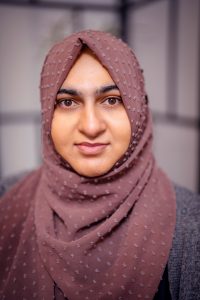
Fatima is an Optometrist, Lecturer in Optometry at the University of Manchester and a Fellow of AdvanceHe. With over a decade’s experience of delivering clinical teaching and assessments at her alma matter, she contributes to BSc and MSci Optometry programmes. She is the Clinic Lead for Final Year Contact Lens Clinic and part of the Education Sub-committee of the British & Irish University and College Contact Lens Educators (BUCCLE). She is actively involved with teaching across five course units and patient-facing clinics across all levels of the Optometry programmes and recently received the Teaching Excellence Award for “Assessment & Feedback” and “Inclusive Education”. Currently undertaking PgCert Medical & Health Education, she has also been awarded the Divisional “Teacher of the Year Award” and been commended for her “Outstanding contribution to equality, diversity and inclusion” via the University’s Making a Difference Awards.
An unexpected journey into academia
By her own admission, Fatima Malik’s career in academia didn’t follow the traditional route. “I wasn’t planning to be an academic,” she explains. “I just knew I enjoyed teaching, to help others understand what I had learnt.” Now a Lecturer in Optometry at the University of Manchester, and the lead for the university’s contact lens clinic, Fatima has spent years blending clinical expertise with an empathetic, student-focused approach to education. It’s a journey that’s been about more than optometry. It’s been about people.
Fatima’s connection to the University of Manchester stretches back to her days on the Manchester Access Programme (MAP), which supports students from underrepresented backgrounds into higher education. “Funnily enough, my staff ID still uses the same photo from my time on MAP,” she laughs. After qualifying as an optometrist, Fatima worked in community practice, where her passion for teaching quickly showed itself. “Friends would often come to me when they didn’t understand something, not because I was necessarily the best at it, but because I enjoyed talking things through with them.”
When a research optometrist role at the university came up, she applied, even though she didn’t have a research background. “I didn’t get the job, but I must have done something right in the interview, because they invited me to supervise in the student clinics instead.” That door opened a whole new career. Starting as a visiting clinical tutor one day a week, Fatima continued to spend the rest of her time in practice. The blend of practical experience feeding directly into clinical teaching helped her students connect theory with real-world application. “Because I was only recently qualified, I could relate to the students. They’d ask things like, ‘What was your first day in practice like?’ or ‘What should I focus on after graduation?’”.
That closeness to the student experience shaped her teaching style, moving beyond simply delivering content to providing mentorship. “I still find myself naturally siding with students sometimes and feeling for them. It’s important we remember what it felt like; balancing deadlines, feeling overwhelmed, finding your way.”
Teaching Through Empathy, Feedback, and Psychological Safety
But Fatima’s approach goes beyond just empathy. Feedback—giving it, receiving it, encouraging it—has become central to her teaching philosophy.
“We’re used to giving feedback to students. But how often do we pause to ask: are they really hearing us? Are we actually helping them?” she reflects. “End-of-unit surveys can be useful, but by then it’s often too late to help that particular cohort. Ideally, I want to know now, whilst I can still make a difference.”
That means creating multiple routes for feedback: anonymous surveys, informal conversations, or even simple show-of-hands checks at the end of a session. And it’s not just students she asks—Fatima regularly gathers feedback from staff, receptionists, and clinical tutors too. “The more I moved into leadership, I found myself less in clinic and teaching room and the more essential feedback became to help me to continue to see how things really played out and to know where things can improve for students, patients and staff.”
This openness ties into psychological safety, a topic she has spoken about in international webinars for the International Association of Contact Lens Educators (IACLE). “If students and staff feel safe to speak up, to give honest feedback or even make mistakes, they learn more deeply. I try to model that by being open about my own mistakes and what I’m still learning. It shows them that we’re all on a lifelong learning journey.”
One idea Fatima has introduced to her teaching is the application of The Hero’s Journey, the narrative framework popularised by Joseph Campbell, which Fatima has applied to the teaching and learning she does. “We usually associate it with stories or films,” she explains, “but I started seeing its relevance in healthcare and education. The student is the hero, ‘crossing the threshold’ into a new, unknown world at university and facing challenges. Exams become the monsters to slay. We, as educators, act as ‘mentors’ guiding and supporting them.”
This framework humanises assessment and feedback, reframing them for both staff and students as part of a bigger growth process. “Feedback isn’t about ticking boxes; it’s like a mirror that helps the other see their strengths and areas to develop.”
Helping Students See Beyond the Classroom
Fatima is also passionate about helping students see education as more than just a route to a job—encouraging them instead to take it as a chance to grow, be curious, and find their own path, even if it’s not the one they originally imagined. “Sometimes students think it’s a straight path: degree to career, but life isn’t always that linear. Interests change, new opportunities arise, and it’s important to leave yourself open to those possibilities.” She uses her own story as an example. “I applied for a job I wasn’t really qualified for, and I didn’t get. But applying opened another door that led me to where I am now. If I hadn’t knocked, that path wouldn’t have opened.”
Whether it’s through feedback, mentorship, or simply being open about her own learning journey, Fatima’s message is clear: education isn’t just about what you learn, but who you become in the process.
For students in optometry, that might involve mastering complex clinical skills. But it’s also about learning how to communicate, how to reflect, how to work as part of a team, and how to shape your own future.
And if you’re in Manchester and need an eye exam or contact lenses? The Optometry Clinics where Fatima teaches offer free, fully supervised appointments with students. “A shameless plug,” she smiles, “but one that helps students get real experience while helping others see more clearly.” It’s a perfect metaphor for her whole approach to education—helping students see what’s possible, one conversation at a time.
TEA is a place where we can share practice and experience around teaching and learning with colleagues, students and the wider public – how we Teach, Explore, Apply
We’d really like to hear your responses to the stories we feature – if you want to respond, please email the ITL team at teaching.learning@manchester.ac.uk, or the University’s Teaching and Learning Online Network (TALON) on Yammer is a great place for you to carry on the discussion of any practice you find really interesting.


Contact Us
+44 (0) 161 306 6000


0 Comments