
From EDI Content to Systemic Curriculum Design
 Dr Catherine Kelly is Director for Service User Engagement and Social Diversity on the Doctorate in Educational and Child Psychology in the Manchester Institute of Education
Across higher education, there is growing commitment to equality, diversity and inclusion (EDI). Many programmes have diversified reading lists, introduced dedicated EDI teaching sessions, and incorporated discussions of marginalisation and inequity into their curricula. These developments are important. Yet they raise a critical question: how do we move beyond teaching about social justice to embedding it within the very structures through which students learn?
This question has shaped much of my work on the Doctorate in Educational and Child Psychology (DEdChPsy). Like many educators, I found that EDI initiatives could sometimes become positioned as valuable additions to existing programmes rather than as principles that fundamentally influence curriculum design, assessment, supervision and student support. As a result, there can be a gap between the values institutions espouse and the experiences students actually encounter.
Social justice in programme design
My research on socially just practice in professional educational psychology has prompted me to think differently about this challenge. Rather than viewing social justice as a topic to be covered, the research suggests it is best understood as an ongoing, cyclical process that involves reflection on power, relationships, organisational culture and wider systems. This shift in perspective moves us from asking what should we teach about social justice? to asking how do our programmes enable or constrain social justice in practice?
As this programme of work has developed, I became increasingly aware that many professionals and educators share a strong commitment to EDI but can falter with implementation. The literature points to a common problem: while there is considerable discussion about the importance of inclusion, there is often less guidance on how to translate principles into coherent, sustainable practice. This can lead to isolated initiatives that are well intentioned but disconnected from the broader student experience.
In response, my work with trainee educational psychologists has focused on developing practical tools that can support systemic reflection and change. One example is the Social Justice Reflective Resource (SJRR), originally designed to help educational psychology services examine how social justice is enacted across different aspects of their work. Although developed in a professional practice context, its underlying principles are equally relevant to higher education.
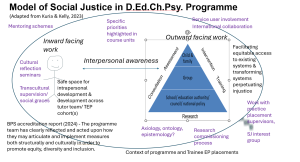
Within the DEdChPsy, this has led us to consider social justice at multiple levels of programme design. Moving away from standalone EDI teaching sessions, we have sought to embed these ideas throughout the programme. For example, an intersectionality seminar series is integrated across modules, enabling students to revisit and deepen their understanding over time. Assessment tasks are being reviewed to ensure stronger connections between social justice theory, placement experiences and professional practice. Structured opportunities for reflection on identity, power and positionality have also been incorporated into seminars, supervision and student support processes.
Taking a whole-programme approach
One of the most important lessons from this work is that meaningful change rarely comes from individual innovations alone. While passionate educators can have significant impact, lasting change is more likely when social justice is built into programme structures, expectations and processes.
For colleagues working in other professional programme and disciplines, this raises a useful challenge. A socially just curriculum is not simply one in which students encounter diverse perspectives. It is also one that considers how programmes are organised, whether assessment methods allow different ways of demonstrating learning, how student and service user voice is included in decision-making, and how support systems respond to unequal experiences and opportunities.
A practical starting point is to look beyond individual teaching sessions and ask broader questions about programme design. Where are issues of power, participation and belonging currently addressed? Where might some students encounter barriers? And how are inclusion and equity reflected within assessment, support and feedback systems? These questions can help shift attention from reactive adjustments towards more intentional and systemic approaches.
Ultimately, embedding social justice within programme design involves moving from content to systems, from individual initiatives to programme-level thinking, and from aspiration to implementation. Research-informed frameworks can provide useful tools for this process, helping educators align institutional values with everyday practice. The opportunity for all of us in higher education is to create learning environments where inclusion is not simply discussed but consistently experienced.

TEA is a place where we can share practice and experience around teaching and learning with colleagues, students and the wider public – how we Teach, Explore, Apply
We’d really like to hear your responses to the stories we feature – if you want to respond, please email the ITL team at teaching.learning@manchester.ac.uk, or the University’s Teaching and Learning Online Network (TALON) on Yammer is a great place for you to carry on the discussion of any practice you find really interesting.
Contact Us
+44 (0) 161 306 6000


0 Comments