
Walking through Students’ Journeys: Reimagining Welcome, Induction & Transition
 Lindsay Bann (Student Success and Development Manager)
Lindsay is based in the Directorate of Student Experience. Her responsibilities include a range of co-curricular and extra-curricular activities including volunteering. The Stellify Award, Peer Support, Student Partnerships, and Welcome, Induction and Transition (WIT). She is also currently undertaking an ITL Fellowship focusing on the development of PEL.
 Chiachi Ming (Research Associate on Student-centred Design Projects)
Ming is a service designer who has spent the past 5 years working across the public sector, charities, and grassroots communities, with a strong focus on Equity, Diversity, and Inclusion. Advocating for human-centred design, she believes in creating inclusive space where diverse narratives of needs inform services, and creates bridges that bring students and staff together.
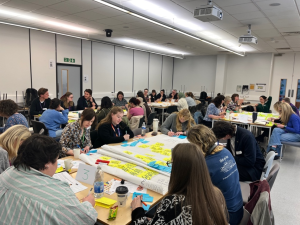
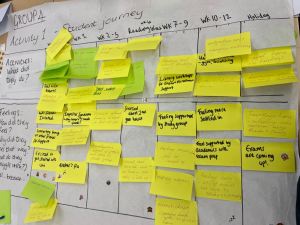
In April 2026 we brought together over 40 Professional services staff at the Induction & Transition Support workshop, including representation from Counselling, Wellbeing, School Hubs, the Students’ Union, Library, Academic English Centre and many others. This 2-hour workshop aimed to invite our staff to empathise, walk through student journeys as they transition to university, and reimagine our support offer during Semester one.
Q1: What was your experience of facilitating Induction & Transition workshop?
Lindsay: In an ideal world, we would have spent a whole day on this or multiple sessions. We knew however that to get as many people together as possible we were probably limited to a single 2 hour workshop. The challenge was how to fit in everything everything we wanted to do!
Ming: The 2-hour workshop felt fast-paced and energising. Honestly, the level of engagement was beyond my expectation. I was initially quite worried about asking 40+ staff to map student journeys for the first time, and to empathise with their challenges and why students might not use support. We also managed to generate ideas within such a short time.
Practice is more useful than simply showing staff the insights. Mapping those student journeys helped staff see how different student identities and situations affect how they navigated support. It also opened up space for staff to actively share their perspectives and learn from each other.
Q2: What moment in the workshop stayed with you?
Lindsay: I couldn’t believe how many people came and how engaged they were! Using student personas meant participants really started thinking about individuals and what was going on for them throughout that first semester. The nuances of student life really came through.
Ming: One moment really stayed with me. When I shared a real student journey as an example, the room became completely quiet. The pause matters, it allows people to listen, reflect and really feel the experience. It’s also encouraging to see different teams share their practices and rethink them through a more empathetic lens.
Q3: What are your hopes for this project in a short and longer term?
Lindsay: At the end of the workshop we asked participants who would like to help us take this work forward and were overwhelmed with offers of help. We now have a group looking at all the ideas that came out of the workshops, prioritising them and finding opportunities to pilot them. A paper is due to go through governance shortly with recommendations that we feel will make the biggest difference to students.
Ming: In the short term, my hope is that the conversations and practice will continue. With many great ideas now, the next step is to work with students to test and refine them, so that we ensure our efforts translate into practice that truly benefits students.
When I talked to students, they always asked me at the end, “When will the changes actually happen?”, especially senior undergraduates. In the longer term, I also see this as a trust-building process, the trust in the university, the trust in themselves. When students are enabled to navigate, access or receive support early on, it builds confidence and trust, reinforcing the belief that “I can achieve my potentials at the University of Manchester.”
Further Reading:
- The first blog in this series, Using Human-centred Design to explore Induction and Transition

TEA is a place where we can share practice and experience around teaching and learning with colleagues, students and the wider public – how we Teach, Explore, Apply
We’d really like to hear your responses to the stories we feature – if you want to respond, please email the ITL team at teaching.learning@manchester.ac.uk, or the University’s Teaching and Learning Online Network (TALON) on Yammer is a great place for you to carry on the discussion of any practice you find really interesting.
Contact Us
+44 (0) 161 306 6000


0 Comments