
Reflections on the AI in Teaching and Learning policy event for Programme Directors – what we learned
We recently (September 2026), held our first University-wide event for Programme Directors (PDs), which aimed to give PDs a space to ask questions, seek clarification and discuss the practical implications of the University’s new AI in Teaching and Learning policy. The session provided useful insight into both the implementation of the policy and how we engage PDs more broadly. My colleagues and I in the Teaching Excellence team are really committed to developing support for programme directors. This work will gain new momentum in December when we are joined by a new Academic Delivery Lead for Programme Leadership. This support is a work in progress, and we’re learning as we go. In this blog, I’m sharing my own reflections on what we got right, what we need to do differently, and what we learnt through the process.
From a policy perspective, the discussions highlighted key areas where we need to do more to support PDs, and academic colleagues more generally, in putting the policy into practice, as well as variations in how it has been interpreted and applied across disciplines. The event also highlighted the value of the resources developed for the AI in Teaching and Learning Needs Hub and how these are supporting colleagues with their teaching.
When engaging with PDs, there was clear appetite among colleagues for opportunities to connect, share practice and discuss common challenges. We also learned a lot about how we can do this more effectively in future, for example, by having events with a clearly defined purpose – are we sharing information, facilitating discussion, or creating an opportunity for connection? – and by creating space for discipline specific discussions (and ensuring better acoustics!).
What we learned and next steps about the policy
For the AI policy specifically, the event was valuable not because it resolved every question, but because it surfaced where colleagues need greater clarity, practical guidance and support. From the insight we gained from PDs before, during and after the event, there were three key things we took away that need attention:
1. A need to look at the Academic Malpractice procedure and support
The relationship between application of the policy and academic malpractice was a recurring concern. There are some fundamental questions about whether the policy is primarily intended to guide conversations about AI use in teaching and learning or to establish rules that can be monitored and enforced and, if the latter, how this might work in practice.
PDs also raised practical questions about how the policy works at programme and course-unit level, who is responsible for ensuring consistency, and what role PDs should play where individual course units or colleagues take different approaches.
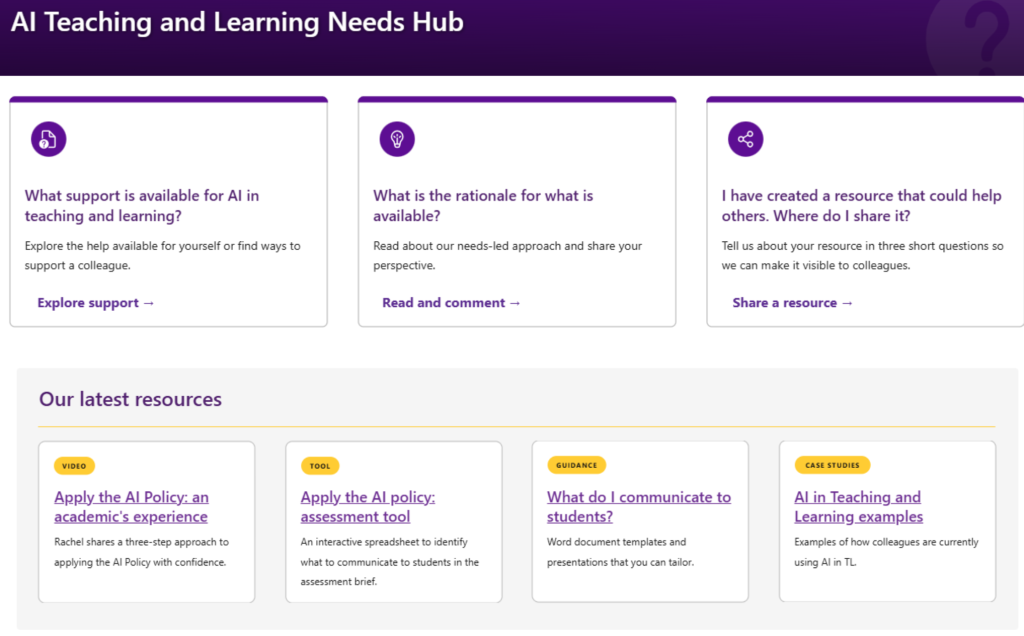
To help answer some of these questions, the Copilot Co-ordination and Advisory (CoCoA) Group continues to support the implementation of the AI in Teaching and Learning Policy, reviewing practical challenges and creating the resources on the AI Teaching and Learning Needs Hub to support colleagues across the University. CoCoA is also liaising with colleagues responsible for academic malpractice procedures to explore how these align with the policy and identify where further clarification or guidance may be needed, particularly around consistent application of the policy and the responsibilities of PDs and other colleagues. The group has also reviewed the questions raised by PDs before, during and after our September event (see AI in Teaching and Learning policy: Pre-submitted questions from Programme Directors).
2. Better support for colleagues in redesigning assessments
Assessment and assessment design was at the heart of many conversations, from questions about applying the policy to different types of assessment through to bigger discussions about the suitability of existing assessment approaches in an AI-enabled environment. Questions about what constitutes AI-Minimal (Category B) versus AI-Permitted (Category C) use arose repeatedly, including how this applies to language support, translation, restructuring text and discipline-specific practice.
The University has recently appointed an Academic Delivery Lead for Assessment, who will help support colleagues in reviewing and developing assessment practices in response to emerging challenges and opportunities, including those associated with generative AI. This work will help inform the continued development of practical guidance and support on the AI Needs Hub for colleagues designing assessments in an AI-enabled world.
3. Fostering more conversations with students about how to make decisions around AI use
The challenge is increasingly about implementation, rather than simply awareness of the policy. This encompasses both supporting students to make decisions about how to use AI responsibly in the context of their learning, and providing practical resources for colleagues to help guide these conversations. Conversations highlighted the importance of accessible guidance, examples and tools that colleagues can use immediately within their programmes, whilst allowing for disciplinary context.
In response to these challenges, the AI Teaching and Learning Needs Hub brings together practical guidance, resources and worked examples to help colleagues support students in making informed decisions about responsible AI use. This includes guidance on communicating the policy to students, study skills resources and examples of how AI can be used appropriately in different learning and assessment contexts. Colleagues may also find the following resources helpful:
- Jisc – Student Perceptions of AI (2025) – insights into students’ experiences of AI
- Advance HE, Authentic Assessment in the Era of AI – exploring the implications of AI for assessment and teaching
- GenAI: Quality Assurance Agency (QAA) – guidance and resources on academic standards, assessment and responsible AI use.
What we learned and next steps regarding engagement events with PDs more broadly
1. The practicalities matter
We learned that events need a clearly defined purpose and a format that matches PDs’ expectations and demand. Attendance was much larger than anticipated, suggesting a strong appetite among PDs for opportunities to come together, while also highlighting the importance of planning for events of this scale. For future sessions, we’ll involve PDs earlier in shaping agendas, communicate the intended outcomes clearly, and ensure formats (and venues) are suited to the size of the group and different types of discussion. We’ll provide more notice and timely follow-up, and we’ll continue to be transparent about where we get things wrong, what we’ve learned and what we’ll do differently as a result. Finally, we’ll create more opportunities to bring colleagues together, to share experiences (and refreshments) and make connections.
2. A reminder of the value of community
We learned that bringing PDs together is valuable in its own right: colleagues welcomed the opportunity to connect and share practice, with some attending an event specifically for PDs for the first time. Feedback called for more opportunities like this, potentially with longer sessions. In future, we aim to create spaces that facilitate peer connection and practice-sharing, while giving each event a clear purpose rather than trying to combine briefings, questions, feedback and networking within a short session.
To strengthen our support for Programme Directors, we have also appointed a new Academic Delivery Lead for Programme Leadership, Doron Cohen, who will help shape future events, facilitate opportunities for colleagues to share experiences and good practice, and foster a stronger community of PDs across the University.
3. Balancing University-wide sharing with discipline-level discussion
We learned that cross-University discussions help identify shared concerns, but differences across Faculties and disciplines can make detailed discussions challenging and questions harder to resolve. Moving forward, we’re keen to identify opportunities for both University-wide sharing and networking alongside Faculty or discipline-level activities.
A personal note
For me personally, the event was an exciting opportunity to get together with Programme Directors, and it’s been a useful point of reflection that these events often serve multiple purposes. They provide a forum for colleagues to share concerns, questions and feedback, present opportunities to learn both during and after events, and create space to help build a community around a role that can otherwise be experienced quite locally.
Whilst there’s lots still to do, we can ensure colleagues’ questions and feedback inform the continued development and evaluation of the AI in Teaching and Learning policy and support available, and how we engage with and support colleagues such as our Programme Directors.
Resources

TEA is a place where we can share practice and experience around teaching and learning with colleagues, students and the wider public – how we Teach, Explore, Apply
We’d really like to hear your responses to the stories we feature – if you want to respond, please email the ITL team at teaching.learning@manchester.ac.uk, or the University’s Teaching and Learning Online Network (TALON) on Yammer is a great place for you to carry on the discussion of any practice you find really interesting.
Contact Us
+44 (0) 161 306 6000


0 Comments