
Reflection Matters – A reflective blog on Race Workshops
 William is a first-year Mathematics student. He serves as a Student Partner on the Representation Matters project, facilitating workshops and co-authoring the project’s research outputs. Aiming for a career in mathematics research, in academia or possibly industry, he took on this project to explore forms of research outside mathematics and the different skills that bring.
Facilitating the Representation Matters race workshops was one of those experiences that genuinely surprised me. I went in expecting conversations about assessment practices, and while we did have those, they quickly opened up into something much broader: how race shows up in the room, in feedback, and in who quietly gets the benefit of the doubt. Language, accent, code-switching, and the unspoken rules around what “professional” looks like all came up, often from people who hadn’t had a space to put words to any of it before.
I facilitated both the race and disability workshops as a student partner, but Alayna has already written about the disability workshops in her own post, so this one is just about the race ones. We ran two workshops in total, with the same structure as the disability sessions: student groups were led by student partners, and I did the facilitation for the student side, while staff groups ran separately with a staff facilitator.
Workshop one: naming what’s there
We started the first workshop with a simple word, association: what comes to mind when you think of inclusive assessment? Accessible kept coming up, which made sense, but so did something more uncomfortable: that exams, for all their problems, were often seen as fairer than the formats where a person is in the room judging you. Presentations, vivas, oral walkthroughs in subjects like chemistry and engineering; these were the spaces where participants felt accent and communication style crept into how harsh feedback could be, sometimes more than what was actually being said. One student talked about accents being marked down in presentations directly. There was this recurring feeling that certain ways of speaking, often Western ones, had become the invisible standard for what good communication is supposed to sound like.
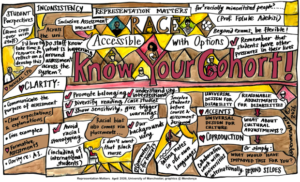
Infographic capturing student perspectives from Race Workshop 1, showing the call for accessible, flexible assessment that genuinely knows its cohort. Representation Matters, April 2026. Artwork by @penmendonca.
What I kept coming back to was how often these things had already been raised and just… hadn’t gone anywhere. People described taking concerns about racism in feedback or in supervision to student reps, going through the right channels, and being told essentially: “unfortunately, that’s how it is.” One participant shared a story about an international student being told directly by a professor, “do you even understand what I’m saying to you?”, and nothing meaningful came of reporting it. That pattern; raising something and getting no real follow-up; came up enough times that it felt less like isolated incidents and more like a structural problem with how feedback loops close, or don’t.
There was also a lot around what it costs to ask for help when you’re already carrying other things. A few people talked about code-switching, adjusting how they came across depending on who was in the room, especially when they needed support. One student who’d recently been diagnosed with ADHD said that as a Black student, asking for help felt like it risked being read as demanding or making a fuss, in a way they didn’t think would be the same for everyone. And intersectionality came up a lot too; people not knowing which part of their identity was being responded to in any given moment. Race, gender, neurodivergence, disability; these things don’t sit separately, and participants were often navigating all of them at once without any clear read on what assumption was actually driving how staff or peers treated them.
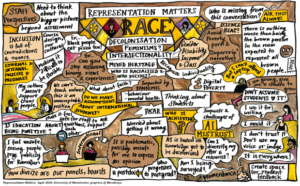
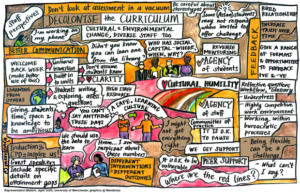
Infographic capturing staff perspectives from Race Workshop 1, centred on decolonisation, intersectionality, and who is missing from the conversation. Representation Matters, April 2026. Artwork by @penmendonca.
The staff conversation ran at the same time in a separate room, and from what came out of the debrief, it was covering a lot of the same ground from a different direction. Staff were grappling with the fact that you can’t really assume people leave who they are at the door when they come to work, and that students entering university now are doing so in a more anxious, more loaded environment than before. Digital poverty came up specifically; one staff member made the point that students who can’t afford a laptop don’t just get to opt out of systems that assume everyone has one. There was also some honest discomfort around representation itself; how trying to represent people well can tip into treating them as extraordinary or symbolic, when what most people actually want is just to be listened to. The question “who is missing from this conversation” came up as something staff felt needed to be asked every time, not as a one-off.
The staff group ended workshop one with a wish list: conditions where students feel genuinely safe giving honest feedback; enough time for academics to actually reflect and develop courses rather than just keep up; proper structures to review whether what’s being done is working; and a real commitment to not asking racially minoritised students to translate their needs into normative language just to be understood.
Workshop two: from naming to building
The second workshop shifted focus toward what could actually change. Students talked about wanting standardised trigger warnings across departments rather than leaving it up to individual lecturers; onboarding support specifically for international students; and diverse marking panels to move assessment away from judging how something is said and toward what’s actually being understood. A “rate my professor” style system came up more than once, something with real transparency and follow-through so that repeated patterns of complaint would actually get reviewed. People were honest about the complications too though; protecting staff from misuse of something like that, what accountability would actually look like in practice.
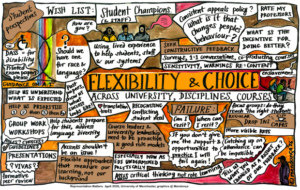
Infographic capturing the student wish list from Race Workshop 2, centred on flexibility, choice, and closing the feedback loop. Representation Matters, April 2026. Artwork by @penmendonca.
What I appreciated most in this part of the conversation was that people weren’t just putting things on a wishlist and leaving them there; they were also poking holes in their own ideas. Grouping students by shared identity for targeted support sounds helpful, but participants pointed out it can flatten real differences within that group, or rely on the kind of positive stereotypes that are still stereotypes. High expectations placed on students in the name of inclusion can end up producing shame when those expectations aren’t met. Someone raised a really specific example of a niche, culturally-grounded essay topic where the student felt like whatever they wrote, “whatever I said, goes,” because there wasn’t enough expertise in the room to properly engage with it. That felt like a really honest thing to say out loud.
On the staff side, the second workshop ran a stop/start/continue format, and the honesty in the room was something I noticed from the debrief. Staff said they need to stop being scared to admit they don’t know things, stop being complacent about what they think they already understand, and stop assuming students come in knowing where to find support. What needs to start was more difficult: genuinely handing over control and agency, building stronger CPD around cultural humility, and being willing to say directly to students that staff don’t have all the answers and want to learn from them. One staff member talked about wanting a proper “welcome back week” format at the start of each year where students and staff actually get to know each other’s contexts. There was also a specific and useful observation about feedback from international students; that whether feedback is about problems or positives can land very differently depending on cultural background, and that building trust takes time and multiple channels, not a single survey.
Infographic capturing the student wish list from Race Workshop 2, centred on flexibility, choice, and closing the feedback loop. Representation Matters, April 2026. Artwork by @penmendonca.
Staff also raised something that I think is easy to gloss over: that asking people to centre cultural humility in their practice is genuinely hard when it was never in their contract or their training. The suggestions that came out were practical ones; a proper workflow rather than just a values statement, a checklist of reflective questions staff can actually return to, peer support that deliberately includes sceptical colleagues rather than just preaching to the converted, and a real named course on cultural humility rather than a one-off session tagged onto something else.
What this points toward
A few things kept showing up across both workshops. One was the gap between what policy says and what people actually experience; DASS exists, but participants flagged that it doesn’t transfer cleanly to placements or fieldwork, and a lot of support that already exists simply isn’t communicated well enough to reach the people who need it. Another was how tangled identity really is in practice; race almost never showed up on its own in these conversations, it came alongside income, disability, neurodivergence, and international status, and solutions that only address one of those threads at a time tend to miss the bigger picture. And the third thing, maybe the most structural of all, was who’s actually in the room at the front; several participants said directly that a lack of diversity among teaching staff shapes these problems before a single assessment is even designed.
None of this wrapped up neatly by the end of the two workshops, and I don’t think it was supposed to. But what did come through was that the people in the room; students and staff alike; were willing to sit with that, to be honest about the limits of what they knew, and to say openly when something wasn’t working. That felt like it mattered in itself. The workshops couldn’t fix everything they surfaced, but they modelled something worth holding onto: that actually listening, and being honest when you don’t have the answer, is not a small thing.

TEA is a place where we can share practice and experience around teaching and learning with colleagues, students and the wider public – how we Teach, Explore, Apply
We’d really like to hear your responses to the stories we feature – if you want to respond, please email the ITL team at teaching.learning@manchester.ac.uk, or the University’s Teaching and Learning Online Network (TALON) on Yammer is a great place for you to carry on the discussion of any practice you find really interesting.


Contact Us
+44 (0) 161 306 6000


0 Comments