
Reflection Matters – Developing Resources that Matter
 Alayna is a final year student of BA Drama and English Literature. She serves as a Student Partner on the Representation Matters project, facilitating workshops, writing and assisting in the working of the project. Graduating in July, she aims to pursue a career in people-centric work including education, social care and human development.
After four sessions of sharing our experiences, concerns, and ideas, a natural rapport developed between facilitators and participants, and between students and staff. The Resource Development Workshops were the final two sessions of the Representation Matters Project, and I was fortunate to facilitate -and, in my own way, participate in- each workshop in person. Over the course of three months, these workshops evolved from structured research sessions to collaborative spaces built on shared purpose, openness and camaraderie.
Through our discussions, we realised that many of us were navigating the same challenges at university, even if we approached them in different ways. Across the previous workshops, we had spent time identifying these barriers and imagining possible solutions. Therefore, it felt fitting that we would come together to co-create a resource designed to address them. Students and staff, who had previously met in separate groups, expressed a desire to collaborate during these final workshops, recognising the value of bringing different perspectives together.
A lack of flexibility had emerged as one of the key themes throughout the earlier workshops, and it was important that we did not reproduce that rigidity in our own facilitation. Instead, we designed a creative and open-ended environment that reflected the diversity of voices we hoped to capture. Tables were arranged end-to-end with a long sheet of brown paper covering the surface, creating a canvas. Around it were collage materials, printed images, stickers, gemstones, glue sticks, Post-it notes, and markers. Together, we had agreed to create an assessment timeline, mapping students’ experiences across the semester alongside ideas, needs, and opportunities for improvement.
The session began slowly. Looking at an entire semester laid out across a roll of brown paper felt almost as overwhelming as living through it. But as soon as one participant shared an idea, the room quickly filled with conversation. Suggestions built upon one another, participants moved freely around the table, adding images, writing notes, and discussing experiences as they worked. There was no strict agenda or set sequence of questions, rather, the purpose was simply to co-create. As a facilitator, my role shifted from directing discussion to participating alongside everyone else. This more relaxed approach allowed me to contribute not only as a researcher but also as a student with lived experience. With my own final university assessments approaching, the limitations of traditional assessment systems were particularly present in my mind. I found myself selecting collage images that acted as metaphors for common student struggles, alongside symbols that represented support, progress, and positive change. The creative process became another way of expressing experiences that are often difficult to articulate through words alone.
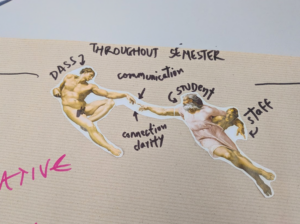
By the end of the workshop, we had produced a rich and detailed assessment timeline filled with practical suggestions, reflections, visual metaphors, and moments of encouragement. This collaborative artefact became the foundation for the assessment resource that the project set out to create.
The second Resource Development Workshop focused on reviewing existing infographic designs to inform the final format of our resource. Participants offered thoughtful and detailed feedback, discussing colour palettes, typography, layout, and accessibility. Students and staff consistently emphasised that the resource should be visually engaging while remaining easy to read and navigate. I was struck by the breadth of the discussions as aesthetics were never limited to appearance but consistently considered broader concerns about inclusion, accessibility, and ensuring that everybody could meaningfully engage with the resource.
There was also a distinct sense of finality during this session, as it marked our last scheduled workshop together. By this point, the workshops had become much more than spaces for data collection. For many of us, they had become spaces where we could share frustrations, provide guidance, and simply talk about our experiences of university life. Without consciously intending to, we had built genuine connections through the workshops.
Facilitating these workshops revealed to me not only the practical strengths of Participatory Action Research, but also its deeply human qualities. Rather than treating participants as subjects of research, the process recognised them as experts in their own experiences and as collaborators in creating meaningful change. The Resource Development Workshops were about much more than producing a final resource. The assessment timeline and subsequent resource were tangible outcomes, but the relationships, conversations, and collective learning that emerged throughout the process were equally significant.
These workshops and the project as a whole transformed my understanding of research. My first introduction to the world of research, the project showed me that research can be creative, collaborative, and rooted in care. Most importantly, it reinforced a principle that now feels self-evident: if we want to improve the experiences of the marginalised, their voices must not simply inform the process, they must shape it from beginning to end.
Further Reading:
- Reflection Matters – A reflective blog on Disability Workshops – By Alayna Kondamudi
- Reflection Matters – A reflective blog on Race Workshops – By William Odumosu
TEA is a place where we can share practice and experience around teaching and learning with colleagues, students and the wider public – how we Teach, Explore, Apply
We’d really like to hear your responses to the stories we feature – if you want to respond, please email the ITL team at teaching.learning@manchester.ac.uk, or the University’s Teaching and Learning Online Network (TALON) on Yammer is a great place for you to carry on the discussion of any practice you find really interesting.
Contact Us
+44 (0) 161 306 6000


0 Comments