
Closing the gaps: How data and collaboration can drive inclusive teaching
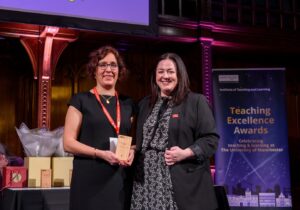
Maria is Deputy Director for Inclusive Education in the School of Biological Sciences and a Principal Fellow of the Higher Education Academy (PFHEA). She was one of the inaugural Institute of Teaching and Learning Fellows (2020) and winner of a University of Manchester Teaching Excellence Award in 2025 for her work on inclusive teaching within the Faculty of Biology, Medicine and Health.
For years, I’ve been interested by one big question: how can we teach in a way that ensures every student—regardless of background—has the chance to reach their full potential?
My first step was to review the available evidence by examining the relevant literature on this topic. Does student attainment vary based on characteristics like ethnicity, gender, disability or socioeconomic background? Sadly, the answer is yes. These differences are what we call awarding gaps—essentially, the likelihood of graduating with a good degree (a first or upper second) can depend on who you are and where you come from.
Awarding gaps are a major challenge in higher education. In the UK, they’re embedded in policy through Office for Students measures and Access and Participation Plans. Ethnicity gaps, in particular, have been highlighted in national reports and universities are working to close them.
Why does this matter? Because these gaps shape futures. Employers often require a 2:1 degree, disadvantaging certain graduates. They also limit access to postgraduate study, meaning we lose valuable global majority talent. Closing awarding gaps isn’t just about fairness—it’s about building a more diverse, inclusive sector and workforce.
Step two: “Know your onions”
For me, that meant getting serious about understanding inclusivity. I enrolled in Advance HE’s Inclusive Teaching and Learning workshops, which covered everything from Equality, Diversity and Inclusion (EDI) basics to inclusive assessment, curriculum design and student engagement. These sessions gave me a solid overview of the challenges and how different institutions are addressing them.
But I wanted to go further, as often, educational research studies focus on small-scale qualitative studies. Therefore, I undertook a distinctive approach, which was to run a large-scale quantitative study—over 20,709 assessment marks, across 30 modules, over two academic years (that’s an average of 334 students per module per year!). My goal? To see if the type of assessment correlates with awarding gaps. For example, do some groups perform better on multiple-choice tests than on written assignments?
Our paper outlining the findings of this study was published in Assessment and Evaluation in Higher Education last summer (Canal & Child, 2025).
What we learned
The results were eye-opening. One key finding? Group work matters—a lot. It doesn’t just boost students’ sense of belonging; it can actually reduce awarding gaps. And here’s the surprising fact: even when group work isn’t part of the summative assessment, simply including it in the module delivery has a positive impact. That tells us something powerful about the value of collaboration and shared learning.
Making an impact
Our paper didn’t just get noticed outside the university (1,200+ views in the first four months)—it also helped spark some positive changes internally. Other Schools at the University of Manchester have started analysing their own data to see how assessment type influences awarding gaps. Our recommendations have been incorporated into the University-wide Enhancement of Assessment Review (EAR) and “assessment type” is now a parameter in the Awarding Gaps Power BI app used by managers and directors of education to make data-driven decisions.
A final reflection
This project is just one example of the work I’ve led in the School of Biological Sciences to address awarding gaps—a series of initiatives now being scaled up across the Faculty of Biology, Medicine and Health. Along the way, I’ve learned that teamwork is everything—not just for students, but for staff too. Building truly inclusive environments requires collaboration between students, academics and Professional Support Services. That’s why I see my recent Teaching Excellence Award for Educational Leadership not simply as personal recognition, but as proof of what we can achieve together. It gives me hope that, one day, we’ll reach our ultimate goal: creating educational spaces where every student can thrive.
References:
- Canal MM, Child R. (2025) Impact of the type of assessment on awarding gaps in bioscience undergraduate degrees. Assessment and Evaluation in Higher Education, 1-14. https://doi-org.manchester.idm.oclc.org/10.1080/02602938.2025.2500365
Further reading:
- The University’s Access and Participation Plan (APP) lays out our institutional priorities and approach to Access and Student Success.
TEA is a place where we can share practice and experience around teaching and learning with colleagues, students and the wider public – how we Teach, Explore, Apply
We’d really like to hear your responses to the stories we feature – if you want to respond, please email the ITL team at teaching.learning@manchester.ac.uk, or the University’s Teaching and Learning Online Network (TALON) on Yammer is a great place for you to carry on the discussion of any practice you find really interesting.
Contact Us
+44 (0) 161 306 6000


0 Comments